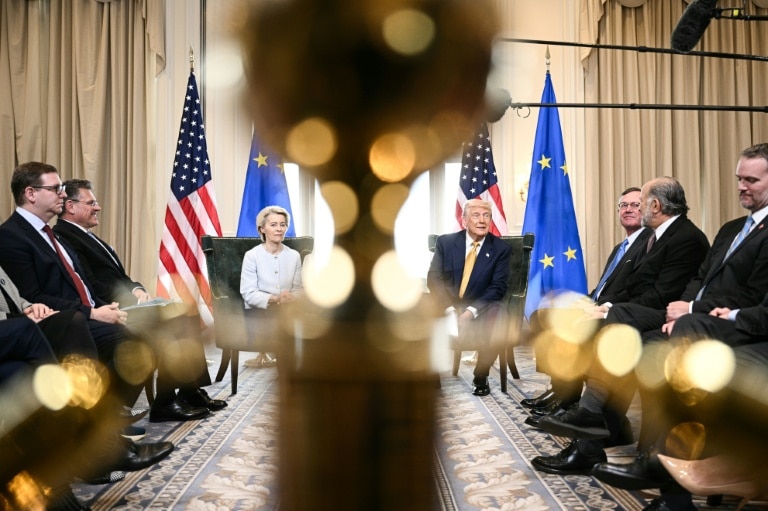
Facing mounting pressure from U.S. President Donald Trump, European Union negotiators convened late-night closed-door talks on Tuesday in a high-stakes push to finalize a long-delayed transatlantic trade agreement, with a hard July 4 deadline hanging over the negotiations. If no deal is reached by the deadline, Trump has threatened to impose steep new tariffs that could reignite a full-blown transatlantic trade conflict.
The framework for this trade pact was first struck nearly a year ago in Turnberry, Scotland, between Trump and European Commission President Ursula von der Leyen. That initial agreement set a 15 percent tariff on most European goods exported to the U.S., but finalizing the binding legal text on the EU side has dragged on for months, drawing growing frustration from the White House.
Negotiations between representatives of the European Parliament and EU member state capitals got underway just after 9 p.m. GMT, with discussions expected to extend through the night. The core goal of the talks is to hash out a compromise that will allow the bloc to meet Trump’s deadline and close out more than 12 months of disruptive trade tensions between the world’s two largest economic partners.
Ahead of the negotiating session, the U.S. Mission to the EU issued a blunt reminder on social media platform X, writing that “A deal is a deal” and that the bloc must uphold the commitment struck between Trump and von der Leyen last year. If the EU fails to deliver, Trump has already warned that the bloc will face “much higher” tariffs, including a planned hike on duties for European passenger vehicles and heavy trucks from the current 15 percent to 25 percent.
The initial wave of tariffs Trump imposed before the Turnberry framework agreement — including steep levies on European steel, aluminum and auto parts — pushed the EU to aggressively expand trade partnerships with other regions across the globe. But Brussels has long recognized that it cannot risk alienating its largest single trade partner: the EU-U.S. trade relationship is worth a staggering 1.6 trillion euros ($1.9 trillion), making it irreplaceable for European economies.
Cyprus, which currently holds the rotating EU Council presidency, reaffirmed Tuesday that the bloc’s top priority remains the “swift implementation of the EU-U.S. joint statement” agreed last year. To get a deal across the finish line, the European Parliament is under heavy pressure from member states to roll back several controversial amendments it added to the text back in March, amendments that U.S. negotiators have already labeled unacceptable.
Bernd Lange, chair of the European Parliament’s trade committee, struck an optimistic tone ahead of the talks, telling reporters he remained hopeful negotiators could reach a workable compromise. But even before the session began, Lange was still working to unify divergent positions across the parliament’s competing political factions, with internal haggling continuing right up to the start of negotiations.
Delays in finalizing the accord have stemmed from multiple outside factors in recent months, including a diplomatic row sparked by Trump’s reported interest in purchasing Greenland, and a U.S. Supreme Court ruling that struck down broad portions of the president’s tariff authority. The European Parliament gave conditional preliminary approval to the text after those delays were resolved, but major sticking points remain between the institution, member states, and U.S. negotiators.
The European People’s Party (EPP), the parliament’s largest political grouping and the party von der Leyen belongs to, has emerged as the most forceful backer of rapid implementation of the deal. EPP leaders argue that resolving the trade uncertainty has become critical for European businesses that have faced unstable market conditions for more than a year. Zeljana Zovko, an EPP lawmaker, told the Agence France-Presse she was “confident that we will get it done” by the deadline. The EPP already secured firm backing for the deal from the hard-right European Conservatives and Reformists group, but several smaller factions have not yet publicly announced their positions, leaving the size of the pro-deal majority and its willingness to compromise unclear.
The Socialists and Democrats, the parliament’s second-largest political bloc, said it would approach negotiations “constructively” but would fight to add robust safeguards to protect European businesses and workers, guaranteeing long-term stability and predictability in trade relations. Two major sticking points remain on the EU side, even as negotiators work to find common ground. The first is a strengthened suspension clause added by parliament, which would revoke favorable tariff terms for U.S. exporters if Washington violates the terms of the agreement in the future. The second centers on “sunrise” and “sunset” provisions: the clauses would keep the EU’s side of the deal from taking effect until the U.S. meets all its existing commitments, and would automatically terminate the entire agreement in 2028 unless it is explicitly renewed by both sides.
Anna Cavazzini, a Green Party lawmaker involved in the negotiations, noted that “the odds are good” for a last-minute compromise, but warned that EU member states would need to compromise on the parliament’s core priorities to get a deal done. “These past weeks have shown time and again that Trump is not to be trusted, so the EU needs stronger tools at hand,” Cavazzini said, in defense of parliament’s proposed safeguards.