The long-running humanitarian crisis in Gaza has entered a new, more tense phase this week, as organizers of the Global Sumud Flotilla, a major initiative delivering aid to the blockaded Palestinian enclave, confirmed that 10 of their vessels remain en route to Gaza after Israeli naval forces intercepted 41 boats in international waters. According to the flotilla’s coordination team, the closest remaining ship is currently just 145 nautical miles from Gaza’s besieged coastline.
Israeli authorities have made their opposition to the aid mission clear: the country’s Foreign Ministry stated Monday that it would not permit any breach of its long-standing naval blockade of Gaza, and issued an immediate demand for all remaining flotilla vessels to reverse course. Earlier the same day, organizers reported that Israeli troops had surrounded 38 of the original 54-vessel fleet when the convoy was 250 nautical miles off Gaza’s coast, detaining roughly 300 international activists on board. In a formal statement, the Global Sumud Flotilla condemned the interception as unlawful high-seas aggression, accusing Israel of consistent, systematic violation of international maritime law, the right to freedom of high-seas navigation, and the United Nations Convention on the Law of the Sea. This latest interception comes just two weeks after Israeli forces intercepted 22 other flotilla vessels off the Greek coast, detaining 181 humanitarian volunteers in that operation. Among the current detainees are 11 Australian citizens, including medical professionals, students and academics, and the Australian government confirmed Monday it is urgently working to verify their safety and status.
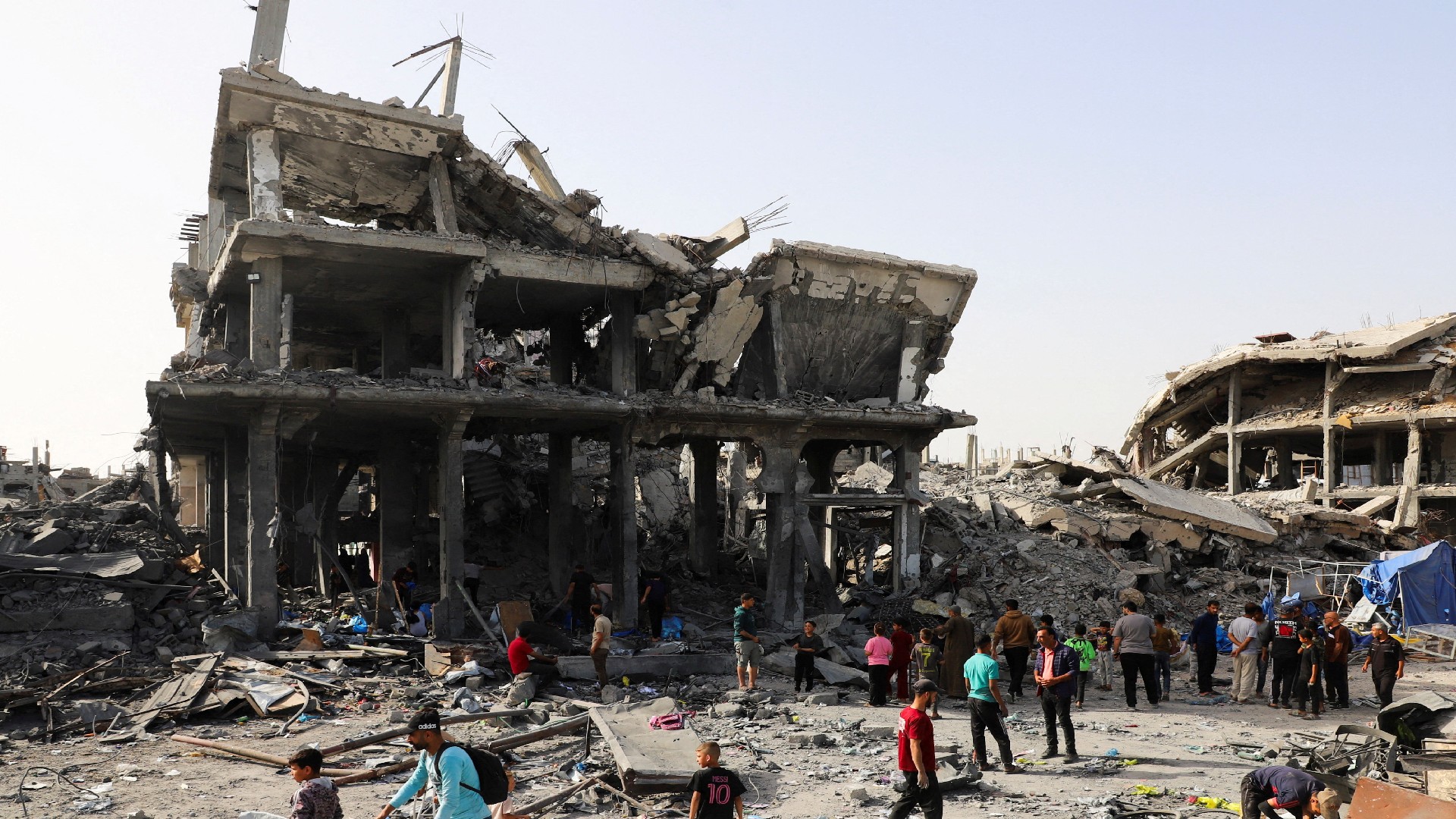
Parallel to the standoff at sea, the catastrophic humanitarian situation inside Gaza continues to deteriorate, according to updates from United Nations and global medical aid groups. The UN Office for the Coordination of Humanitarian Affairs (OCHA) warned in its most recent situation report that conditions in the enclave remain dire: the vast majority of Gaza’s population has been displaced, with most residents exposed to persistent threats to public health and environmental safety. Israeli military operations across the enclave have intensified in recent days, with reports of sustained air strikes and ground gunfire in major population centers including Deir al-Balah, Khan Younis, and Gaza City. A string of deadly Israeli attacks on civilian areas between May 13 and 17 has killed multiple civilians, including two Palestinian brothers in Jabalia on May 14, one civilian near Jabalia’s Abu Hussein school on May 16, and three community kitchen workers at a food distribution site in Deir al-Balah on May 17. The deadliest of these recent attacks came on May 15 – Nakba Day, the annual commemoration of the 1948 displacement of Palestinians – when an Israeli strike on a Gaza City residential building killed Izz al-Din al-Haddad, leader of Hamas’s armed wing, along with his wife, daughter, and four other civilian residents.
Updated official figures from Palestinian medical sources put the total death toll in Gaza since the start of the conflict on October 7, 2023, at 72,763, with an additional 172,664 people wounded. Thousands more are still missing and presumed dead beneath the rubble of destroyed buildings. Even after the temporary October ceasefire, violence has continued: at least 871 Palestinians have been killed and 2,562 injured, while recovery teams have recovered 776 bodies from destroyed structures in that period.
Gaza’s already crippled healthcare system is now on the brink of total collapse, according to the enclave’s Ministry of Health. Official data shows that 76 percent of Gaza’s medical imaging equipment has been destroyed or rendered unusable by Israeli attacks and strict aid restrictions. All nine MRI machines that previously operated across the enclave have been destroyed, leaving no MRI services available anywhere in Gaza. Just five of 18 existing CT scanners are still functional, and only 33 out of 88 X-ray machines remain operational. This catastrophic loss of diagnostic capacity has severely hampered the ability of medical workers to treat wounded and sick patients, the ministry added.
Overcrowded displacement camps across Gaza are now facing a fast-spreading public health outbreak, according to UN agencies and Medical Aid for Palestine (MAP). Skin infections and other diseases linked to unsanitary conditions and rodent and insect infestations are spreading rapidly, driven by contaminated food supplies, unsafe overcrowded housing, and the total collapse of basic sanitation services. Children are disproportionately affected by the outbreaks. Mohammed Ibrahim Salem, a community health worker with MAP in central Gaza, reported that scabies is particularly widespread among displaced populations, and warned that critical medication supplies are already exhausted. “The current stock is completely inadequate to handle the rising number of skin infections in overcrowded camps, leaving thousands of displaced people without access to essential treatment,” Salem said. The World Health Organization has also warned that Gaza’s rehabilitation services are overwhelmed, with more than 43,000 people across the enclave – one quarter of them children – having sustained permanent, life-changing injuries that require long-term care.
Aid access remains severely constrained, even as needs grow exponentially. OCHA data shows that between May 1 and May 11, only half of all aid trucks arriving from Egypt were able to offload supplies at Israeli-controlled border crossings into Gaza. Severe restrictions on imports of fuel and flour have also driven a catastrophic bread shortage, forcing most local bakeries to close and forcing the World Food Programme to cut back on life-saving food distribution. As of April, WFP data shows that 77 percent of Gaza residents still face extreme levels of acute food insecurity, facing chronic hunger and risk of famine.
The rising violence is not limited to Gaza: in the occupied West Bank, settler violence and Israeli military operations have killed two Palestinian teenagers in recent days. On May 13, 16-year-old Youssef Kaabneh was killed by Israeli fire near the village of Jiljilya, north of Ramallah, during a settler incursion that left another child with a critical chest wound. The Palestinian Red Crescent Society confirmed its medical teams were able to treat the wounded child, but reported increasing restrictions on access for emergency responders. On May 16, a second 16-year-old, Fahd Awais, was shot and killed by Israeli forces in al-Lubban ash-Sharqiya, south of Nablus. In that incident, the Red Crescent said Israeli forces blocked ambulances from reaching the wounded teenager before he died.
Israeli Prime Minister Benjamin Netanyahu acknowledged in a recent televised address that Israeli military forces now control roughly 60 percent of Gaza’s territory, an area that exceeds the “yellow line” boundary agreed to during the October ceasefire, further escalating tensions over the expanding military operation.