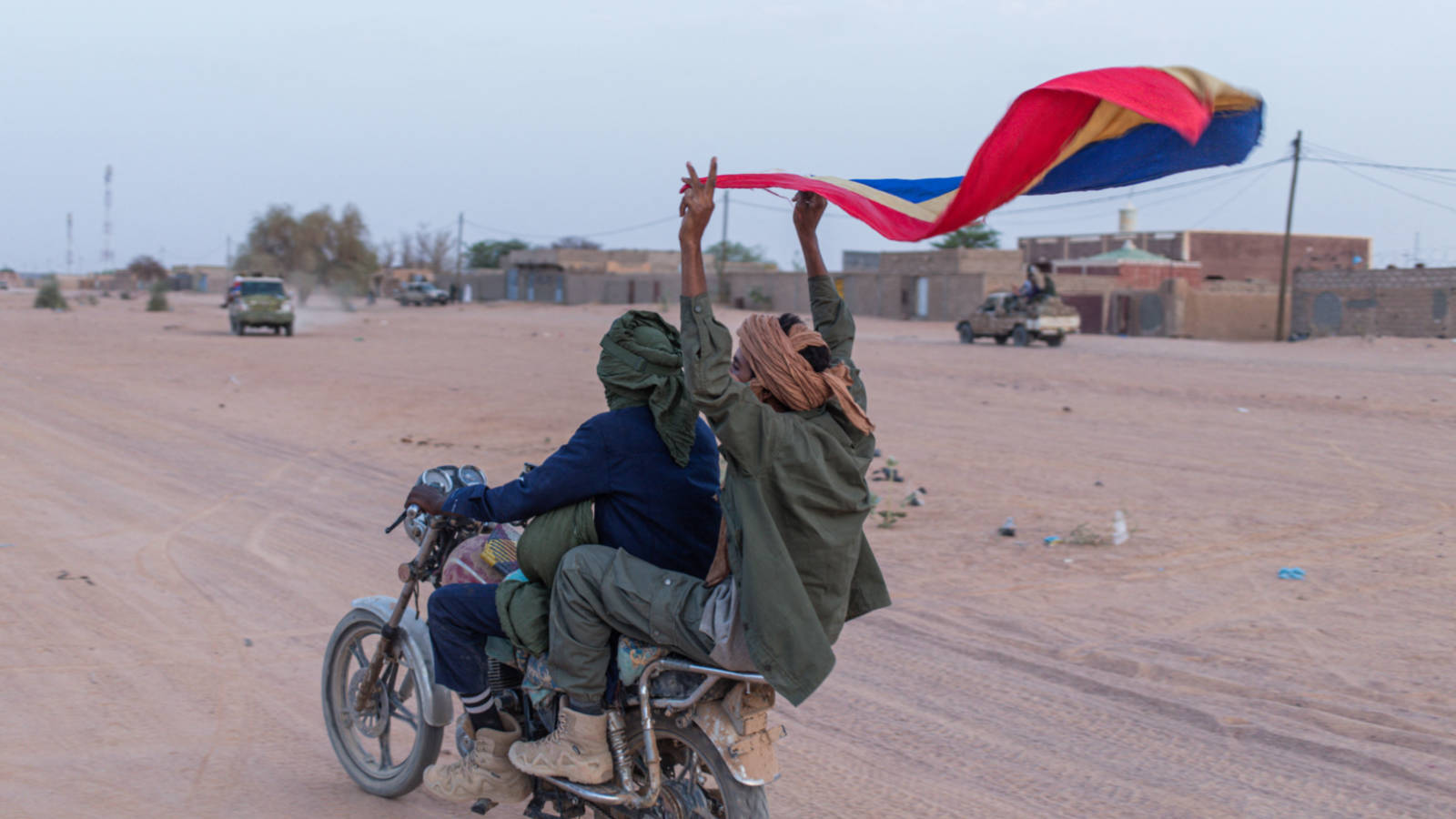
More than a month after a joint surprise offensive by Tuareg separatist fighters and an al-Qaeda-linked militant coalition threw Mali into renewed large-scale conflict, fighting continues to rage across the vast West African Sahel nation, marking the most severe threat to the ruling military junta since it seized power in 2020.
The coordinated assault, launched in late April by the Azawad Liberation Front (FLA, a Tuareg separatist grouping) and Jama’at Nusrat al-Islam wal-Muslimin (JNIM, the Sahel’s most powerful al-Qaeda-affiliated militant organization), has already yielded sweeping gains for the alliance. Rebel fighters have seized multiple population centers and military outposts, enforced a blockade of the capital Bamako, and assassinated Malian Defense Minister Sadio Camara in a suicide bombing targeting his residence in the key garrison town of Kati, just outside the capital.
Rooted in decades of unresolved tension and a regional power vacuum created by the departure of Western and UN peacekeeping forces, the current crisis stretches back decades. A former French colony that gained independence in 1960, Mali has struggled to exert full control over its remote northern territories, which span more than 1,000 kilometers north of Bamako across the Sahara. Tuareg nationalist groups have demanded autonomy or independence from successive Malian governments since independence, launching repeated uprisings that culminated in a 2012 separatist rebellion that ignited the country’s ongoing interlocking civil conflict. That conflict has shifted and flared for 14 years, shaped by foreign intervention, military takeovers, and shifting regional alliances.
Since August 2020, Mali has been ruled by a military junta led by Assimi Goita, a special forces officer who first led a coup against elected civilian president Ibrahim Boubacar Keita, then seized full power in a second 2021 coup after ousting the transitional civilian leadership he had installed. Under Goita’s authoritarian rule, Mali cut ties with long-time Western partners, expelled French counter-terrorism troops in 2022, and forced the decade-long UN peacekeeping mission to withdraw in 2023. In place of Western partners, Goita has deepened political and military ties to Moscow, which deployed first Wagner Group paramilitaries from 2021, then reorganized those forces into the state-run Africa Corps after Wagner’s collapse following Yevgeny Prigozhin’s 2023 mutiny and death. An estimated 2,000 Africa Corps mercenaries are currently deployed across Mali to support the junta’s counter-insurgency operations, though the force has been repeatedly accused of widespread human rights abuses against civilians alongside junta forces.
The April 2025 offensive has already broken the status quo across the country. Within days of the initial attacks, FLA fighters captured Kidal, the strategic northern hub that is the heart of Tuareg separatist activity, forcing Africa Corps mercenaries to withdraw from the town on April 26. The Malian junta has responded with intense aerial bombardment of the occupied town, while JNIM advanced on the capital, releasing video footage on May 6 showing its fighters burning food trucks bound for blockaded Bamako. Three days after Camara’s assassination, Goita appointed himself interim defense minister and publicly claimed the security situation remained “under control,” but attacks have persisted. On May 6, JNIM fighters stormed Kenieroba Central Prison, a major maximum-security facility just outside Bamako that held more than 2,500 inmates, many of them detained insurgents and political prisoners.
Human cost of the conflict continues to mount. Hundreds of people are estimated to have been killed across the country in the fighting, while junta forces have been accused of widespread forced disappearances of civilians accused of collaborating with rebel groups.
To understand the unprecedented alliance between the FLA and JNIM, it is necessary to examine the distinct origins and goals of the two groups. JNIM, a Salafist jihadist organization formally affiliated with al-Qaeda, was formed in 2017 through the merger of four separate militant groups active across the Sahel. Designated a terrorist organization by the UN Security Council and governments worldwide including Mali and the United States, JNIM claims it seeks to expel Western influence from the region and impose strict Sharia law. With an estimated fighting force of 6,000 members drawn from multiple ethnic groups across the Sahel, JNIM is currently the strongest militant organization in the region, controlling swathes of territory in eastern Mali, northern Niger, and northern Burkina Faso, and has launched high-profile attacks as far south as coastal West African states including Benin, Togo, and Côte d’Ivoire. Since 2023, the group has enforced a partial blockade of the historic trading hub of Timbuktu, and launched a nationwide fuel blockade in November 2025 that has paralyzed economic activity across much of Mali.
In contrast, the FLA is a Tuareg nationalist separatist group formed in 2024 through a merger of the long-standing Tuareg independence movement MNLA and smaller regional factions. The group seeks full independence for the northern Malian territory it calls Azawad, where Tuareg people make up the majority population and represent roughly 10 percent of Mali’s total national population. Led by veteran Tuareg commander Alghabass Ag Intalla, the FLA’s emergence followed the 2024 formal cancellation of decades of stalled peace negotiations between the junta and Tuareg separatist coalitions. The 2013 and 2015 Algiers peace accords, which were supposed to grant Tuareg regions broad autonomy, were never implemented by successive Malian governments, leading the FLA to abandon negotiations and renew armed struggle.
While the two groups have sharply contrasting long-term goals—with the FLA focused on nationalist separatism and JNIM seeking a transnational Islamist state—regional analysts describe their current alliance as a pragmatic, temporary partnership united by a single shared enemy: the Goita junta. “This is a marriage of necessity from Azawad’s [FLA’s] perspective, and an operational arrangement from al-Qaeda’s [JNIM’s] perspective,” explained Jibrin Issa, a Sahel-based political analyst. “The aim is to distract the Malian army in the north while jihadist groups push southwards to encircle the capital and open multiple pressure fronts simultaneously.” Malian journalist Hamdi Jowara, based in Paris, echoed that analysis, noting that the coordination between the two groups takes the form of divided operational responsibilities rather than formal organizational integration, a dynamic that echoes a 2012 period of collaboration between the FLA’s predecessor MNLA and JNIM’s predecessor Ansar Dine that collapsed into violent infighting after Ansar Dine attempted to impose strict Sharia law on captured northern territories.
The conflict has also drawn in multiple regional and global powers, reflecting the Sahel’s growing status as a site of great power competition. Russia’s Africa Corps, which has played a central role in the junta’s counter-insurgency efforts, has already suffered high-profile setbacks including the withdrawal from Kidal, with Algeria—long a key regional mediator with close ties to both Moscow and Mali—reportedly brokering the deal for the mercenary force’s exit from parts of the north. Beyond Russia, Turkey has expanded its influence in Mali in recent years, supplying drones to the junta and providing personal security for Goita through the Turkish private military firm Sadat. Ukraine, which has sought to counter Russia’s influence in the region, acknowledged in July 2024 that it had provided military support to Tuareg fighters battling Africa Corps, prompting the junta to sever full diplomatic relations with Kyiv that August; it remains unclear whether Ukrainian support for the rebels is ongoing.
Regionally, the offensive comes as Mali leads the new Alliance of Sahel States (AES), a bloc formed by the three junta-ruled Sahel states of Mali, Burkina Faso, and Niger after they withdrew from the long-standing regional bloc ECOWAS in 2024. The AES inaugurated a 5,000-strong joint counter-terrorism force in December 2025, and has already condemned the FLA-JNIM offensive as a “monstrous plot backed by the enemies of the liberation of the Sahel.”
Despite the junta’s promises of a sweeping crackdown to “neutralize” the rebel coalition, the FLA has openly announced plans for further territorial expansion. FLA spokesperson Mohamed Elmaouloud Ramadane confirmed to the BBC in late April that the group’s next targets are the major eastern Malian city of Gao, followed by the historic city of Timbuktu. “Timbuktu will be easy to take over once we fully control Gao and Kidal,” Ramadane said, signaling that the conflict is set to intensify in the coming weeks as rebels push to expand their control across northern Mali and JNIM continues to pressure the isolated capital.