Eight years after the last North Korean sports delegation crossed the border into South Korea, a historic inter-Korean football matchup is set to capture global attention on Wednesday, when North Korea’s Naegohyang Women’s FC takes on South Korea’s Suwon FC Women in the semi-finals of the Women’s Asian Champions League. The long-awaited visit has already sparked extraordinary public interest: all 7,087 general admission tickets sold out within hours of being released last week, and when the North Korean squad arrived at Incheon International Airport on Sunday, players and officials were immediately surrounded by crowds of journalists and local supporters holding handwritten welcome signs.
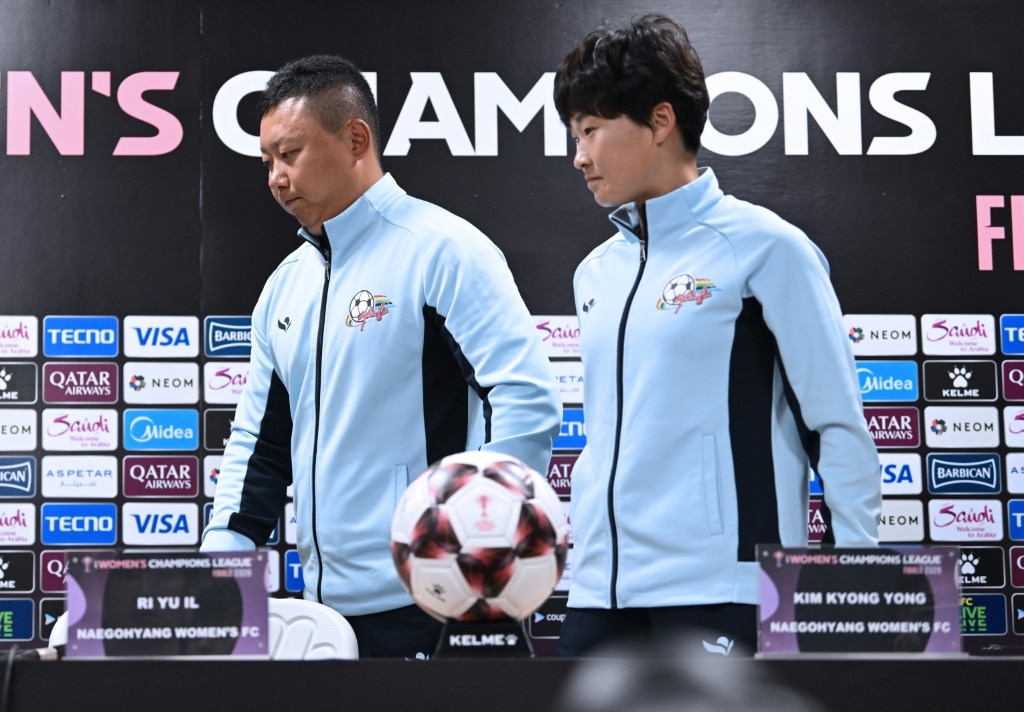
At a pre-match press conference held Tuesday at Suwon Sports Complex, head coach Ri Yu Il pushed back repeatedly on questions about whether his team expected cheers from South Korean fans, emphasizing that the squad’s sole priority is the game itself. “We are here solely to play football,” Ri told reporters. “Simply put, we will focus only on each match. Therefore, the issue of the supporters is not something I, as a coach, or our players need to concern ourselves with. We will concentrate exclusively on the game.”
Unlike typical international club matches, this clash has unique logistical and political constraints. North Korean citizens are generally barred from entering South Korea, meaning there will be no official away fan section for Naegohyang. Around 3,000 spectators from South Korean civic groups, backed by $200,000 in funding from Seoul’s unification ministry, are expected to attend and cheer for both squads. Organizers have had to navigate strict South Korean national security laws that prohibit public display of the North Korean national flag, a hurdle that mirrors approaches taken in past inter-Korean events: groups will instead wave unification flags depicting the entire Korean Peninsula.
Throughout the press conference, both Ri and team captain Kim Kyong Yong remained composed and showed no visible emotion, with all responses translated by a North Korean interpreter. Kim framed the match as an opportunity to honor support from home, saying “We will give our all to repay the trust and expectations of our people and our parents and families.”
Looking ahead to the semi-final, Ri downplayed the significance of Naegohyang’s 3-0 win over Suwon in the competition’s group stage earlier this year, noting that past results rarely predict future outcomes in knockout football. “Just because they played in the group stage, it would be absolutely wrong to say that one team is stronger or weaker than another based solely on those results,” Ri said. “For us, our focus is simply on doing our best to achieve a good result in tomorrow’s match.”
Women’s football is a standout sport for North Korea on the international stage: the country’s senior women’s national team currently ranks 11th in the FIFA global rankings, far outperforming the men’s side which sits at 118th. North Korean women’s sides have consistently competed at the highest levels of Asian and international competition.
The visit takes place against a tense diplomatic backdrop: North Korea has so far not responded to repeated calls for unconditional dialogue from South Korean President Lee Jae Myung, who has adopted a far more conciliatory stance toward Pyongyang than his conservative predecessor. The two Koreas remain technically at war, as the 1950-1953 Korean conflict ended in an armistice rather than a formal peace treaty.
The winner of Wednesday’s semi-final will advance to Saturday’s tournament final, also hosted in Suwon, where they will face the winner of the other semi-final between Australia’s Melbourne City and Japan’s Tokyo Verdy Beleza.