In a landmark moment marking the first visit by a North Korean sports team to South Korea in eight years, the head coach of Naegohyang Women’s FC has doubled down on a singular focus: competitive football, not political or cross-border fanfare. The team will face off against South Korea’s Suwon FC Women on Wednesday in a high-stakes semi-final match of the Asian Women’s Champions League, hosted at Suwon Sports Complex.
The rare inter-Korean football clash has sparked unprecedented public enthusiasm across South Korea. When general admission tickets went on sale last week, all 7,087 available seats sold out in just a few hours. Upon the team’s arrival at Incheon International Airport on Sunday, Naegohyang players and officials were immediately surrounded by crowds of journalists and local supporters holding handwritten welcome messages. Organizers estimate that around 3,000 spectators from South Korean civic groups, backed by Seoul’s Unification Ministry, will be in the stands to cheer on both squads.
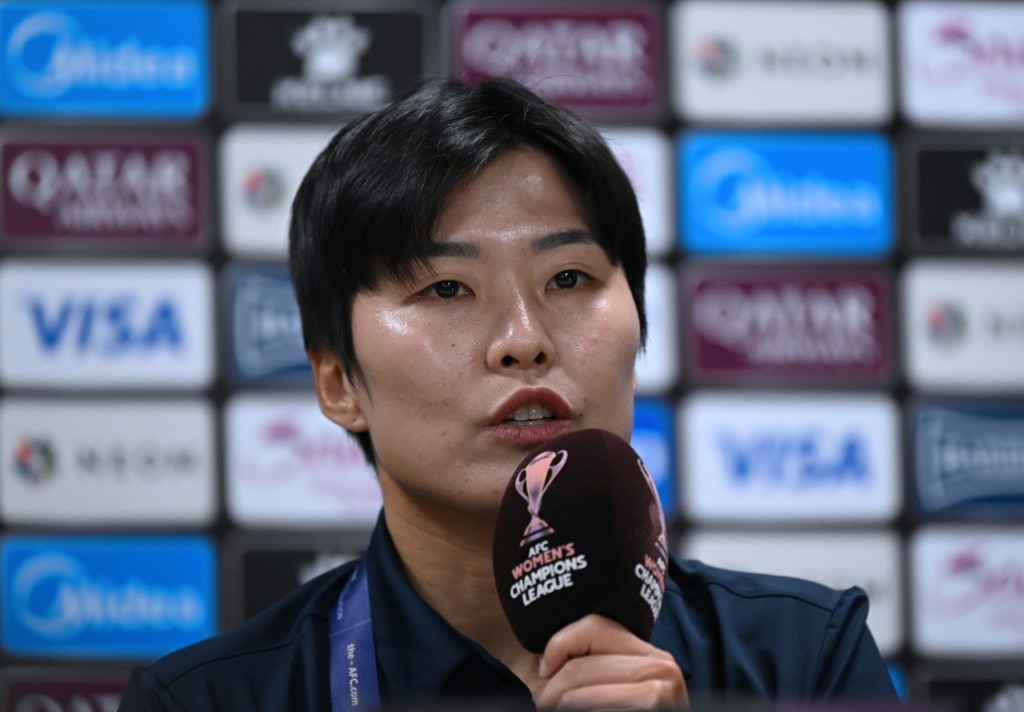
However, structural political divisions prevent any official away contingent for the North Korean side. Since the 1950-1953 Korean War ended in an armistice rather than a formal peace treaty, the two Koreas remain technically at war, and North Korean citizens are generally barred from entering South Korea. At a crowded pre-match press conference on Tuesday, head coach Ri Yu Il pushed aside repeated questions about whether he expected South Korean fans to support his team, emphasizing that off-pitch dynamics are irrelevant to his squad’s goals.
“I’m not sure whether similar questions will continue to come up, but we are here solely to play football,” Ri told reporters. “Simply put, we will focus only on each match. Therefore, the issue of the supporters is not something I, as a coach, or our players need to concern ourselves with. We will concentrate exclusively on the game.” When asked about Naegohyang’s 3-0 group stage victory over Suwon earlier in the tournament, Ri dismissed the idea that the result would give his side any decisive advantage. “Just because they played in the group stage, it would be absolutely wrong to say that one team is stronger or weaker than another based solely on those results,” he said. “For us, our focus is simply on doing our best to achieve a good result in tomorrow’s match.”
Suwon captain Ji So-yun, a former Chelsea midfielder, acknowledged that the hype around the match is unlike anything she has experienced in women’s football. Ji framed the upcoming game as a hard-fought competitive battle, noting that Naegohyang’s squad is widely considered nearly as strong as North Korea’s full national women’s team, one of the top-ranked sides in the world. “When North Korean players compete, they tend to be very physical and there is also a lot of verbal confrontation on the pitch,” Ji said. “So our players should not back down. If they challenge us, we will challenge them back. If they kick us, we will kick them back.”
Context around the historic match reflects longstanding political divisions on the Korean peninsula. Under South Korea’s current President Lee Jae Myung, who has adopted a far more conciliatory stance toward Pyongyang than his conservative predecessor, Seoul has repeatedly proposed unconditional dialogue with North Korea — proposals that Pyongyang has yet to respond to. The Seoul government has allocated $200,000 to support the civic groups organizing cross-border cheering efforts, and local media reports that organizers have worked with authorities to establish cheering guidelines: under South Korea’s national security law, public displays of the North Korean national flag are banned, so groups have instead planned to wave unified flags depicting the entire Korean Peninsula, as was done in previous cross-border sporting events.
Women’s football is a consistent strength for North Korean international sport, with the country’s senior women’s national team holding 11th place in the current FIFA World Rankings — a stark contrast to the men’s national side, which sits at 118th. The winner of Wednesday’s semi-final will advance to Saturday’s tournament final, also hosted in Suwon, where they will face the winner of the other semi-final between Australia’s Melbourne City and Japan’s Tokyo Verdy Beleza.