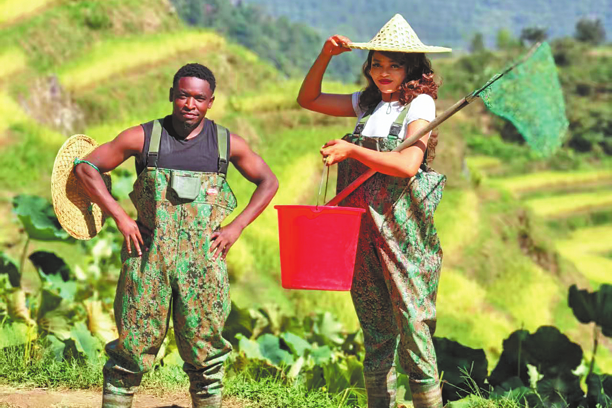
Beneath the blazing summer sun of East China’s Zhejiang province, a young foreign woman wearing a woven straw hat steps barefoot into the muddy waters of a terraced rice paddy. One hand grips a handwoven fishing net, the other holds a chipped wooden bucket ready to hold her catch. She wades slowly through the shallow water, her toes sinking into soft silt as she searches for native carp raised in Yunhe county’s centuries-old rice-fish co-culture system. Within an hour, her fresh catch is carried to a village kitchen, where it is transformed into a fragrant, steaming traditional Chinese dish, ready to be shared with local hosts.
That woman is Ibeakamma Chinazaekpere Ugochinyere, a Nigerian scholar who goes by her Chinese name Wang Qian. Now a doctoral candidate at Zhejiang Normal University’s College of Education, she traveled to the mountainous Yunhe county in 2025 to take part in filming the documentary series *A Foreign Apprentice Comes to the Mountains*. What was originally scheduled to be a straightforward media assignment quickly evolved into a deeply personal journey that reshaped her understanding of Chinese culture and development.
Ugochinyere’s connection to China stretches back to her primary school years in Nigeria, when she first developed a fascination with the country’s long history and unique culture. That childhood curiosity became a reality when she earned a Confucius Institute scholarship, an opportunity that allowed her to move to China to pursue her education. A decade later, she says China has become more than a place of study — it is her second home. “What the Chinese government gave us was not only the opportunity to study, but also a deep affection that crossed mountains and seas,” she explained.
Over her 10 years in China, Ugochinyere has grown from a curious cultural explorer into an active bridge for China-Africa people-to-people exchange. Her immersive stay in Yunhe added an unexpected new layer of meaning to that work. On camera, she worked alongside local villagers to dig up sweet potatoes, handcraft traditional tofu, harvest rice and cook family-style meals. Off camera, she found herself slowly drawn into a way of life that felt both entirely new and unexpectedly intimate. Having spent most of her time in China living in bustling urban centers, the quiet rhythm of rural life opened her eyes to a side of the country she had never experienced before.
For Ugochinyere, the unassuming magic of China’s countryside lives in small, everyday moments: soft mist curling over forested mountain peaks when she opens her curtains at dawn, a warm bowl of hand-folded wontons shared by a local neighbor, a daily schedule shaped by the cycles of the land and seasonal weather, rather than the nonstop noise and rush of city life.
Again and again during her stay, she returned to one observation: China’s rural revitalization drive is extraordinary. What impressed her most, however, was not just the visible signs of new prosperity — cleaner infrastructure, newer public facilities, higher living standards. What stood out to her was that development in Yunhe, and later in Wuyi county of Jinhua, did not come at the cost of cultural heritage.
“This project made me understand that while we are advancing modernization, embracing new development, and promoting rural revitalization, we must also preserve old buildings, past history and traditional knowledge,” she said. In her view, the centuries-old wooden farmhouses, historic architecture and surviving traditional handicrafts she encountered across the countryside are not outdated relics to be bulldozed for new construction; they are the foundation that allows rural communities to hold onto their unique cultural identity. “These old buildings, these old crafts and the things that have been preserved are all telling the story of who they are,” she noted. That balance, she argues, is what makes China’s rural transformation distinct from development models she has seen elsewhere: “We welcome development and modernization, but we do not need to lose ourselves, our culture or our history.”
Another group that left a lasting impression on Ugochinyere was the cohort of young Chinese villagers who have chosen to leave urban careers to return home and rebuild their local communities. She met dozens of young entrepreneurs using digital tools to market local farm produce, redesign traditional product packaging, and sell village goods to national audiences via livestreaming e-commerce. This new wave of entrepreneurship has injected fresh energy into rural areas, where older generations previously lacked the resources and digital skills to reach broader consumer markets.
“I’m really proud of them. They are willing to go back home, bring development, start businesses and promote the products of their villages,” she said. What stuck with her most were not grand policy announcements, but small, human moments of connection: elderly villagers greeting the film crew with warm grins and homemade snacks, new family restaurants and small businesses popping up on every return visit to Yunhe, the clear sense that ongoing changes were being experienced and shared by every member of the community.
The experience also stirred warm childhood memories for Ugochinyere, who grew up surrounded by mountains, rivers and untouched nature in Nigeria. In quiet, unspoken ways, the rolling hills and lush landscapes of rural China felt strangely familiar. So when filming wrapped, she found she could not leave the experience behind.
“If I have time off in the future, I would love to go back, rent a house or stay in a homestay for a while, and spend more time walking around,” she said. “I want to work the land again, dig up potatoes again, and experience that feeling once more. I haven’t felt that way in many years.” Smiling, she summed up what the journey meant to her with a famous Chinese phrase that now feels personal: “Lucid waters and lush mountains are invaluable assets. China’s countryside is truly a treasure.”