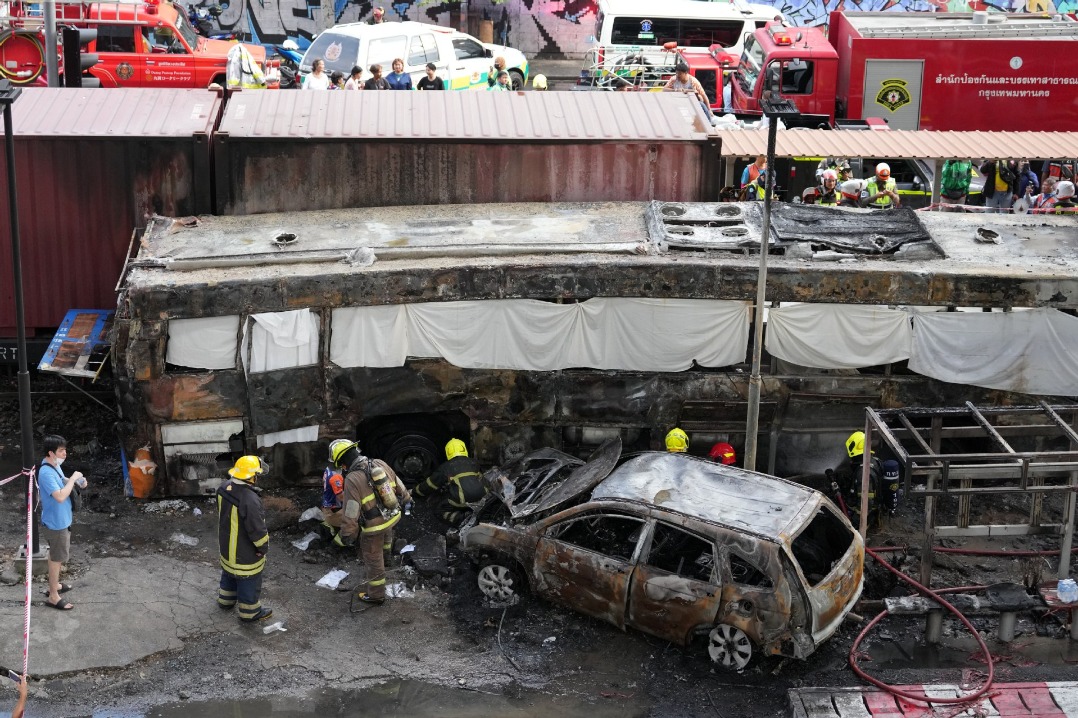
A devastating collision between a freight train and a public bus in central Bangkok has left eight people dead and 25 others injured, prompting Thailand’s prime minister to demand rapid support for victims and a sweeping probe into transport safety across the capital. The deadly crash unfolded at approximately 3:40 p.m. local time on Saturday, in the immediate vicinity of the Airport Link Makkasan Station, one of the capital’s busy transit hubs.
Eyewitness accounts confirm the public bus became trapped on the railway tracks after gridlocked city traffic forced it to stop in the train’s path. The force of the collision was so severe that the bus burst into flames, billowing thick black smoke across the surrounding neighborhood and damaging multiple vehicles parked or stopped nearby. Emergency response teams including urban search and rescue units, fire crews, and advanced medical teams were immediately dispatched to contain the blaze, extract survivors, and triage casualties.
Official updates from Thai authorities later confirmed all eight fatalities were passengers aboard the public bus. All injured victims have been transported to adjacent medical facilities for urgent care, with several still listed in critical condition as of Sunday morning. The Thai Department of Rail Transport has formally launched a full investigation to determine the root causes of the disaster.
Preliminary evidence points to chronic urban traffic congestion as a contributing factor, which left the bus unable to clear the railway crossing before the oncoming freight train arrived. Investigators are also conducting a full inspection of the crossing’s infrastructure to confirm whether warning signals and automatic safety barriers were operating correctly at the time of the crash.
Thai Prime Minister Anutin Charnvirakul visited the accident site Saturday evening to meet first responders and oversee the response effort. During his visit, he issued explicit instructions for all relevant government agencies to accelerate victim assistance efforts, ensure full coverage of medical care for all those affected, complete a transparent full investigation, and conduct a comprehensive review of existing safety protocols for all at-grade railway crossings across the country.
The tragedy has reignited long-simmering public concern over transportation safety in Thailand, particularly in densely populated, heavily congested urban centers where existing infrastructure has struggled to keep pace with growing road and rail traffic volumes. Many safety advocates have called for urgent upgrades to aging crossing systems and new traffic management strategies to reduce the risk of similar incidents in the future.