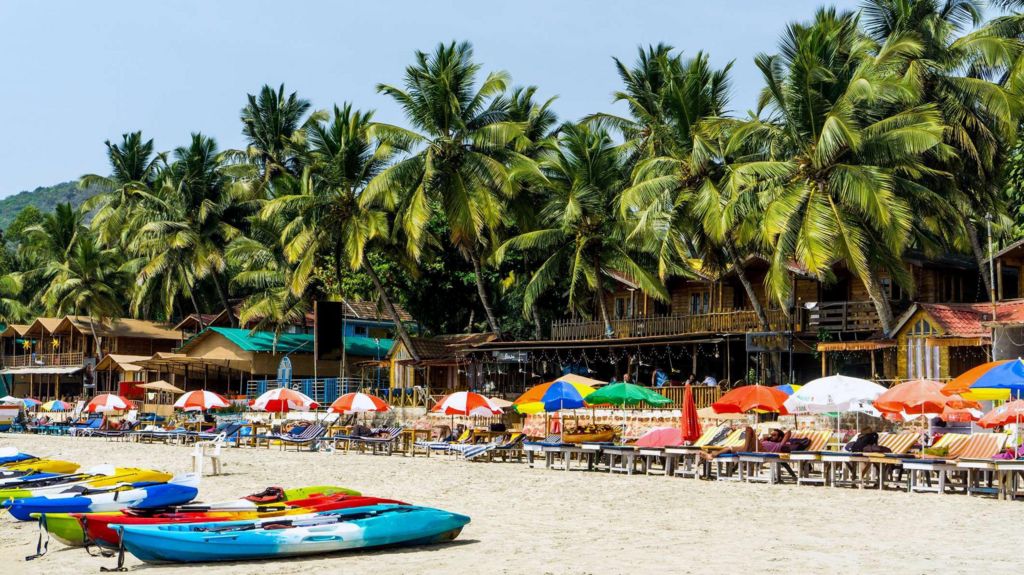
On a blazing midday at crescent-shaped Palolem Beach, tucked along the southern edge of Goa’s sweeping sun-kissed coastline, crowds still jostle for space on the sand and cool off in the gentle Arabian Sea waves. Beachside food shacks and budget-friendly backpacker hostels that line the bay of India’s self-styled party capital are at full capacity. The biggest shift from a decade ago, however, is striking: the crowds of European and Russian travelers that once packed these shoreline villages are nowhere to be found. Today, nearly every visitor is domestic, a visible marker of a dramatic shift in Goa’s decades-old tourism economy.
Official data from Goa’s state tourism department quantifies this stark divide. In 2017, the state welcomed nearly 900,000 international tourists, a pre-pandemic peak. By 2025, that number has fallen to roughly 500,000 – a drop of nearly 45% that cuts the international visitor count in half. The reverse trend holds for domestic travel: domestic tourist arrivals have surged from 6.8 million in 2016 to more than 10 million in 2024, as growing numbers of travelers from across India turn to Goa for their coastal getaways.
State officials have cited ongoing global geopolitical volatility as a core headwind slowing international arrivals, but industry insiders and long-time visitors note the decline began well before recent global conflicts. A range of interconnected challenges have eroded Goa’s long-held appeal for international travelers, who have flocked to the state’s laid-back, budget-friendly shores since the hippie movement of the 1960s and 1970s.
Economic pressure tops the list of barriers. Multiple foreign visitors interviewed by the BBC point to widespread post-pandemic cost-of-living crises across Europe and Russia, combined with spiking airfare driven by global energy instability and Middle East tensions, that have put long-haul trips to Goa out of reach for many. “Some of my friends are choosing Turkey or Egypt over Goa this year because it’s closer to home and cheaper,” explained Sophie, a Russian ballet dancer on her fifth visit to the state. Rico, a regular visitor from Newcastle, United Kingdom, added that most Europeans now prioritize domestic holidays to cut costs.
Beyond rising travel costs, cumbersome and increasingly expensive visa processes are another major deterrent. Many international travelers blame extended processing wait times and a recent hike in five-year visa fees for pushing them to choose alternative destinations. Ernest Dias, a member of Goa’s tourism advisory committee and owner of a large travel charter firm, notes that rival destinations across South and Southeast Asia – including Sri Lanka and Vietnam – offer convenient on-arrival visas that cater to modern travelers’ preference for spontaneous, last-minute getaways. Just this year, a large Russian charter group canceled a planned Goa trip and rebooked to Vietnam, where inbound travel demand has skyrocketed, Dias confirmed.
Affordability of accommodation is another key pain point. The boom in domestic tourism and the fast-growing MICE (meetings, incentives, conferences, exhibitions) sector has driven up prices for three- and four-star hotels, pricing out many budget-focused international travelers. Compared to regional competitors like Thailand, Sri Lanka and Vietnam, Goa also has far less supply of low-cost beachfront resorts, where all-inclusive package deals can cost half as much as comparable stays in Goa. The cancellation of a direct Air India route between London Gatwick and Goa has compounded these issues, forcing many European travelers to arrange inconvenient layovers in Mumbai that detract from their trip experience.
Infrastructure and cleanliness gaps have also pushed visitors away. While the state government has increased efforts to clear litter from Goa’s beaches, many access roads remain blighted by uncollected garbage – an unwelcome sight for international travelers who prioritize high cleanliness standards. Prohibitively expensive taxi fares, driven by local union opposition to app-based ride-hailing services that would offer transparent, competitive pricing, create another persistent headache for visitors. “It’s like living in the Stone Age,” Dias noted, explaining that travelers cannot book rides through popular apps due to aggressive pushback from local taxi associations.
These challenges have hit Goa’s tourism-dependent local economy hard. Shervyn Lobo, who operates a 100-room hotel near popular Baga Beach, reports international footfall has dropped by at least 10% at his property. While strong domestic demand has offset revenue losses, international travelers are far more valuable to local businesses: they typically stay longer, fill hotel rooms during off-peak periods, and spend more on local excursions, motorbike rentals and meals at independent beach shacks, unlike many domestic travelers who opt for all-inclusive package deals. This shift means the drop in international visitors ripples through the entire local tourism ecosystem, from small street vendors to activity operators.
State officials have acknowledged the problem after years of inaction, and have launched new efforts to win back international travelers. The tourism department is hosting international promotional road shows in emerging source markets, with recent events in Poland and upcoming outreach across Scandinavia. Officials are also targeting new non-European source markets in Asia and Africa to diversify Goa’s international visitor base. Even so, the challenge is steep: as regional competitors offer cheaper, cleaner, and more traveler-friendly experiences, Goa will need to enact major reforms to reclaim its status as a top global budget beach destination and win back the international travelers that built its global reputation.