On Friday, international financial markets suffered widespread downturns as geopolitical gridlock in the Middle East and underwhelming outcomes from the high-stakes US-China leaders’ summit reignited investor anxiety over sustained inflation that threatens to undermine global economic expansion. The standoff over the Strait of Hormuz, a critical chokepoint for global energy shipments, sent crude prices jumping by as much as 3.5%, lifting benchmark Brent crude to nearly $109 per barrel by mid-afternoon GMT.
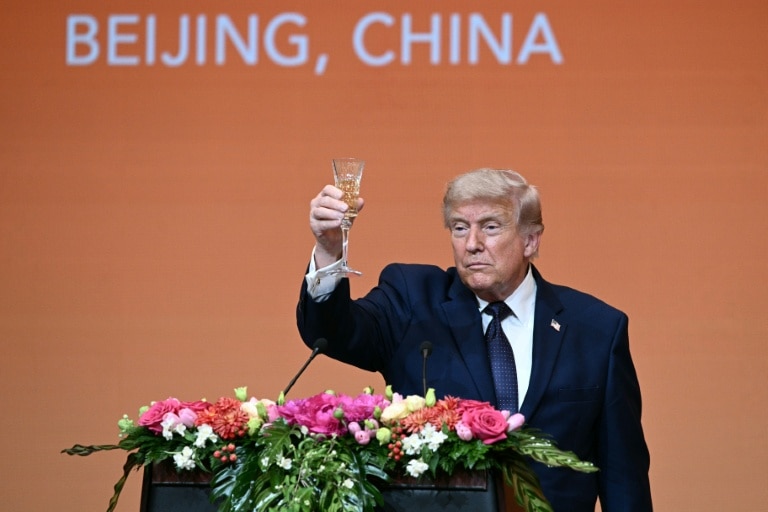
The much-anticipated summit between US President Donald Trump and Chinese President Xi Jinping failed to deliver the concrete breakthroughs investors had hoped for, both on Middle East de-escalation and bilateral trade negotiations. While Trump claimed the two sides had struck “fantastic trade deals”, he offered no detailed specifics, only noting that Beijing had expressed interest in purchasing American oil and soybean exports, and confirmed he did not raise the contentious issue of existing tariffs during discussions. China’s top diplomatic officials later clarified that the two nations had agreed to uphold previously reached accords and set up new bilateral trade and investment working councils, but offered no new commitments to resolve ongoing tensions.
Market analysts characterized the meeting as heavy on symbolic goodwill but light on tangible policy progress. With diplomatic efforts to reopen the Strait of Hormuz — where commercial oil tanker traffic has slowed to a near halt following the outbreak of regional conflict — stuck in limbo, fresh uncertainty flooded through global energy and financial markets. The White House confirmed that both leaders agreed the strait must remain open for global energy trade, but investors had pushed for more concrete action to restore full shipping access, which has been blocked amid the ongoing US-Iran impasse. Trump amplified geopolitical jitters Thursday in an interview with Fox News, saying he would “not be much more patient” with Iran, leaving energy markets on edge over potential further supply disruptions.
Rising crude oil futures triggered a sharp jump in government bond yields across major developed economies, as investors demanded higher returns to compensate for growing inflation risk. In the United Kingdom, where newly inaugurated Prime Minister Keir Starmer is already facing fresh challenges to his leadership, 30-year government bond yields climbed to 5.869% — their highest level since 1998, surpassing the previous record set just three days earlier. In Japan, 30-year bond yields hit the 4% threshold for the first time since 1999.
“Bond yields have continued to march higher, and this has introduced more volatility to the wider financial markets as investors worry about the impact of increased government borrowings across the developed economies and what they mean for their economies,” explained Fawad Razaqzada, a senior market analyst at FOREX.com.
Across global equity markets, losses were broad and deep. In Asia, Japan’s Nikkei 225 closed 2% lower, while Hong Kong’s Hang Seng Index and China’s Shanghai Composite dropped 1.6% and 1% respectively. Major European bourses fared worse: London’s FTSE 100 closed down 1.7%, Paris’ CAC 40 fell 1.6%, and Frankfurt’s DAX 30 slid 2.1% by the end of trading. On Wall Street, the Dow Jones Industrial Average and S&P 500 both dropped 0.9% from the fresh all-time highs set Thursday, driven by a cooling in the ongoing AI-fueled tech rally that pulled the Nasdaq Composite down 1.1%. The US dollar strengthened against all major global currencies, including the British pound, euro, and Japanese yen.
“Stalled US-Iran diplomacy keeps supply fears firmly in focus,” noted Matt Britzman, senior equity analyst at Hargreaves Lansdown. “Even if resolved next month, the oil market could remain undersupplied through October, keeping inflationary pressures high and adding another headache for consumers, central banks, and, eventually, investors.”
Susannah Streeter, chief investment strategist at Wealth Park, echoed that assessment, adding: “With diplomatic efforts aimed at resolving the Middle East conflict in limbo, fresh uncertainty has flooded in.”
By 1530 GMT, key market metrics stood at: Brent North Sea Crude up 3.0% at $108.88 per barrel; West Texas Intermediate up 3.5% at $104.71 per barrel; Dow Jones at 49,636.63 (down 0.9%); S&P 500 at 7,436.28 (down 0.9%); Nasdaq Composite at 26,335.25 (down 1.1%); FTSE 100 at 10,195.37 (down 1.7%, close); CAC 40 at 7,952.55 (down 1.6%, close); DAX 30 at 23,950.55 (down 2.1%, close); Nikkei 225 at 61,409.29 (down 2.0%, close); Hang Seng Index at 25,962.73 (down 1.6%, close); Shanghai Composite at 4,135.39 (down 1.0%, close); GBP/USD at 1.3324 (down from 1.3400); EUR/USD at 1.1624 (down from 1.1673); USD/JPY at 158.68 (up from 158.33); EUR/GBP at 87.25 pence (up from 87.09 pence).