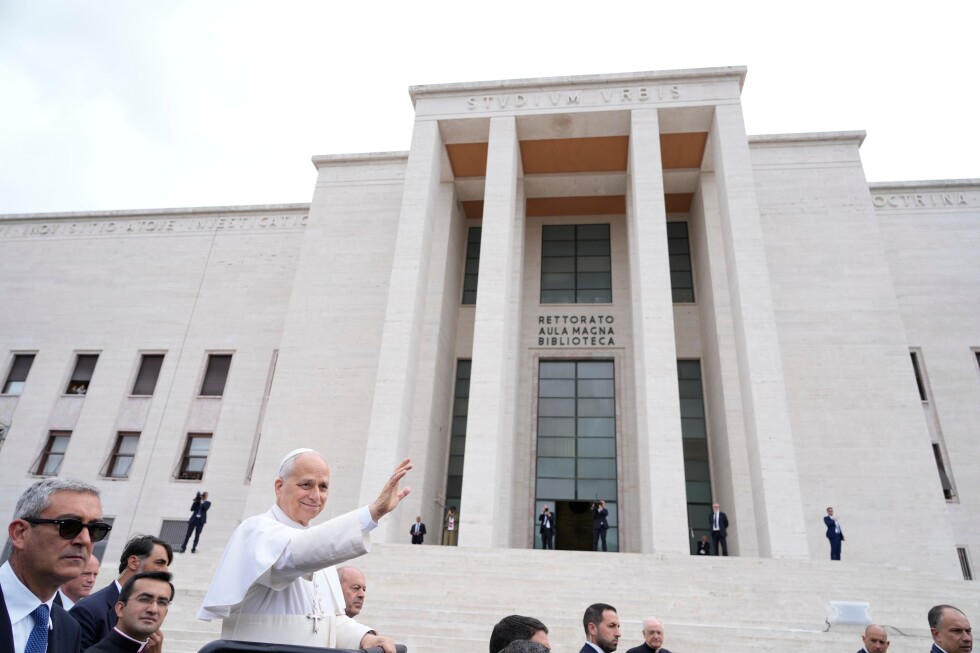
On a historic Thursday visit to Rome’s La Sapienza University, the largest institution of higher education in Europe, Pope Leo XIV delivered a stark warning to the global community: unregulated investments in artificial intelligence and cutting-edge military weaponry are pushing the world toward a dangerous “spiral of annihilation.” The appearance marked a pivotal moment for the Vatican, coming 16 years after Pope Benedict XVI canceled a planned visit to the 14th-century campus amid widespread protests from faculty and students, a controversy that left a long shadow over Vatican-university relations.
Unlike the fraught planned visit in 2008, Pope Leo was met with a warm welcome from the La Sapienza community, highlighted by a special greeting for a group of recently arrived Palestinian students from Gaza. These young scholars entered Italy this week via a humanitarian corridor organized by the Italian government in partnership with Catholic organizations, an initiative that has brought hundreds of Gazans to Italy for higher education and critical medical care since the Israel-Hamas war began in October 2023.
During his time on campus, Pope Leo met with several of the newly arrived Gaza students twice: once during an informal greeting at the university’s chapel, and again after his keynote address in the institution’s main lecture hall. La Sapienza, founded by Pope Boniface VIII in 1303, is one of the oldest continuously operating universities in the world, adding historic weight to the pope’s address focused on global conflict and ethical progress.
In his speech, Pope Leo called out the dramatic surge in global military spending this year, with a specific note on exponential increases across Europe. He argued that this growth in military budgets has come directly at the expense of underfunded public education and healthcare systems, enriching a small cohort of elite stakeholders who show little regard for collective global well-being.
The pontiff extended his critique to the rapid development of artificial intelligence, urging the creation of stricter, more transparent monitoring frameworks for AI innovation across both military and civilian sectors. He stressed that AI must never be allowed to remove human accountability for life-or-death choices, nor should it be allowed to worsen the already devastating human cost of ongoing global conflicts.
“What is happening in Ukraine, in Gaza and the Palestinian territories, in Lebanon, and in Iran illustrates the inhuman evolution of the relationship between war and new technologies in a spiral of annihilation,” Pope Leo told the assembled audience. He pushed back against this trend, arguing that education and academic research must chart a different course centered on the inherent value of human life—“the lives of peoples who cry out for peace and justice.”
Addressing ongoing conflicts, Pope Leo explicitly repeated his call for immediate ceasefires and negotiated peace in both the Middle East and Ukraine, two conflicts that have dominated global headlines and displaced millions of people over the past several years. This address aligns with Pope Leo’s long-stated position that AI regulation is one of the most critical existential challenges facing humanity, particularly when it comes to its unregulated use in warfare and daily life. Vatican observers confirmed he plans to expand on these themes in his first encyclical, a major papal teaching document set for release in the coming weeks.
For 19-year-old Nada Rahim Jouda, one of the Gaza students who met the pope just two days after arriving in Italy, the visit marked a surreal moment in a life upended by war. Jouda, who will study business science at La Sapienza, described Rome as “like heaven for me,” contrasting the city’s lush, calm landscape with the constant instability and destruction of Gaza, where “everything is gray and troubles everywhere and miserable people in the streets.”
Even as she begins her new life, Jouda carries the weight of the family she left behind. Her mother is recovering from leukemia and was unable to access consistent cancer treatment or check-ups amid the war, which forced her entire family to flee their home four times. Her two younger sisters, ages 13 and 17, remain in Gaza with her mother. “They all rely on me. I’m the only hope that they have,” Jouda said.
This Associated Press religion coverage is produced through a collaboration between AP and The Conversation US, with funding from Lilly Endowment Inc. The AP retains sole editorial responsibility for all content.