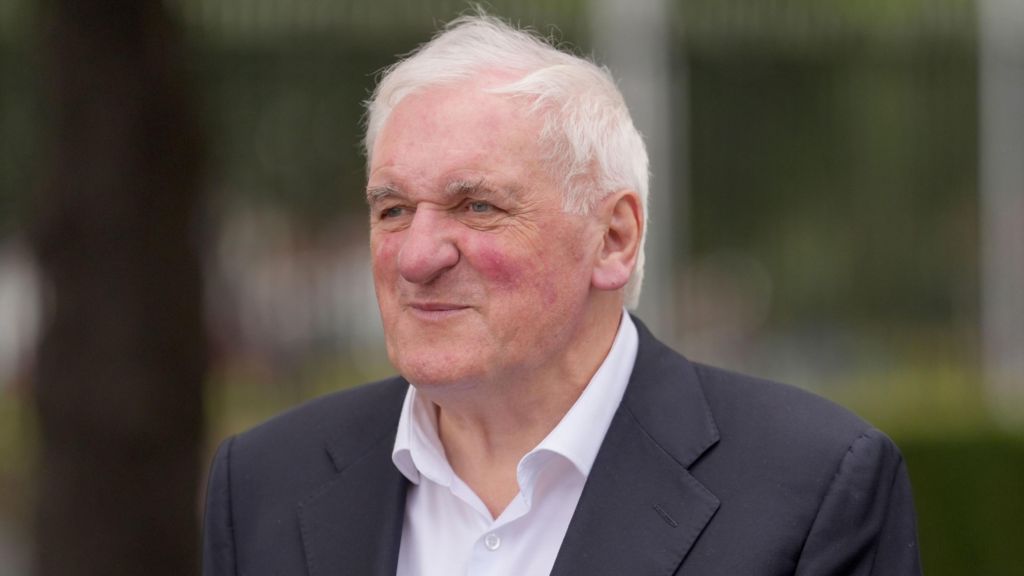
A secret recording of former Irish Taoiseach Bertie Ahern making racially specific remarks about immigration has sparked widespread political criticism across the Republic of Ireland, reigniting fierce public debate over one of the country’s most divisive policy issues.
The undercover recording, made approximately 10 days prior to its circulation on social media, was captured during a canvassing trip by Ahern to a Dublin residential housing estate, where a local voter pulled him aside to press for his personal stance on migration. After the voter opened with criticisms of “hordes of foreigners” entering Ireland and called for full border closures, Ahern offered remarks that would quickly draw condemnation.
In the recording, Ahern stated he had no objection to Ukrainian refugees entering the country, citing the ongoing war in Ukraine as a justifiable context for their arrival. But he went on to single out African migrants, saying: “The ones I worry about are the Africans. We can’t be taking in people from the Congo and all these places. I think there’s too many from those places.” When asked about Muslim migrants, Ahern doubled down, claiming he did not see concerns with current Muslim residents but argued “the next generation, when the kids start growing up, that’s when I think the problem will be.” He added that he had shared this concern with current Irish Justice Minister Jim O’Callaghan, who oversees migration policy.
After the voter informed Ahern she had recorded the entire conversation and planned to share it online, she accused him of failing to “speak up for the Irish” as he left. The video has since spread widely across social platforms, though it has not been formally verified by the BBC.
In subsequent comments to Irish national broadcaster RTÉ, Ahern pushed back against criticism, arguing his remarks had been taken out of context from a longer conversation. He clarified that he “has no problem with people who come here through the visa and asylum systems”, noting that many African migrants who completed the process legally now live and work in his local Dublin constituency. Ahern also emphasized that he supports the Fianna Fáil government’s current immigration policies, adding only that he has historically called for a speedier asylum processing system, a change the government has already partially implemented.
Current Taoiseach Micheál Martin was quick to distance his government and party from Ahern’s comments, calling the remarks “not appropriate”. “It’s not correct or proper to be specific about any given ethnicity,” Martin told reporters, noting that Ireland is home to many Irish citizens from diverse ethnic backgrounds that deserve full respect. He defended the country’s existing asylum framework, calling it “fair and robust” and noting that recent reforms have created a more efficient, accelerated processing system. Martin later confirmed to the Dáil, Ireland’s national parliament, that he accepted Ahern’s walkback of his original comments.
Ahern, who served as Taoiseach from 1997 to 2008 and was a key architect of the 1998 Good Friday Agreement that ended decades of conflict in Northern Ireland, has a complicated political history. He resigned as prime minister in 2008 amid a growing personal finance scandal, and a 2012 corruption tribunal found he provided false evidence about the source of more than €250,000 in bank accounts linked to him. He resigned from Fianna Fáil shortly after the report’s release, though he has remained active in political campaigning for the party in recent years. The recording in question was made while Ahern was canvassing for a Fianna Fáil by-election candidate, and multiple other competing candidates have publicly condemned his remarks.
Immigration has emerged as one of the most hotly contested political issues in Ireland in recent years, driven by shifting demographic trends and rising pressure on public services. 2022 census data shows that one in five Irish residents were born outside the country. Since 2022, Ireland has admitted tens of thousands of Ukrainian refugees alongside asylum seekers from other global conflict zones, a surge that critics argue has worsened the country’s long-standing housing crisis. O’Callaghan, the current migration minister, recently acknowledged that the current volume of asylum seekers is “too high”, noting that annual arrivals have jumped from 3,000-4,000 pre-pandemic to more than 18,500 in the most recent reporting period. Despite the surge in asylum claims, overall net immigration to Ireland fell to 59,700 in 2025, down from a peak of 79,300 in 2024.