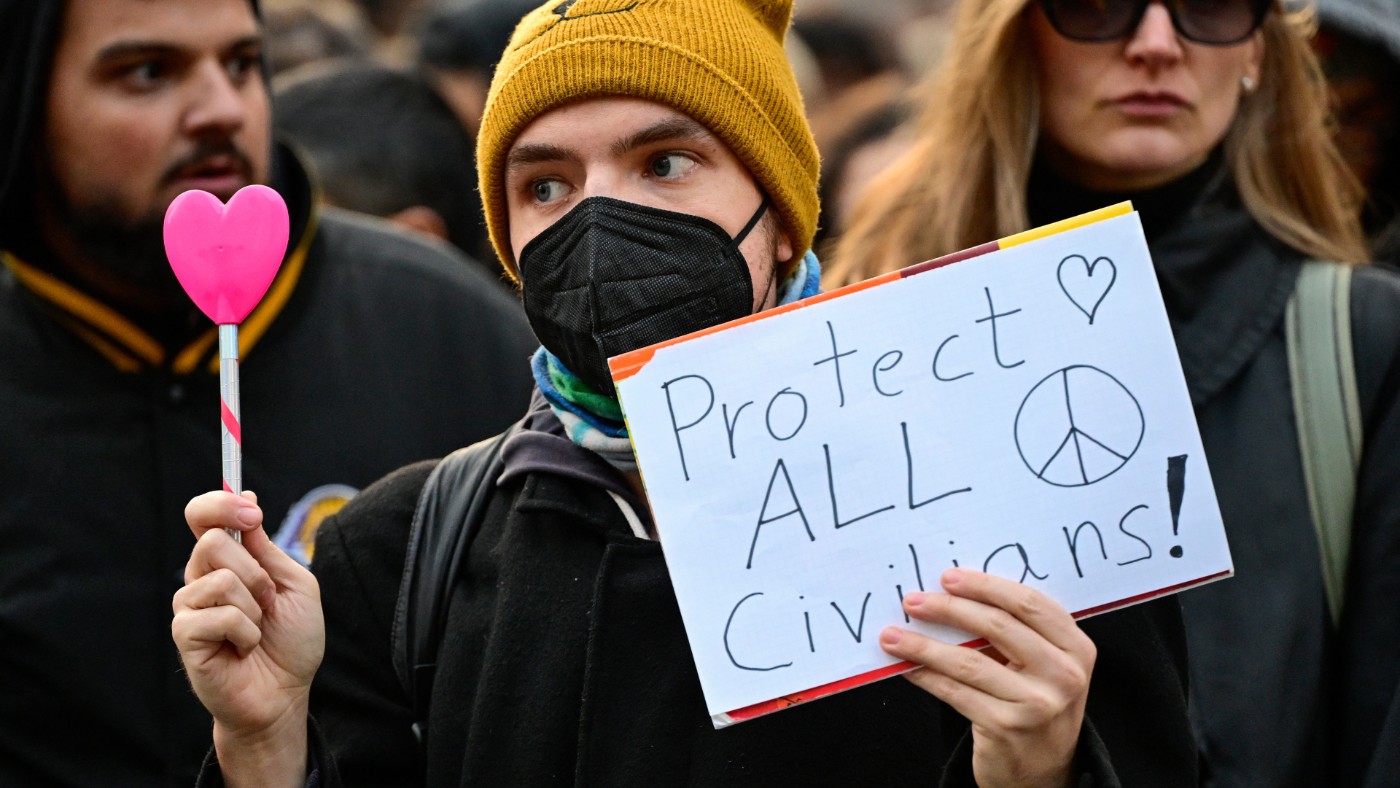
Germany’s Federal Office for the Protection of the Constitution (BfV), the country’s domestic domestic intelligence service, has released a controversial new dossier categorizing grassroots secular pro-Palestinian organizing within Germany as a form of extremism, triggering widespread debate over civil liberties, political speech, and the country’s official policy toward the Israel-Gaza conflict.
The document outlines three core focus areas: the alleged ties between antisemitism and secular pro-Palestinian extremism, common symbols and markers used by activist groups, and cross-ideological networking between pro-Palestinian organizers, left-wing extremists and Islamists. BfV notes that the movement is highly diverse, made up of long-standing established groups as well as newer formations that emerged following the October 7, 2023 attacks led by Hamas. According to the dossier, all these factions are united by what BfV frames as inherent hostility toward Israel, regularly rejecting the country’s right to exist and spreading rhetoric that runs counter to norms of international understanding.
The report specifically calls out pro-Palestinian protests against Israel’s military campaign in Gaza, noting that in Berlin, the epicenter of German pro-Palestinian activism, events frequently feature anti-Israel and occasionally antisemitic statements and displays. The dossier names the Popular Front for the Liberation of Palestine (PFLP) and the global Boycott, Divestment, Sanctions (BDS) movement as key “relevant actors,” claiming that even groups that publicly support a two-state solution implicitly endorse terrorist activity by Hamas, Palestinian Islamic Jihad (PIJ), and the PFLP, and frame the October 7 attacks as legitimate resistance. It also warns that so-called extremist Palestinian individuals are driving rising radicalization and increasing willingness to use violence.
In its section on protest symbols, BfV even frames widely used pro-Palestinian messaging as evidence of extremism. The popular slogan “from the river to the sea, Palestine will be free” and the sliced watermelon symbol — which uses the fruit’s red, green, black and white colors to echo the Palestinian flag, often as a subtle nod to Palestinian solidarity when public display of the flag is restricted — are both labeled as attempts to deny Israel’s right to exist. “The outline of the entire State of Israel is depicted in the colours of the Palestinian flag (as a sliced watermelon), thereby denying Israel’s right to exist,” the report reads. The dossier also alleges that pro-Palestinian extremists act as a unifying ideological bridge between disparate extremist factions across the political and religious spectrum, from Islamist groups to German and Turkish left-wing and even right-wing extremist networks, exploiting the humanitarian crisis in Gaza to radicalize mainstream civil society. The report only mentions the word “genocide” once when referring to accusations against Israel, referring to the death of more than 73,000 Palestinians and widespread destruction of Gaza simply as the “situation.” Notably, the BfV’s broad claims of antisemitism and extremism are not backed by specific cited examples in the document.
The release of the dossier comes as German law enforcement has already waged a sweeping crackdown on pro-Palestinian demonstrations across the country, with broad political backing rooted in Germany’s official “Staatsräson” — a core state principle that enshrines unconditional support for Israel as a central part of German national identity, a commitment tied to the country’s Nazi-era history of the Holocaust that killed six million Jews. In recent months, Berlin police have repeatedly broken up peaceful pro-Palestinian gatherings, arresting dozens of demonstrators including minor protesters. Video footage from multiple days of actions in April 2026 shows officers forcibly dragging non-violent protesters to the ground and aggressively restraining them, with no evidence of protester violence prior to police intervention.
One protester interviewed by Middle East Eye, whose reporting first documented the crackdown, said demonstrators have faced ongoing repression simply for their Palestinian identity and opposition to Israel’s military campaign. “They [have been] arrest[ing] us for three years until now,” the protester said. “Just because we are Palestinian, and they are committed to a genocide. They are fascism.”
The repression extends beyond street protests. In March 2026, families and legal representatives of anti-arms trade activists who were arrested for breaking into a facility run by Israel’s largest weapons manufacturer in Germany accused authorities of subjecting the detainees to extreme solitary confinement under harsh, restrictive prison conditions.
Germany’s unwavering political support for Israel has shaped both its domestic and foreign policy in recent years. Berlin is the world’s second-largest arms supplier to Israel, trailing only the United States. While Berlin briefly paused some arms transfers in October 2025 after Israel launched its ground offensive to seize full control of Gaza City, shipments resumed just one month later. In April 2026, Germany joined Italy to block a joint motion put forward by Spain, Ireland, and Slovenia at the EU level to suspend the bloc’s trade agreement with Israel over its conduct in Gaza. German Foreign Minister Johann Wadephul dismissed the proposal as inappropriate, arguing that critical conversations about Gaza must happen through constructive dialogue with Israel rather than punitive measures.
The BfV’s core claim that pro-Palestinian activism amounts to extremism because it rejects Israel’s right to exist has also sparked legal and political pushback. International law scholars note that while defenders of Israel regularly invoke the country’s right to exist, no provision of international law guarantees this right to any sovereign state; statehood is widely recognized as a political reality rather than a legally granted status. Critics also argue that the BfV’s framing conflates criticism of Israeli government policy with antisemitism, noting that the agency’s claim that activists fail to distinguish between the Israeli state and global Jewish communities echoes the very conflation it accuses protesters of making. Since the start of Israel’s current military campaign in Gaza, the country has expanded its territorial control through force, having already displaced 750,000 Palestinians during its founding in 1948. Today, Israeli forces occupy more than half of the Gaza Strip and have advanced into southern Lebanon, redrawing de facto borders across the region.