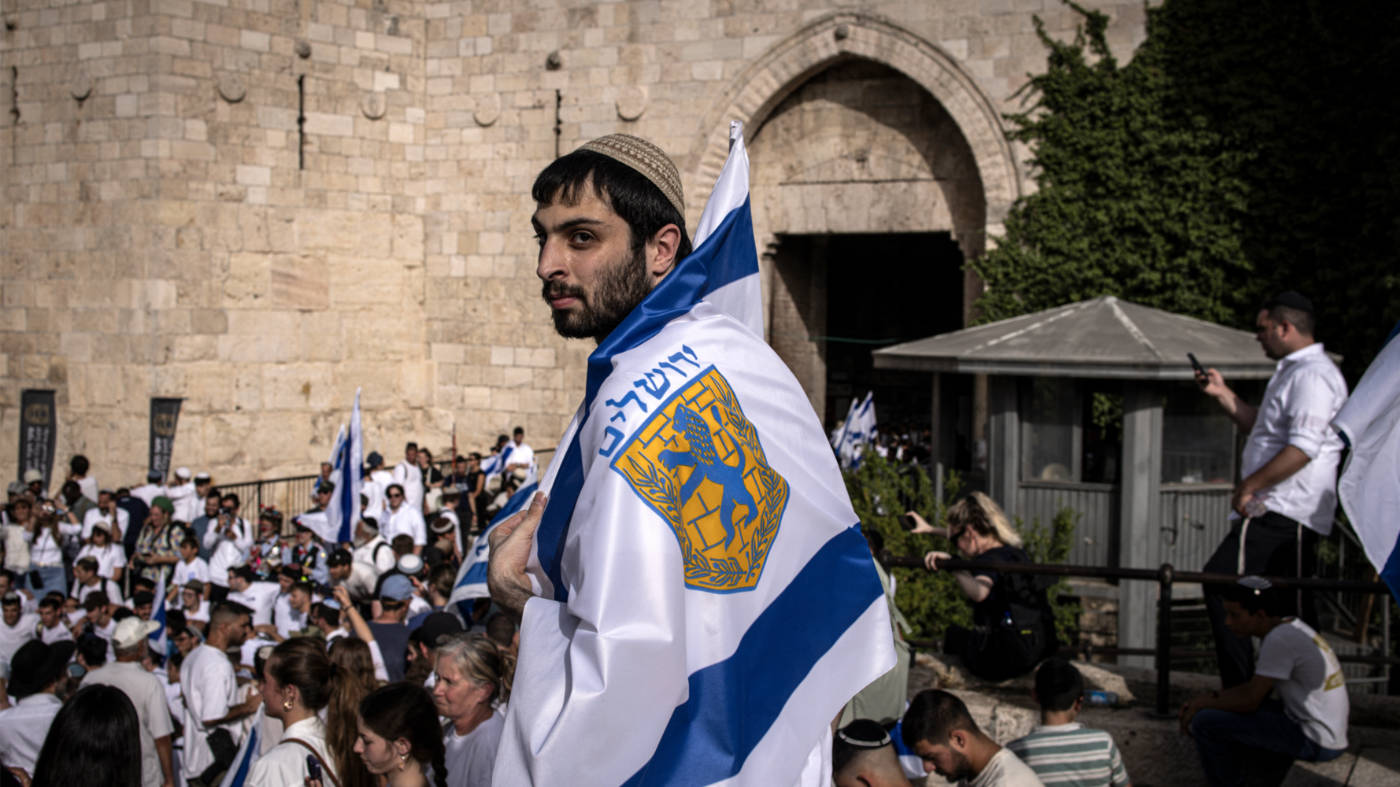
This week, Israelis are set to observe Jerusalem Day, a national holiday that marks the capture of East Jerusalem by Israeli military forces in the 1967 Six-Day War. The annual commemoration will kick off at sunset on Thursday, May 14, and conclude at nightfall the following day, May 15 – one day before Palestinians mark the Nakba, the catastrophic displacement and violence that accompanied the founding of the state of Israel in 1948.
The origins of the holiday stretch back to 1968, just one year after the 1967 war, when Israeli lawmakers voted to establish a formal observance of Israel’s seizure of Palestinian-inhabited East Jerusalem. It was formally enshrined as a national holiday in 1998, when then-prime minister Benjamin Netanyahu signed the legislation into law during his first term in office. Immediately following the 1967 conflict, Israel annexed the occupied areas of Jerusalem, granting permanent residency status to local Palestinian residents. That status allows Palestinians to vote in municipal elections, but bars them from voting for Israel’s national parliament, the Knesset. Today, roughly 350,000 Palestinians call East Jerusalem home, the majority of whom hold no Israeli citizenship and have no national representation in the government that governs their daily lives.
For Israelis, the holiday centers on commemorating soldiers killed in the 1967 battle for Jerusalem, and is framed as a celebration of the reunification of the city under full Israeli control. This year, the Jerusalem Municipality has called on participants to “march with courage and valour, with Israeli flags raised high, and connect themselves with the celebration of Jerusalem’s eternity, and bind Jerusalem forever.”
The centerpiece of the annual observance is the Flag March, which draws tens of thousands of participants, the majority of whom identify with Israel’s ultra-nationalist and far-right factions. Per the Knesset’s official description of the event, the large procession starts in central Jerusalem, moves into the Old City, and concludes at the Western Wall with a collective prayer of thanksgiving. But human rights groups and independent media have repeatedly documented the event as a flashpoint for anti-Palestinian violence, harassment, and provocation.
Far-right Israeli leaders routinely use the march as a platform to broadcast their expansionist and supremacist agenda. Last year, Finance Minister Bezalel Smotrich told a crowd gathered near the Western Wall that “we are conquering the Land of Israel. We are liberating Gaza. We are settling Gaza. We are defeating the enemy.” Smotrich’s comments, delivered months ahead of a 2025 ceasefire in the Israel-Gaza war, drew loud applause from attendees. National Security Minister Itamar Ben Gvir, who has overseen a sharp rise in settler incursions into the Al-Aqsa Mosque compound since taking office in 2022, used the 2024 march to deliver an overtly provocative message: “Jerusalem is ours. Damascus Gate is ours. The Temple Mount is ours. … it is ours.”
Under Ben Gvir’s leadership, Israeli police deployed more than 3,000 officers to secure the 2024 march, clearing a path for participants through the Old City’s Damascus Gate and Muslim Quarter. Israeli human rights organization B’Tselem has documented that during the procession, far-right participants regularly hurl racist chants, assault Palestinian residents, and vandalize Palestinian property in the Muslim Quarter, while local businesses are forced to close and residents are confined to their homes to avoid violence. Independent Israeli left-wing outlet Local Call has described the march as “a display of racism and violence under police protection,” noting that once confined to fringe far-right groups, open racist chants have become widespread across participants in recent years, amid Israel’s ongoing military campaign in Gaza.
B’Tselem has recorded dozens of violent incidents targeting both Palestinian residents and journalists covering the event. In 2023, before the start of the current Gaza war, one reporter told the group that “groups of Jews threw stones, plastic water bottles, and broken flag poles at us,” with at least two correspondents hit by rioters. Another journalist described being struck in the head by a projectile, saying he was too afraid to leave the area before the march concluded out of fear of further attack. Uri Erlich, spokesperson for Israeli NGO Emek Shaveh, which defends cultural heritage rights in the region, noted that a broader shift has occurred in recent years: “It is not the march that has become more extreme, but [Israeli] society.”
This year’s observance comes amid new controversial policy moves from the Israeli government. Multiple reports confirm the government plans to redraw Jerusalem’s municipal boundaries for the first time since the 1967 annexation of East Jerusalem, expanding the city’s borders further into the occupied West Bank’s Palestinian-inhabited territory. Additionally, Israeli newspaper Haaretz reported last month that the government has allocated more than 1 million shekels ($344,000) to fund new satellite flag marches led by Israeli settlers in cities across the country outside Jerusalem.
The stated goal of the program is to reinforce “a sense of connection and identification with Jerusalem, Israel’s capital, even among those who do not live in it.” Marches are scheduled in Lod, Ramla, Haifa, Yavne, Ashdod, Beersheba, Herzliya, Petah Tikva, and Raanana, many of which have large Palestinian citizen populations. This is not the first time parallel flag marches have been held outside Jerusalem: in recent years, processions in cities including Lod and Jaffa have already sparked severe intercommunal tension with local Palestinian communities.
This year’s Jerusalem Day, held on the eve of the Nakba commemoration – which marks the 1948 ethnic cleansing of Palestine that left an estimated 13,000 Palestinians dead and 750,000 displaced from their ancestral homes – is expected to reignite longstanding international and regional tensions over the status of Jerusalem and the rights of Palestinian residents in the city.