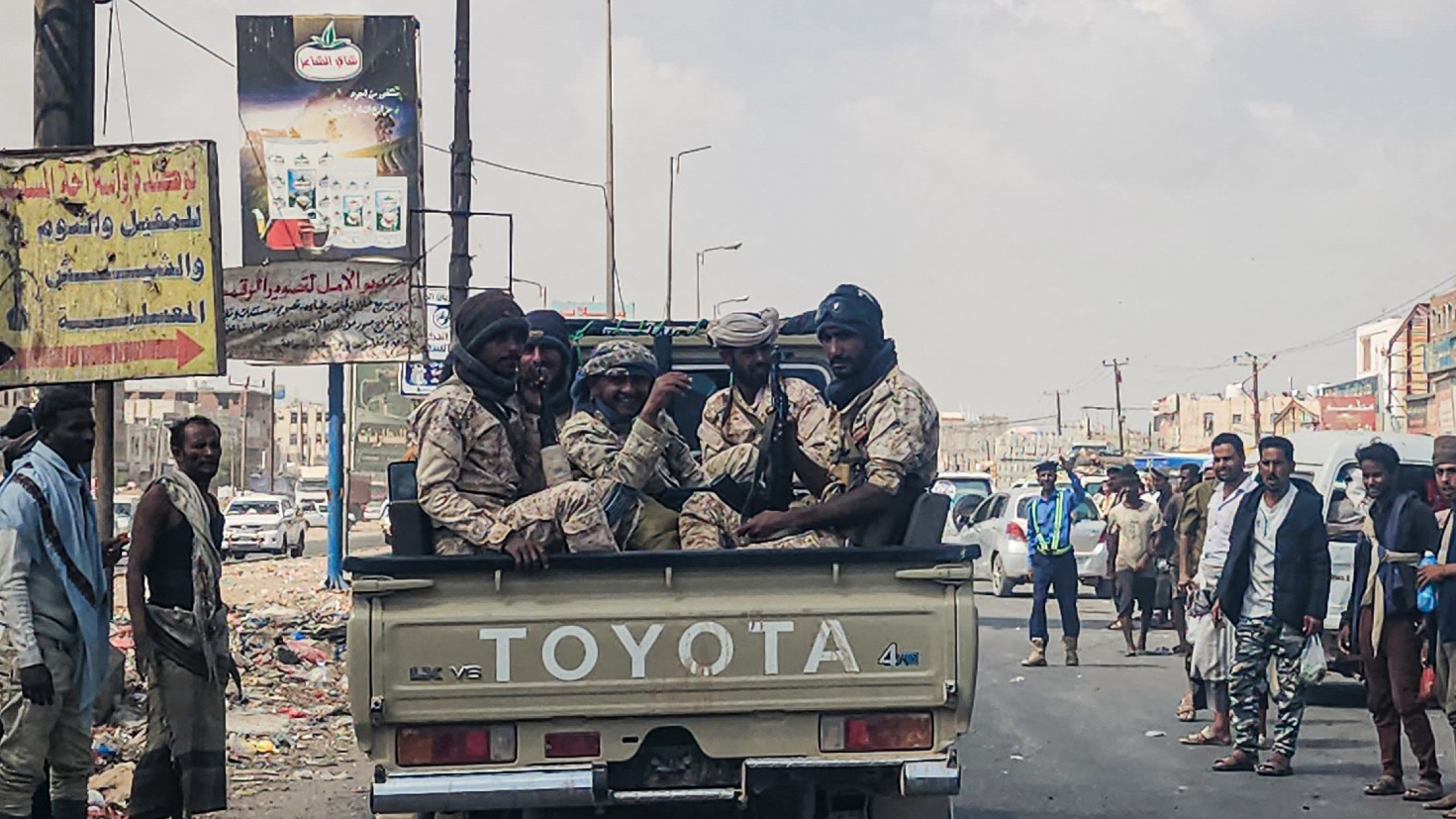
For decades, Yemeni Salafi preacher Gawed cut a familiar figure across Lahj governorate’s mosque circuit. Dressed in traditional Yemeni attire—a mawaz, the men’s sarong-like garment common across the region—and sporting a full beard, the 43-year-old Quranic sciences graduate spent his days proselytizing, teaching a Salafi interpretation of Islam that strictly separated religious guidance from political affairs, a framework he learned from iconic Salafi leader Muqbil al-Wadi’i, who founded the movement’s foundational Dammaj religious center in Yemen’s Saada governorate in the 1980s after studying in Saudi Arabia.
The Salafi movement, a Sunni Islamist current that adheres to a literalist reading of Islamic scripture centered on the practices of Islam’s earliest three generations, would see its apolitical posture upended by decades of escalating conflict with Yemen’s Houthi movement. A Zaydi Shia faction rooted in Saada governorate, the Houthis share with other Shia sects a core belief that leadership of the Muslim community following the Prophet Muhammad rightfully belonged to Ali ibn Abi Talib, the Prophet’s cousin and son-in-law, and his line of descendant Imams, a doctrine that places it at ideological odds with Salafi thought.
Tensions between the two groups simmered for more than a decade in Saada, their shared historic stronghold, before boiling over in 2013, when Houthi forces laid siege to Dar al-Hadith, the prominent Salafi center in Dammaj. The siege left more than 250 people dead, and by 2014, Salafis were forced to evacuate the facility entirely. Thousands fled to other Yemeni governorates, including Gawed and a contingent that resettled in Lahj. Shortly after the Salafi evacuation, Houthi forces advanced on Yemen’s capital Sanaa, securing a decisive victory that brought roughly 30 percent of the country—most of the densely populated northern and western regions—under their control.
When Houthi forces pushed into Lahj in 2015, Gawed and his fellow displaced Salafis abandoned their apolitical tradition and picked up arms. “We didn’t fight for political reasons; we fought to protect our lands and our faith from the Houthis as they tried to invade our villages and distort Islam,” Gawed told Middle East Eye in an interview. For the Salafi preacher and his followers, the fight against the Houthis has never paused: Gawed says his group has remained on the front lines continuously since 2015, vowing not to stop until the entire country is “liberated” from Houthi control. “If we purify our intentions for Allah, we will defeat them across the nation. That is all that is required now,” he said.
Though Salafis fought alongside various anti-Houthi factions for nearly a decade, 2023 brought a major strategic shift. Backed by Saudi Arabia, Yemen’s internationally recognized Presidential Leadership Council (PLC) launched the National Shield Forces (NSF), a new unified military formation led by Salafi commanders. Drawing on Gawed’s years of frontline combat experience and religious standing, the NSF appointed him a commander despite his lack of formal military academy training.
Gawed explained that the decision to form an independent, Salafi-led force grew out of longstanding friction fighting alongside factions that did not share the movement’s core ideological commitments. “At times, fighting under groups that did not share our beliefs was a struggle, so forming the NSF was a priority,” he said, adding that the NSF welcomes all committed anti-Houthi fighters regardless of ideological background. “I am not speaking only of Salafis; I believe in any fighters committed to liberating Yemen from the Houthis above all other purposes.” Today, the NSF includes hundreds of non-Salafi fighters serving alongside Salafi troops.
After its formation, the NSF first operated quietly, but it emerged as a decisive player amid rising tensions between the PLC and the Southern Transitional Council (STC), a rival southern Yemeni separatist faction. Moving from positions along the Saudi border and in Marib governorate, NSF forces successfully pushed STC influence out of large swathes of Hadhramout, Shabwa, and Abyan before advancing into Aden, the PLC’s temporary headquarters. Though this campaign was not directed at the Houthis, Salafi fighters took an active role, with Gawed noting that Salafi doctrine frames obedience to legitimate governing authority as a core religious duty rooted in Quranic teachings that command believers to obey Allah, the Prophet, and those placed in authority over the community. “We fight under the banner of Islam, and our faith commands us to obey Wali Al-Amr (the leader in authority). Therefore, we fought alongside the PLC against those attempting to create chaos,” Gawed said. “If a new faction emerges today to sow disorder and hinder our primary goal of fighting the Shia, we will fight them as well.”
This shift from mosque outreach to formal military power is an unprecedented turning point for Yemeni Salafis, who have only intermittently engaged in armed conflict in the past. The movement played a key allied role in the 1994 Yemeni Civil War, backing former president Ali Abdullah Saleh’s northern government against southern secessionist forces, but for most of modern Yemeni history, Salafis remained focused on religious outreach and avoided formal political or military leadership roles.
Salafis’ formal entry into high-level Yemeni governance began in 2022, when the PLC was formed, and prominent Salafi anti-Houthi commander Abu Zara’a al-Maharami was given a seat on the council. A new milestone was reached in April 2026, when PLC head Rashad al-Alimi appointed Salafi Brigadier General Hamdi Shukri as Commander of the Fourth Military Region, a strategic command that covers Aden, Lahj, Taiz, Abyan, and parts of al-Dhale. Today, Salafis hold top military leadership positions across nearly all PLC-controlled Yemeni territory, with other anti-Houthi forces—including fighters affiliated with the Islamist Islah party and the Yemeni Republican Guard—now operating under Salafi command in multiple governorates.
Gawed, for his part, says he welcomes the movement’s growing institutional power, framing it as part of a broader push to unify fragmented anti-Houthi forces under a single PLC-aligned military umbrella. “It is not only the Salafis; the Yemeni army is currently restructuring military groups to fight under a single umbrella, the PLC, represented by the Ministry of Defence. Once unified, we will all direct our weapons toward the Houthis,” he explained. After years of debilitating internal infighting between anti-Houthi factions—including repeated violent clashes between Islah and the STC—Gawed says internal tensions have calmed as military restructuring progresses.
Not all Yemeni military officials frame the rise of Salafi leadership through an ideological lens, however. Speaking to Middle East Eye on condition of anonymity due to restrictions on speaking to media, a senior Yemeni Defence Ministry source said he opposes dividing military forces along factional, regional, or religious lines. “I am against the division of military groups based on party, region or religious beliefs. We are all Yemenis, and we fight to liberate Yemen from the Iran-backed militia,” he said. The source pushed back against framing top commanders exclusively by their Salafi affiliation, noting: “If there is a good leader, he is promoted to commander because he is skilled and loyal to the country, not because he is a Salafi, an Islahi or anything else. All military regions and units have official names and should be referred to by their designated unit, brigade or region title, rather than being called ‘the Salafi forces’.” Even so, the source acknowledged Salafis’ critical frontline contributions, confirming they have played a major role in battles across multiple governorates and deserve representation in top military leadership, and noted that military restructuring to unify command is largely complete.
Political analyst Mohammed Sultan, however, argues that Salafis’ rapid rise to power is less a product of institutional restructuring and more a reflection of Saudi geopolitical priorities in Yemen. “The National Shield Forces were formed by Saudi Arabia under the exclusive leadership of Salafis,” Sultan explained. “Saudi Arabia took this step in 2023 when it felt it had almost no other reliable forces on the ground to support its interests.” By 2023, Sultan noted, the STC and Republican Guard were backed by the United Arab Emirates, while the Islah party was no longer viewed as loyal to Riyadh, leaving Salafis as the only major faction aligned with Saudi goals. When STC forces positioned themselves near Saudi borders in Hadhramout in late 2025, it was Salafi NSF forces that successfully displaced them, cementing Saudi trust in the movement. “Since then, Saudi Arabia has placed greater trust in the Salafis. Consequently, they have secured more positions within the Yemeni army, as Saudi Arabia is the primary benefactor funding the military,” he said.
While Sultan acknowledges that Salafi fighters are brave, effective, and loyal to their command, he warns that their rise to power carries long-term risks for Yemen’s future governance. The core challenge, he argues, is that top positions are being allocated based on factional loyalty rather than professional proficiency—a dynamic that will complicate efforts to build a unified civil state if a peace deal with the Houthis is ever reached. “If a reconciliation with the Houthis is reached or the war ends, establishing a civil state will be extremely difficult,” he said.