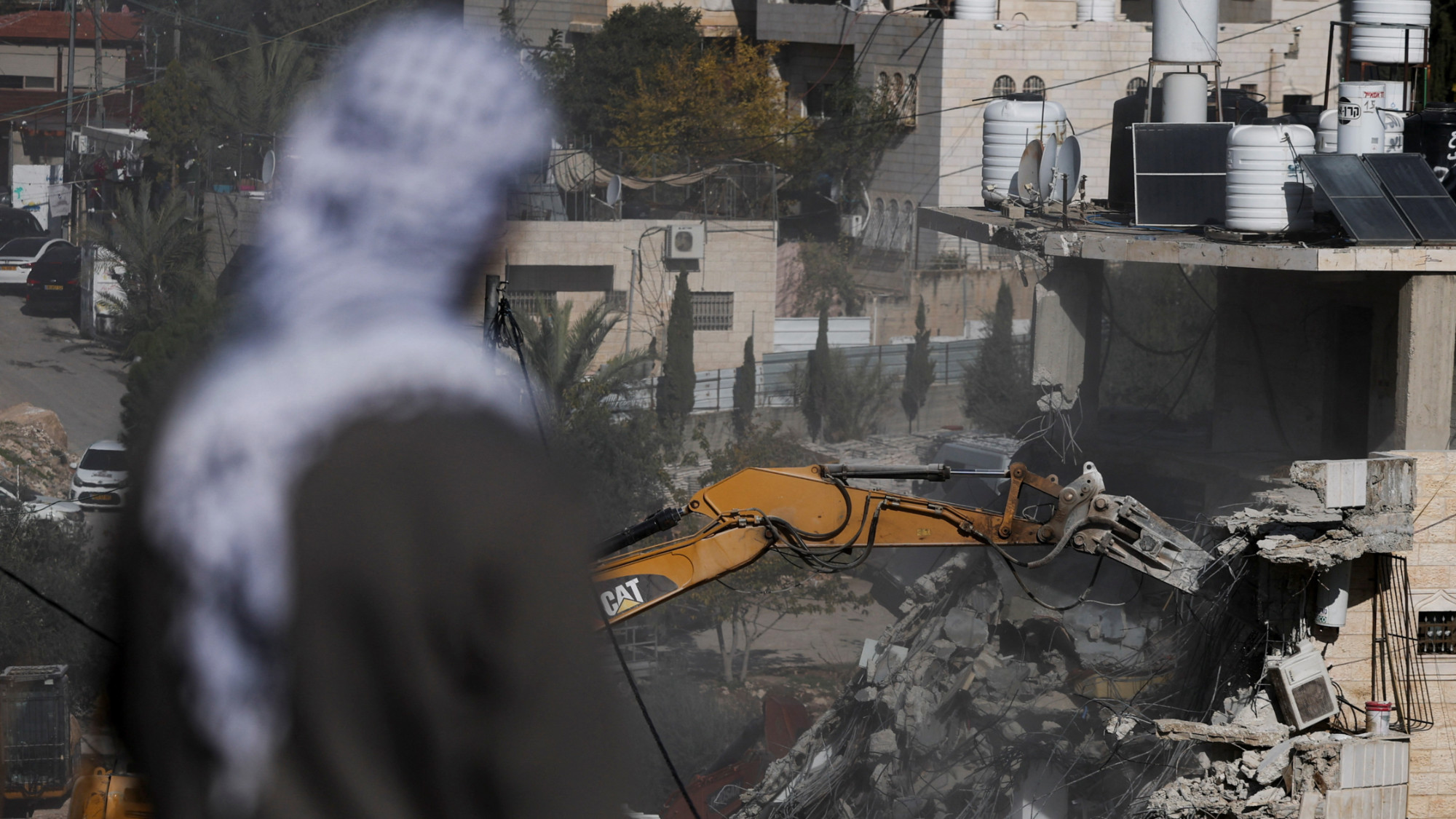
Standing amid the crumbled concrete and twisted metal that was once his family home in occupied East Jerusalem, Fakhri Abu Diab’s gaze falls on a small corner where he once shared a warm cup of tea with his mother. For the 55-year-old Palestinian father of five and grandfather of 16, the rubble is more than just destroyed property—it is the erasure of a lifetime of memories, of a childhood spent tending nearby land with his mother, and of the tight-knit community life his family built over generations.
Abu Diab’s home, located in the al-Bustan neighborhood of Silwan just south of Jerusalem’s Old City and Al-Aqsa Mosque, was demolished by Israeli authorities in early 2024. It is one of dozens of Palestinian homes leveled in the area this year as part of long-running plans to expand Israeli settler infrastructure and build religiously themed national parks. A veteran anti-occupation activist, Abu Diab shared his grief with Middle East Eye: “They demolished my childhood, my memories, and even the scent of my mother.”
Silwan, a Palestinian district hugging the southern walls of the Old City, has been a flashpoint for Israeli displacement efforts for decades. Alongside other high-risk Palestinian neighborhoods including Sheikh Jarrah to the north of the Old City and Ras al-Amoud to the southeast, Silwan has been the target of systematic state-backed campaigns to clear land for expanding Israeli settlements. For years, sustained Palestinian resistance and international scrutiny slowed the pace of demolitions and expulsions—but that shifted dramatically after the outbreak of the Gaza conflict in October 2023.
Since that time, Israeli authorities have sharply accelerated home demolitions and forced expulsions across occupied East Jerusalem, with al-Bustan emerging as one of the worst-affected zones. Across the entire city, an estimated 20,000 Palestinian-owned properties currently face active demolition orders. As Israeli forces have also stepped up violent crackdowns on local protest and dissent, Palestinian residents say they are increasingly isolated and defenseless, with little meaningful international support or global media attention focused on their plight. Local residents and rights activists warn that if the current pace of demolitions continues, entire Palestinian communities across Silwan, Sheikh Jarrah and Ras al-Amoud could be completely cleared. This demographic shift would leave Al-Aqsa Mosque surrounded entirely by Israeli settler compounds and biblical parks, cutting the holy site off from its surrounding Palestinian community.
Today, the scale of destruction in al-Bustan is visible along every narrow, winding street, with piles of rubble and empty flattened lots appearing every few meters. “I used to live here with my wife, my children, and my grandchildren. Ten of us lived in this house,” Abu Diab said. “The suffering is not only in the demolition of the house, but in the demolition of our past, our lives, and our future.”
The campaign to displace Palestinians from Silwan dates back to 1967, when Israel occupied East Jerusalem and immediately introduced laws that enabled the transfer of Palestinian property to Jewish ownership, while launching large-scale archaeological excavations in the district’s Wadi Hilweh neighborhood. Today, Silwan is home to roughly 55,000 Palestinians spread across 12 neighborhoods covering 6,000 dunams in the Kidron Valley and southern slopes of the Mount of Olives. For decades, three neighborhoods—Wadi Hilweh, al-Bustan and Batn al-Hawa—have borne the brunt of demolition and displacement campaigns, as powerful state-backed settler organizations push to clear the area to expand biblical tourist sites including the “City of David” and the planned “King’s Garden.” Since the early 2000s, more than 2,000 Palestinians across these three neighborhoods have faced expulsion threats, framed either as settler property claims or responses to alleged unpermitted construction. Between 2006 and 2023, Israeli authorities demolished an average of just one to two homes per year in Silwan, held back by ongoing Palestinian resistance and public pressure. But that pace has exploded since October 2023.
Local residents and researchers confirm that Israeli authorities have demolished 54 homes in al-Bustan alone—more than half of the approximately 115 total homes in the neighborhood—since the Gaza war began. Most of the remaining properties now face imminent demolition. The Jerusalem municipality has adopted increasingly aggressive tactics to push residents out: it gives homeowners strict deadlines to demolish their own homes, imposing heavy financial penalties for any delay, and has openly warned residents that crews will return weekly to carry out demolitions if residents refuse to comply. Aviv Tatarsky, a researcher with Israeli human rights organization Ir Amim, calls the current campaign a devastating escalation that marks a dangerous turning point for Palestinian communities in the area. “The people of Silwan defended their homes for over 20 years, and now they feel they can no longer stop what is happening,” Tatarsky told Middle East Eye. “It increasingly looks as though Israel will wipe out al-Bustan. We do not know how to stop it.”
The accelerated demolitions in al-Bustan are no accident, Tatarsky explains. The neighborhood, home to roughly 1,500 Palestinians, sits in a strategically critical position: it links the existing heavily guarded settler enclaves of Wadi Hilweh to the northwest and Batn al-Hawa to the east, where 2,500 Israeli settlers already reside. Clearing Palestinians from al-Bustan would create uninterrupted territorial continuity between these existing settler areas, and connect the Silwan settlements directly to West Jerusalem, which lies on the other side of the 1949 Green Line armistice boundary. The ultimate goal, Tatarsky says, is to normalize the erasure of Palestinian Silwan in Israeli public consciousness, rebranding the entire area as an extension of West Jerusalem tied exclusively to biblical Jewish history. “So al-Bustan is central to dramatically changing what Silwan is,” he added.
Israeli authorities have publicly justified the demolitions by citing building code violations, claiming most Palestinian homes in al-Bustan were constructed without permits. But critics note that permits are effectively impossible for Palestinian residents to obtain under Israeli zoning rules, and the law is enforced selectively against Palestinians while ignoring violations by settler groups. Israeli newspaper Haaretz has reported that demolition orders for multiple al-Bustan properties were suddenly dropped after the land was sold to settler organizations, even as those same groups have been allowed to build an events hall, synagogue, restaurant and visitor center without required permits. The clear end goal, researchers say, is to clear al-Bustan to make way for the “King’s Garden” biblical archaeological park, which will connect to the existing “City of David” tourist complex built on seized Palestinian land in Wadi Hilweh.
“There is no ownership dispute, no court ruling, and no justification for these executive measures other than transforming a built and inhabited neighbourhood into a park shaped by Zionist religious narratives,” said Ziad Ibhais, a Jerusalem affairs researcher. “That is what makes al-Bustan emblematic of the wider conduct of the occupation municipality in Jerusalem. These powers are being used against Palestinian landowners to impose nationalist-religious visions adopted by the [Israeli] occupation municipality on land over which it has neither sovereignty nor legal authority under international law.”
International law widely recognizes Israel’s occupation of East Jerusalem as illegal, holding that an occupying power cannot claim sovereignty over occupied territory or make permanent demographic changes to the area. Currently, more than 233,000 Israeli settlers reside in occupied East Jerusalem, alongside more than 500,000 in the occupied West Bank, according to the Israeli NGO Peace Now. All Israeli settlements are widely regarded as a violation of international law.
Two major settler organizations, Ateret Cohanim founded in 1978 and Elad founded in 1986, lead the displacement campaign in Silwan. Though formally registered as private non-profits, both groups operate with extensive backing from the Israeli state, receiving political support from the Israeli parliament, cooperating closely with Israeli police, and accessing direct government funding. “They are effectively an arm of the state,” Tatarsky noted.
Palestinian residents have exhausted all available channels to stop the demolitions, bringing multiple legal challenges to both settler claims and municipal plans, and even drafting two alternative community development plans that would preserve existing homes while upgrading neighborhood infrastructure. In a recent proposal, most residents agreed to an extremely strict set of planning concessions to save their neighborhood, in negotiations with the Jerusalem municipality. But the municipality pulled out of talks in February 2024 and announced it would move forward with full demolition plans.
The collapse of negotiations and lack of legal recourse has left residents in deep despair. Most families whose homes are demolished initially move in with extended relatives, while some manage to rent alternative housing elsewhere in Jerusalem—but skyrocketing housing prices put that option out of reach for many, forcing extended families to scatter across different regions. For Abu Diab, the damage goes far beyond housing insecurity: the displacement has destroyed the traditional Palestinian extended family social structure that sustained generations of residents. “Our way of life is to live together as extended families – with your children, your brothers, your cousins, all close to one another,” he said. “Now we are facing a housing crisis, a psychological crisis, and a health crisis. We have been completely scattered. They have destroyed our social fabric and our support system.”
Tatarsky argues the accelerated demolitions are only possible because of the current regional context: with the international community focused almost exclusively on the Gaza conflict and many Western powers having signaled implicit support for Israeli actions, the Israeli government feels it can act with complete impunity to push through its long-term demographic goals in East Jerusalem. For Abu Diab, the stakes extend far beyond al-Bustan, extending to the future of Jerusalem’s Palestinian community as a whole. “Al-Bustan matters because it is where we were born and raised, but also because it is the heart of Silwan,” he said. “If Israel takes control of Silwan, it will pave the way for greater control over Al-Aqsa Mosque. If there is no real action, the area will change completely, and there will be a new Nakba for the people of Jerusalem.”