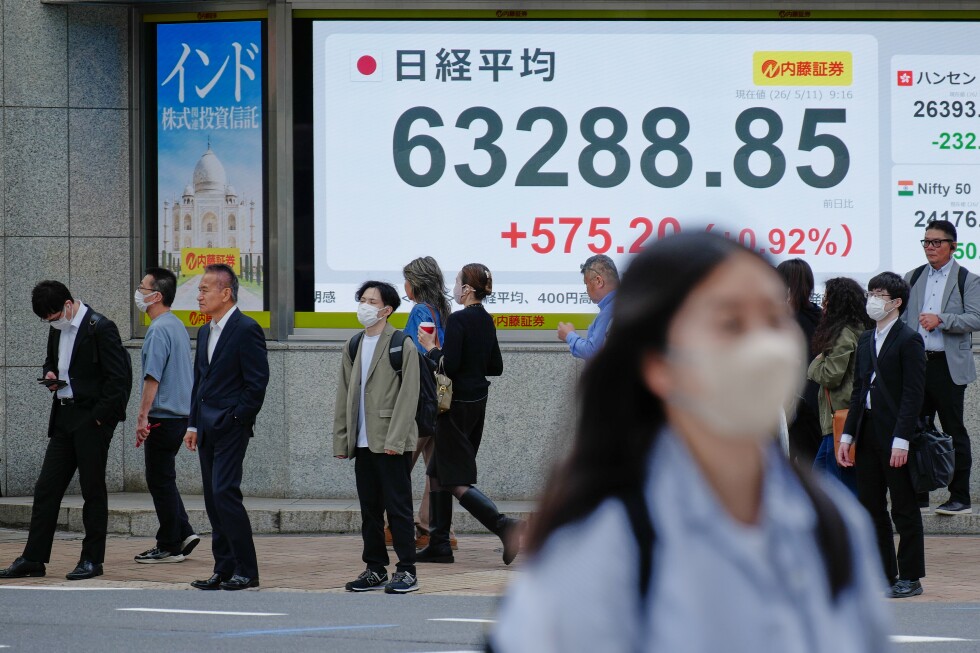
Global financial markets kicked off the new trading week with divergent performance across Asian equities on Monday, as a sudden breakdown in preliminary Iran peace talks sent crude oil prices soaring and erased some of the bullish momentum carried over from record-breaking closes on Wall Street.
Last Friday, U.S. equity markets notched a series of fresh all-time highs, driven by a stronger-than-forecast U.S. jobs report that eased investor fears about the economic fallout from the ongoing Iran conflict. The benchmark S&P 500 climbed 0.8% to 7,398.93, the tech-heavy Nasdaq composite gained 1.7% to hit a record 26,247.08, and the Dow Jones Industrial Average edged up less than 0.1% to close at 49,609.16. But that bullish momentum failed to translate to unified gains across Asian markets when trading opened Monday.
Japan’s benchmark Nikkei 225 index slipped 0.4% to end the session at 62,486.84, after briefly crossing the 63,300 threshold to hit an intraday record earlier in the day. The steepest drag on the index came from SoftBank Group, Japan’s one of the largest listed tech-focused investment holding, which dropped more than 5% by closing bell. In contrast, South Korea’s Kospi jumped 4.1% to 7,804.71, also notching an intraday all-time high, as chipmaking giants Samsung Electronics and SK Hynix led broad gains across the country’s technology sector.
Over the past month, both Japanese and South Korean markets have rallied significantly, driven by booming investor interest in artificial intelligence and technology-related assets, with the Nikkei 225 up more than 10% and the Kospi surging over 30% even amid the ongoing Iran conflict. Among other major Asian benchmarks, Hong Kong’s Hang Seng Index edged down 0.3% to 26,319.93, while mainland China’s Shanghai Composite Index gained 0.9% to 4,219.13, supported by newly released positive economic data: official figures showed China’s factory gate prices rose 2.8% year-on-year in April, the highest annual growth rate since 2022, and weekend export data came in well above analyst expectations. Australia’s S&P/ASX 200 lost 0.6%, Taiwan’s Taiex added 0.9%, and India’s Sensex fell 1.3% to close out Monday’s session.
The sharpest market movement of the day came in global energy markets, after U.S. President Donald Trump took to social media Sunday to reject Iran’s formal response to the latest U.S. proposal for ending the conflict, calling the terms “TOTALLY UNACCEPTABLE!”. International benchmark Brent crude jumped 4.2% to trade at $105.57 per barrel on Monday, while U.S. benchmark West Texas Intermediate crude rose 4.7% to settle at $99.89 a barrel. Before the Iran war began in late February, Brent traded at roughly $70 per barrel, marking a more than 50% increase amid ongoing geopolitical disruption.
Analysts point to continued disruption to global energy supply chains as a key factor keeping oil prices elevated. The Strait of Hormuz, a critical global chokepoint that carries roughly a fifth of the world’s daily oil and gas trade, remains largely closed, and the U.S. continues to enforce a sea blockade of major Iranian ports. Most analysts expect oil prices to remain elevated for an extended period as long as the conflict remains unresolved.
Upcoming diplomatic talks could still shift the trajectory of both energy and equity markets, however. President Trump is scheduled to meet with Chinese President Xi Jinping later this week, and the Iran conflict is expected to top the agenda. The U.S. has been pushing Beijing, which maintains close economic ties with Tehran, to leverage its influence to help reopen the Strait of Hormuz and move Iran toward a negotiated peace deal.
In a client note published Monday, ING commodities analysts Warren Patterson and Ewa Manthey noted that “there remains a glimmer of hope” that the upcoming talks could yield progress on de-escalation. “The hope is that China can use its influence over Iran to push it closer towards a peace deal,” they wrote. “Clearly, this is easier said than done.” The pair added that the global oil market remains “heavily headline-driven” as traders react to every new development in diplomatic efforts.
In currency markets, the U.S. dollar gained slightly against the Japanese yen, climbing to 157.14 yen from 156.61 yen in previous trading. The euro slipped modestly to $1.175, down from $1.1780, as investors shifted toward safe-haven assets amid rising geopolitical uncertainty. U.S. stock futures edged lower in early pre-market trading Monday, pointing to a potential mild pullback from last week’s record closes when U.S. markets open for the week.