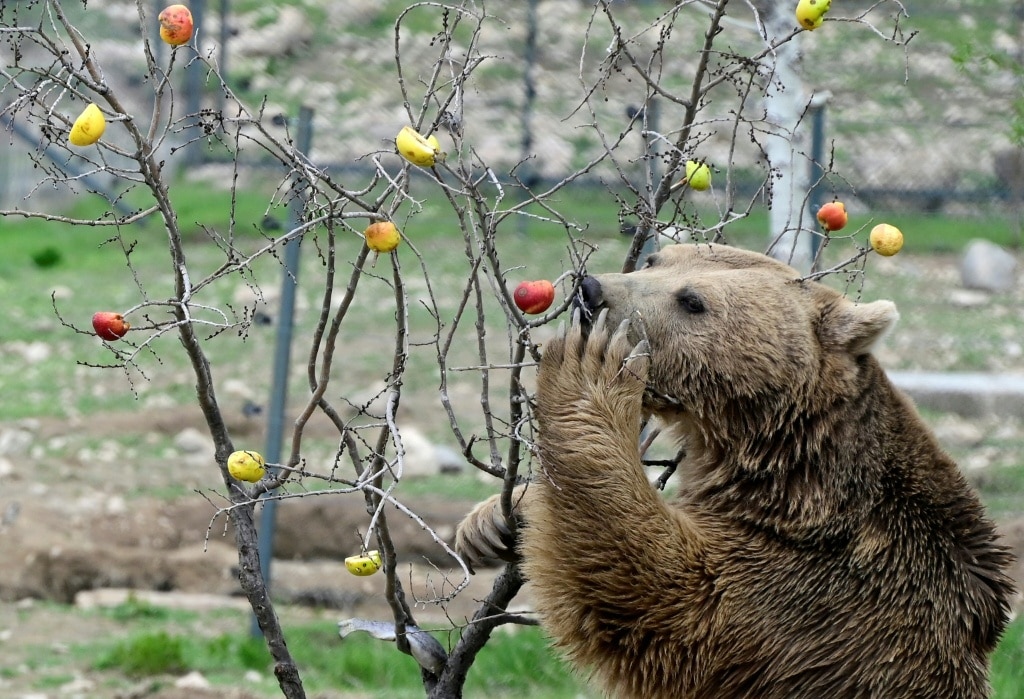
High in the misty Caucasus highlands of Armenia, three Syrian brown bears — Nairi, Aram, and their young cub Lola — now roam spacious, natural mountain enclosures, digging dens and foraging for fresh produce that mimics their wild diet. It is a stark contrast to the life they escaped just over a year ago: confined to a cramped three-meter cage in the heart of Armenia’s capital Yerevan, forced to sit in their own waste and fed a steady diet of sugary junk food. For these three bears, the rescue was a life-changing second chance, but conservationists warn that as many as 20 more bears remain trapped in inhumane captivity across the country, held as luxury status symbols by the nation’s wealthy elite.
The problem of captive wild predators in Armenia is not a new one, rooted in long-standing patterns of illegal wildlife trafficking and elite trophy collecting that have persisted since the collapse of the Soviet Union. Strategically positioned at the crossroads of Asia and Europe, Armenia has become a key transit and destination hub for illegal wildlife trafficking, according to global crime research. A 2023 Global Organized Crime Index report identifies persistent demand for rare and dangerous wild animals among the country’s ultra-wealthy, where owning large predators has become a display of power and social status.
High-profile cases have brought the issue into public view for decades. In 2015, an Armenian member of parliament drew widespread international criticism after publicly acknowledging he kept six endangered Siberian tigers on his private property. The crisis reached a breaking point in 2016, when a private zoo owned by a businessman in the northern city of Gyumri collapsed into insolvency, leaving dozens of caged animals — including lions and bears — to starve to death behind locked gates.
Today, the Frontline for the rescue mission is run by the Foundation for the Preservation of Wildlife and Cultural Assets (FPWC), a local non-profit that operates Armenia’s only dedicated bear rehabilitation center on a remote mountainside an hour outside Yerevan. Rescuers have documented appalling conditions across the country’s unregulated captive sites: bears are confined to tiny concrete cages at hotels, private backyards, and even roadside petrol stations, denied access to natural sunlight and the ability to hibernate, a critical biological need for the species. Many suffer from severe health issues caused by inappropriate diets, with widespread rotting teeth resulting from being fed cookies, sugary snacks, and even Coca-Cola by their untrained owners.
“It became clear the moment we mapped the scale of the crisis that we needed a dedicated rescue and rehabilitation space,” explained Tsovinar Hovhannisyan, FPWC’s conservation manager. The three bears Nairi, Aram and Lola were among the most high-profile rescue operations the group has ever completed. Their owner refused to hand the animals over, claiming the bears were “happy” living with him and accusing rescuers of threatening their lives. The team waited more than eight hours in heavy rain for a court order to enter the property and seize the animals. When they finally entered the cage, Hovhannisyan recalled, the space was caked in layers of filth and reeked of waste: “It was horrible, those are memories I will not forget.”
Now, with Armenia scheduled to host a major UN COP summit on biodiversity this October, the FPWC team is racing against time to rescue the remaining 20 known captive bears across the country. But the mission faces a critical barrier: the rehabilitation center is already at maximum capacity, home to 32 bears that can never be released back into the wild after a lifetime of captivity left them unable to hunt. The organization is currently fundraising to expand its enclosures to accommodate more rescued animals.
Wealthy owners often see large predators like bears as a bragging right, says FPWC communications manager Ani Poghosyan. “It is a status symbol for them. Something to brag about, especially owning a big predator — it is a way to prove their power and masculinity.” Even when owners initially agree to surrender the animals, many change their mind at the last minute, leaving rescuers empty-handed after traveling to remote properties.
For the bears that do make it to the center, the team works to recreate as wild an environment as possible. Enclosures are large enough for the animals to roam, dig their own winter dens, and climb trees, and staff provide live prey to encourage natural foraging behaviors. After years trapped in tiny cages, many newly rescued bears are initially afraid to explore the full space of their new enclosures, used to being confined to a few square meters. But over time, most begin to exhibit natural behaviors, including hibernation, something they were never able to do in their former cages.
While the bears will never be able to survive in the wild, the center’s mission is simple: give them the chance to live out the rest of their lives as bears. “They need to dig, they need to climb, they need to smell wild plants and feel free,” said Narine Piloyan, the center’s coordinator. “They need to feel that they are wild.”