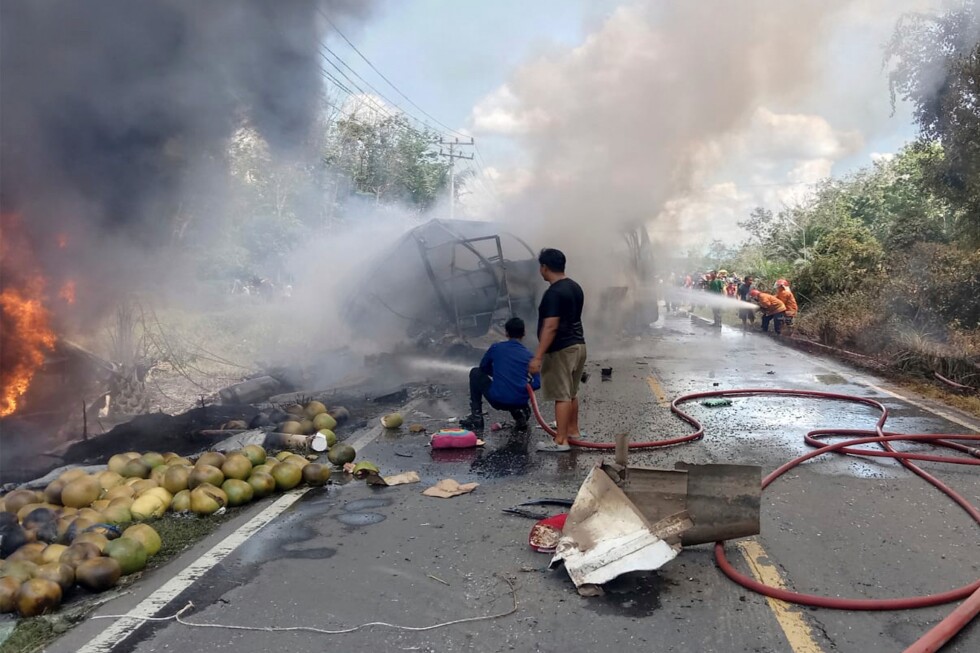
On a midday Wednesday in Indonesia’s Sumatra island, a devastating highway collision between a passenger intercity bus and a fuel tanker has left at least 16 people dead and four others injured, local disaster management officials confirmed. The crash unfolded on the Trans-Sumatra Highway in North Musi Rawas regency, South Sumatra province, as the bus traveling from Lubuklinggau city in South Sumatra to the neighboring city of Jambi carried roughly 20 passengers when it veered into the opposite lane and struck the oncoming tanker.
Preliminary investigations, shared by Mugono, a local disaster agency official who goes by a single name consistent with common Indonesian naming conventions, point to a sudden mechanical emergency just moments before impact. According to initial findings, the bus began emitting sparks, prompting the driver to swerve right off the bus’s original travel lane in an attempt to prevent an on-board fire. That evasive maneuver put the bus directly in the path of the speeding oncoming tanker, leaving the tanker’s driver no time to react to avoid a catastrophic head-on crash.
The extreme force of the collision ignited an intense blaze that quickly engulfed both the bus and the tanker, trapping dozens of people inside the burning vehicles. All fatalities died from burns sustained in the fire: the count of the dead includes the bus driver, 13 bus passengers, and the tanker’s driver and assistant. Among the four survivors pulled from the wreckage, three suffered critical burn injuries while the fourth sustained only minor harm, and all four were immediately transported to a nearby local health clinic for emergency care.
Authorities have not yet finalized the total death toll, as officials are still working to trace the bus’s full passenger manifest and cross-check data to confirm how many people were on board at the time of the crash. Visual documentation released by Indonesia’s National Search and Rescue Agency captures the scale of the disaster: thick black plumes of smoke billow into the sky above roaring orange flames as firefighters work to extinguish the blaze. After the fire was contained, the highway was left strewn with twisted, charred metal wreckage from both destroyed vehicles.
Rescue teams composed of disaster management personnel, local traffic police, and other first responders worked to evacuate victims and clear the crash site, but the operation faced significant complications. Multiple victims remained pinned under the wreckage, slowing recovery efforts and causing major traffic disruptions along the busy Trans-Sumatra Highway.
This fatal collision is far from an isolated incident: deadly road and transit accidents are an all-too-common occurrence across Indonesia, a pattern widely attributed to underfunded road infrastructure and widespread lax vehicle and driver safety standards. Just one week prior to this Sumatra crash, another deadly transit incident near Jakarta, the nation’s capital, claimed 15 lives. In that earlier crash, a long-distance passenger train hit a broken-down taxi stranded on the tracks, then collided with a stopped commuter train near a suburban station. All 15 fatalities were women, all seated in the commuter train’s women-only rear carriage.