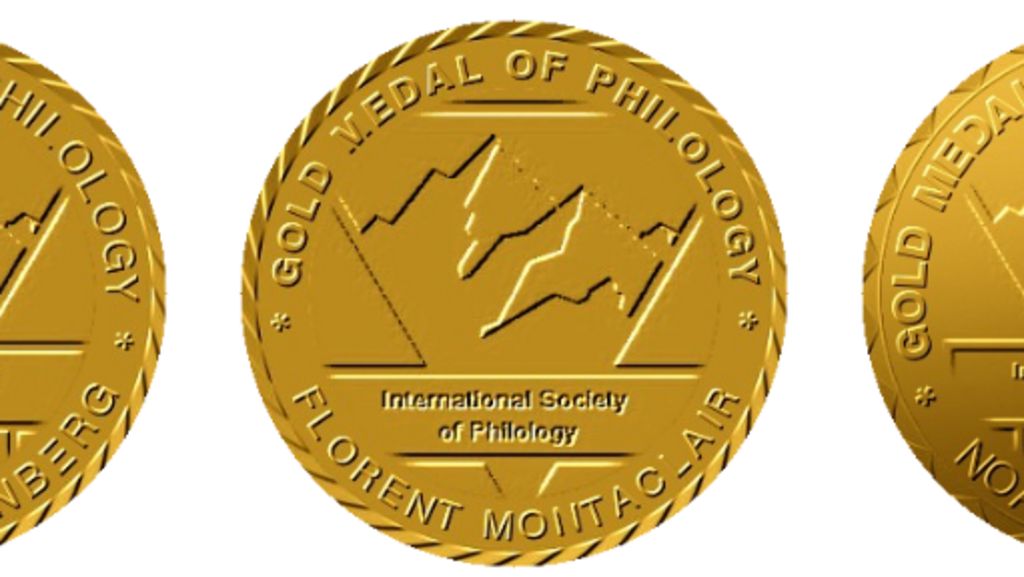
A years-long academic hoax involving a completely fabricated prestigious prize has shaken the French higher education system, leaving a veteran scholar under criminal investigation and suspended from his longtime position. Florent Montaclair, who taught for two decades at a university in Besançon, eastern France, stands accused of inventing a Nobel-equivalent award in philology — the study of language through historical texts — and then awarding the top honor to himself to bolster his professional credentials.
The elaborate scheme dates back to 2015, when local press in Besançon published a story touting Montaclair as a finalist for the Nobel Prize. By the end of that year, reports claimed he had claimed the Gold Medal of Philology, a fictional award tied to a fake governing body: the International Society of Philology. In June 2016, the self-styled laureate held an official award ceremony at France’s National Assembly in Paris, an event attended by sitting government ministers and even Nobel Prize winners. Later that same year, Montaclair expanded his hoax by presenting an honorary version of his fake medal to 88-year-old legendary American linguist and philosopher Noam Chomsky at a public event in Brussels, with footage of the ceremony still accessible online.
The fake International Society of Philology even maintains a public website that lists supposed prize winners dating all the way back to 1967, including iconic Italian writer Umberto Eco. Observers have since noted that the unpolished, low-budget design of the site should have raised red flags early on. Beyond the invented prize and society, Montaclair also added a falsified academic credential to his resume: a doctorate in French literature and grammar from an institution called the University of Philology and Education in Lewes, Delaware. Public records confirm no such university has ever existed.
The hoax went undetected in France for years, even after it was exposed in 2019. That year, after Montaclair named Romanian philologist Eugen Simion as the next Gold Medal recipient, the announcement triggered a firestorm of interest in Romania, where skeptical local journalists launched an investigation that quickly uncovered the entire fraud. Despite the revelation, the truth never spread to French academic circles, and Montaclair continued teaching at his university for several more years.
The full scope of the fraud only came to light last year, when Montaclair was scheduled to lead an academic panel on disinformation and fake news. A colleague, recalling the old rumors from Romania, flagged the issue to university leadership, prompting an official probe. When French law enforcement searched Montaclair’s home in February of this year, the scholar immediately acknowledged the hoax, investigators report. He told officers he had personally ordered the gold medal from a Paris-based jeweller just weeks before the 2016 ceremony, paying just €250 (approximately £215) for the award.
In his defense, Montaclair has denied the fraud amounts to criminal conduct. He claims the invented award was simply a failed attempt to establish a new academic distinction, not a con. He also notes that the local media that originally covered his “Nobel shortlist” nomination were responsible for framing the fake award as a Nobel-equivalent honor, rather than making that claim himself.
Investigators from the Besançon public prosecutor’s office are currently examining whether the fake credentials helped Montaclair advance his academic career or gain unfair professional or financial benefits. Prosecutor Paul-Edouard Lallois, who is leading the probe, called the affair “such an unlikely tale, it could be out of a film.” If investigators cannot prove the hoax resulted in illegal gain, prosecuting Montaclair on criminal charges may prove impossible. Currently, Montaclair has been suspended without restriction from his university position, pending the outcome of the ongoing investigation.