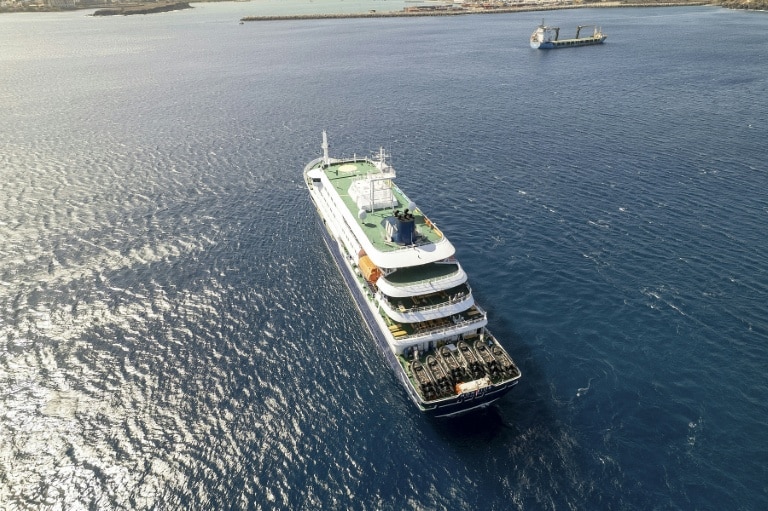
A polar expedition cruise ship, the MV Hondius, remains anchored off the coast of Cape Verde’s capital Praia this week, after the West African island nation barred the vessel from docking over a suspected hantavirus outbreak that has already claimed three lives. All 149 passengers and crew, representing 23 nationalities including citizens of Spain, the United Kingdom and the United States, are now under strict isolation aboard the ship as public health authorities across the globe coordinate a response.
The outbreak unfolded as the vessel completed a journey from Ushuaia, Argentina, bound for Cape Verde. Operator Oceanwide Expeditions confirmed in a statement Monday that two fatalities occurred on board the ship, while a third death was recorded after a passenger disembarked prior to the vessel reaching Cape Verde’s waters. One confirmed hantavirus case is currently receiving intensive care in Johannesburg, South Africa, and two additional people on the MV Hondius remain in need of urgent medical attention.
Hantavirus, a rare pathogen most often transmitted to humans from exposure to rodent excrement, has been formally confirmed in the patient treated in Johannesburg. However, Oceanwide Expeditions emphasized that investigators have not yet formally linked the three deaths to the virus, and no confirmation of hantavirus has been returned for the two symptomatic people still aboard the ship. “The exact cause and any possible connection are under investigation,” the company added.
Cape Verdean public health officials defended the decision to bar the ship from entering port, framing the move as a critical measure to protect the local population. Maria da Luz Lima, president of the country’s National Institute of Public Health, told public broadcaster RTC Sunday that the vessel would remain anchored offshore with no contact between passengers and the Cape Verdean public.
Despite the outbreak and fatalities, the World Health Organization (WHO) has moved to reassure the global public that the broader population risk remains low. “There is no need for panic or travel restrictions,” WHO Europe director Hans Kluge said in a public statement, noting that hantavirus infections are uncommon and almost always tied to contact with infected rodents. The agency added that while rare, person-to-person transmission is possible, and infections can lead to severe respiratory illness that requires close monitoring.
The UN health agency says it is acting with urgency to support the response effort, collaborating with all involved governments to coordinate medical care, evacuations, on-board investigations and public health risk assessments.
International authorities are now working to identify a new port of disembarkation to allow for full medical screening and care. The Canary Islands, a Spanish territory off the coast of Northwest Africa, is currently the leading candidate for the disembarkation. Dutch authorities have agreed to lead a coordinated effort to repatriate two symptomatic passengers to the Netherlands for treatment, though the operation is still pending approval from Cape Verdean local officials.
Dutch Foreign Ministry confirmed to AFP that it is actively exploring options for medical evacuation of the affected passengers, and will coordinate the full operation if it receives approval. Local doctors have already boarded the vessel to assess the health of the two symptomatic crew members, but Cape Verde has not granted permission to evacuate them to onshore medical facilities.