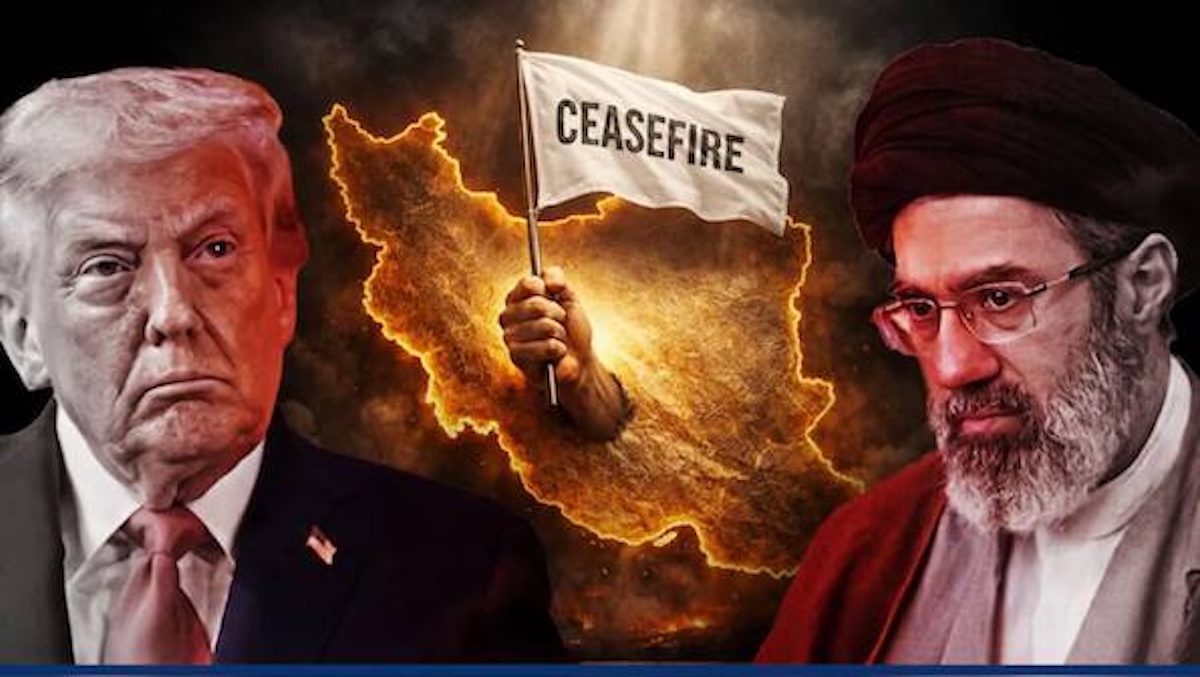
Tensions have escalated sharply in the Persian Gulf after former U.S. President Donald Trump unveiled a new U.S. military-led initiative to escort stranded commercial vessels through the closed Strait of Hormuz, a move Iranian officials have decried as a deliberate provocation designed to trigger conflict and justify expanded military aggression against the Islamic Republic.
The plan, branded “Project Freedom” and scheduled to launch Monday, was first announced by Trump on his social media platform Truth Social, and later confirmed by U.S. Central Command (CENTCOM). In his announcement, Trump framed the operation as a humanitarian gesture, stating his administration had notified nations with ships trapped in the key waterway that U.S. forces would safely guide vessels out of Iranian restricted areas so they could resume commercial activity. CENTCOM later released detailed force deployments for the mission: it will include guided-missile destroyers, more than 100 land and sea-based aircraft, multi-domain unmanned surveillance and combat systems, and a contingent of 15,000 active-duty service members. The command also noted the operation will be backed by a new cross-agency international coordination framework called the Maritime Freedom Construct, which pairs diplomatic outreach with military coordination to bolster maritime security in the strait.
Iran, which closed the strategically critical strait in response to the U.S.-Israeli war and the Trump administration’s naval blockade of the country, has issued a firm, unified rejection of the plan. An anonymous senior Iranian official told independent outlet Drop Site that Trump’s proposal is engineered to goad Iran into firing the first shot, creating a false pretext for military escalation. The official stressed that any commercial vessel attempting to traverse restricted transit routes without prior coordination with Iranian authorities will be intercepted immediately by Iranian security forces. Should U.S. military vessels intervene to disrupt these interceptions, the official added, Iran will respond with immediate, proportional force. The official also noted that U.S. warships are currently positioned far from the restricted transit corridor, meaning Iran would engage non-compliant commercial vessels long before they could reach American assets, accusing Trump of leveraging civilian ships as political pawns in his domestic and geopolitical agenda.
Ebrahim Azizi, chair of the Iranian Parliament’s national security commission, echoed the criticism, warning that any U.S. interference in Iran’s new maritime regulatory framework for the Strait of Hormuz constitutes a direct violation of the ceasefire brokered earlier this April. He dismissed Trump’s initiative outright, stating that the strategically vital waterway cannot be governed by “delusional posts” on social media.
The escalation over the strait comes as both sides navigate fragile, indirect negotiations to end the three-month-long war. Iranian Foreign Ministry spokesperson Esmaeil Baghaei confirmed Sunday that Tehran is currently reviewing the U.S. government’s response to Iran’s 14-point peace proposal, which was shared via Pakistani intermediation. Baghaei clarified that the proposal is exclusively focused on ending immediate hostilities, and that no nuclear-related negotiations are currently underway, despite repeated claims from Trump and U.S. Defense Secretary Pete Hegseth that halting Iran’s purported nuclear weapons program is a core U.S. war aim. Iran has long denied pursuing nuclear weapons, and U.S. intelligence assessments have repeatedly concluded Iran does not maintain an active nuclear weapons program as described by U.S. officials. Trump has already cast doubt on the proposal’s viability, writing on social media Saturday that he cannot imagine the plan being acceptable, claiming Iran has not paid a sufficient price for its actions over the past 47 years.
The exact details of the 14-point proposal remain publicly unconfirmed, but foreign policy analysts have offered preliminary assessments. Trita Parsi, executive vice president of the Quincy Institute for Responsible Statecraft, argued Sunday that the proposal represents an unstated push for a broad grand bargain to resolve the 47-year history of U.S.-Iran hostility, rather than just a temporary ceasefire. Parsi noted the plan implicitly calls for both sides to restrain their regional proxies, including Israel and Hezbollah, an approach that could align with Trump’s known negotiating instincts.
Domestically, the war has become a growing political liability for Trump. A new ABC News/Washington Post/Ipsos poll released Friday found that 61% of U.S. voters view Trump’s decision to launch the war as a mistake, while 66% disapprove of his handling of the conflict. The poll also recorded Trump’s lowest presidential approval rating to date.
Analysts have noted that Iran’s current strategy, which includes closing the Strait of Hormuz to disrupt global energy and commodity trade, aligns directly with a long-documented asymmetric warfare doctrine developed by Iran’s military leadership. Archival footage from the 1990s, recently shared online by journalist Séamus Malekafzali, featured late Iranian Revolutionary Guard Corps commander Hossein Salami — who was killed in a U.S.-Israeli strike last year — outlining the doctrine for IRGC staff. Salami argued that while direct conflict with the U.S. is possible, victory is achievable if Iran can shift fighting to terrain that neutralizes U.S. military advantages and exploits U.S. weaknesses. Geopolitical analysts paraphrase the doctrine as focusing on drawing out conflict to raise economic costs and fuel domestic political turmoil in the U.S., eroding its political will to sustain military engagement.
This approach is already visible in the closure of the Strait of Hormuz, a waterway that carries roughly 25% of global seaborne oil trade and one-third of the world’s seaborne fertilizer trade annually. Harrison Mann, a fellow with the advocacy group Win Without War, explained the dynamic during a Sunday CNN appearance, noting that Iran is able to inflict meaningful economic pain on the U.S. and its allies through this form of economic warfare, a pressure campaign that will be unsustainable for Trump over the long term.
Project Freedom has drawn immediate backing from hardline U.S. Iran war supporters, including South Carolina Senator Lindsey Graham, a leading Republican advocate for military action against Tehran. Graham said he fully endorses Trump’s decision, stating that while he supports a diplomatic end to the conflict, it is past time to reestablish freedom of navigation in the strait and respond forcefully to Iran if it continues what Graham described as “terrorizing the world.”