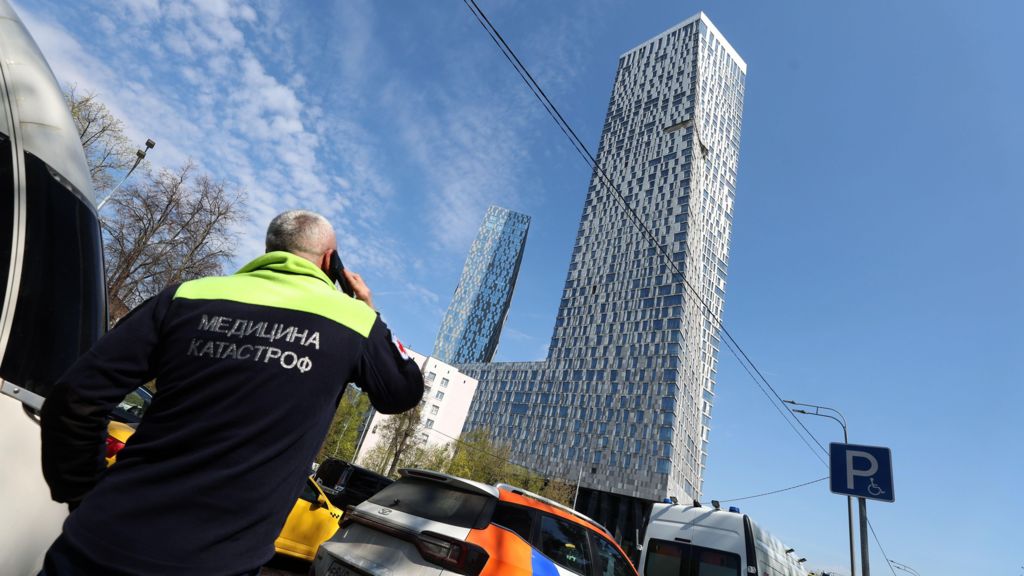
In the early hours of Monday, a Ukrainian drone struck a luxury residential high-rise in southwestern Moscow, leaving visible structural damage to an upper floor’s facade but causing no reported casualties, according to local officials. The incident marked the third straight night of drone attacks targeting the Russian capital, coming just days before Moscow hosts a significantly reduced 9 May parade honoring the Soviet Union’s defeat of Nazi Germany in World War II.
Unverified footage circulating across social media platforms captured first responders entering a heavily damaged apartment, where broken windows, scattered dust and piles of rubble filled the space. A second clip showed pieces of downed drone debris spread across the street at the base of the building. Moscow Mayor Sergei Sobyanin confirmed that two other drones targeting the city were successfully intercepted by Russian air defenses, and the capital’s two major international hubs, Vnukovo and Domodedovo, temporarily paused all flight operations overnight as a security precaution.
Across multiple Russian regions between Sunday and Monday, Russian defense officials reported that a total of 117 Ukrainian drones were shot down. Sixty of those drones were directed at the St. Petersburg region, in what regional governor Aleksandr Drodzhenko described as a large-scale coordinated attack.
The damaged residential building sits in one of Moscow’s most exclusive neighborhoods, located less than 10 kilometers from the Kremlin and Red Square, where the scaled-back 9 May victory parade will be held this Saturday. Since Russia launched its full-scale invasion of Ukraine in February 2022, Ukrainian drone strikes on Moscow have become a recurring occurrence. While drone warnings frequently force temporary airport shutdowns on the capital’s outskirts and disrupt commercial air traffic, most of central Moscow is shielded by Russia’s Pantsir-S surface-to-air missile systems, making successful strikes this close to the city center a relatively rare event.
Growing security anxiety ahead of the annual celebrations prompted the Kremlin to announce last week that it would scale back the traditional large-scale military parade on Red Square, citing an ongoing “terrorist threat” from Ukraine. This year will mark the first time since 2008 that no armored vehicles or long-range missile systems will be featured in the event. Separately, Russian state media reported Monday that multiple local mobile network providers have announced restrictions on mobile internet access across most of Moscow for the coming week, a measure framed as necessary for national security.
Ukrainian President Volodymyr Zelensky openly acknowledged the increasing drone pressure, commenting that the Kremlin’s decision to downsize the parade reveals Moscow’s fear that drones could reach Red Square itself. “This is telling… We need to keep up the pressure,” Zelensky said.
Over the course of the full-scale war, Ukraine has rapidly expanded its domestic production of long-range drones, which are now capable of striking targets hundreds of kilometers inside Russian territory. These unmanned systems regularly target Russian energy infrastructure and oil refineries across the country, with the strategic goal of cutting into Russia’s total oil output and reducing critical export revenue that funds Moscow’s war effort.
A day before the Moscow strike, Zelensky announced that Ukrainian forces had hit three Russian oil tankers, a cruise missile-carrying warship and a patrol boat in separate attacks on two Russian Black Sea ports. Zelensky noted that the targeted tankers were part of Russia’s so-called “shadow fleet” of vessels that Moscow uses to evade Western oil sanctions imposed after the 2022 full-scale invasion.
Despite the increasing Ukrainian drone strikes deep inside Russia, Moscow continues its daily campaign of deadly aerial attacks against Ukrainian population centers. On Monday, Ukrainian emergency officials confirmed that a Russian missile strike near the northeastern city of Kharkiv, located just kilometers from the Russian border, killed four civilians and left 18 others injured.