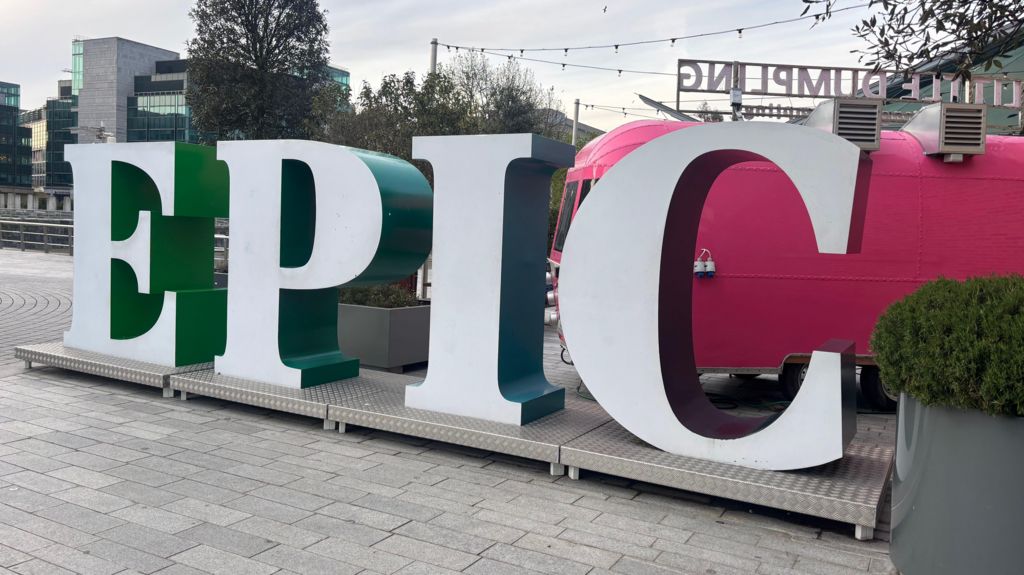
For more than two centuries, the iconic and deeply hurtful phrase “No Irish need apply” hung over job postings across 19th and 20th century Britain and the United States, a public marker of systemic anti-Irish discrimination. Today, that phrase gives its name to a groundbreaking new exhibition at Dublin’s EPIC, the world’s only fully digital immigration museum, which unpacks the long, complex, and often painful history of Irish emigration to England across 200 years.
Centuries of cross-channel migration have shaped demographic and cultural landscapes on both sides of the Irish Sea. Today, roughly 500,000 people born in Ireland call England home, with peak numbers hitting 900,000 in the 1970s, a legacy of the mass emigration wave that swept Ireland in the 1950s. Even before the catastrophic Great Famine of the 1840s, more than 400,000 Irish-born people already resided in England; that number grew by more than 50% in the decades following the famine, and migration has remained a constant feature of Irish life ever since. Since the formation of Northern Ireland, between 25% and 35% of all Irish emigrants heading to England have come from the region, many fleeing economic hardship or political violence during the decades of the Troubles.
The exhibition draws on rigorous new research from the London School of Economics (LSE) that offers unprecedented insight into the socioeconomic conditions of Irish communities in England across generations. To build their dataset, LSE researchers analyzed more than 500,000 surnames from the 1911 United Kingdom Census to identify Irish family lineages, tracking outcomes for both first-generation immigrants and descendants born in England to Irish heritage. They also cross-referenced this data with core civil records including census returns, birth certificates, marriage registrations, and death records to measure living standards via infant mortality rates and life expectancy.
The study’s findings paint a stark picture of long-term disadvantage. Across the 19th and 20th centuries, Irish households in England remained, on average, 50% poorer than their English neighbors, a gap that persisted across generations even as native English families gradually accumulated intergenerational wealth. Professor Neil Cummins, one of the lead researchers on the project, attributes this persistent gap to two key factors. First, for most of the modern era, migration from Ireland to England was overwhelmingly made up of working-class people with lower levels of formal education. Second, multiple lines of evidence — from anecdotal accounts to new LSE statistical analysis — confirm that systemic discrimination against Irish workers was widespread in English labor markets, creating what Cummins terms an “Irish penalty” that held back economic progress for generations.
Despite this documented history of exclusion and hardship, the exhibition also highlights the dramatic social and economic transformation of Irish communities in England over the past 30 years. Cummins, who has lived in England for two decades, notes that modern London is a radically different space for Irish people than it was half a century ago. “It is a multicultural place where being Irish confers many advantages,” he explains.
Curator Dr Christopher Kissane echoes that observation, noting that shifting economic tides in Ireland — particularly the growth of the Celtic Tiger economy from the 1990s onward — have transformed both migration patterns and outcomes. Mass emigration from Ireland is no longer the norm it once was, and the highly skilled Irish professionals who do move to England today are among the highest earning groups in the country, integrating seamlessly into English society. “The Irish have gone from being one of the poorest groups in England to one of the best off,” Kissane says.
That personal experience of modern Irish migration to England is reflected in the stories woven through the exhibition, including that of Holly McGlynn, head of communications at EPIC. McGlynn moved to London with her partner following the 2008 Irish financial recession, lived there for 16 years, and raised three children in the city. Recounting her experience to BBC Northern Ireland, she said: “I had a very positive experience living in London. People were always very excited to hear that I was Irish.” The Covid-19 pandemic prompted her to re-evaluate her priorities and return to Ireland, but her experience reflects how far conditions have shifted for Irish people in England from the dark days of “No Irish need apply” job ads.