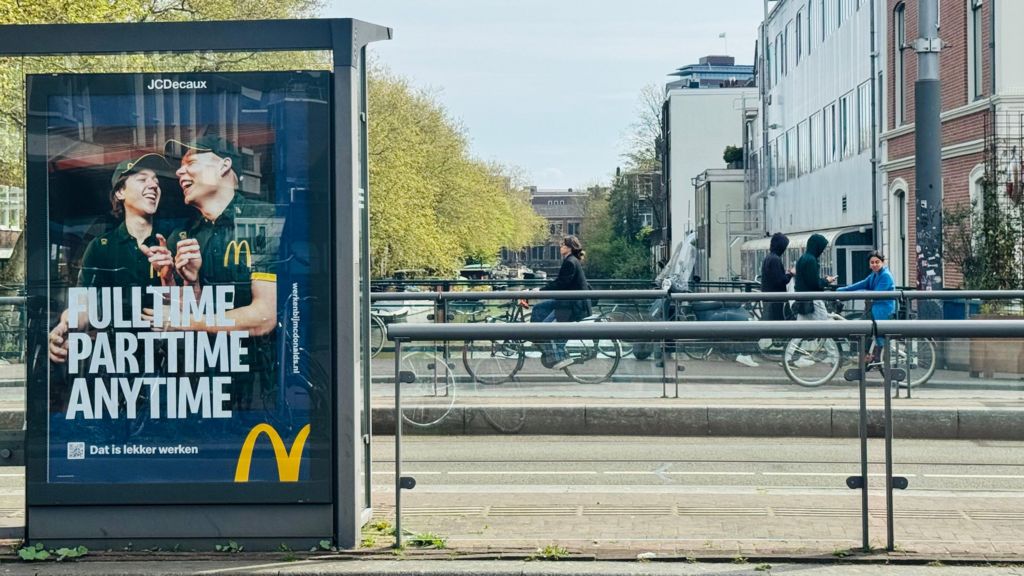
Amsterdam has cemented its place in climate policy history by becoming the world’s first capital city to implement a full public advertising ban on both meat and fossil fuel products. Since May 1, all promotions for beef burgers, petrol-powered cars, airline travel and other high-carbon goods have been removed from municipal billboards, tram shelters, and metro stations across the city.
At one of Amsterdam’s busiest downtown tram stops, positioned next to a lush roundabout blooming with bright yellow daffodils and iconic orange Dutch tulips, the transformation of the city’s outdoor advertising landscape is impossible to miss. Where ads for chicken nuggets, gas-powered SUVs and low-cost international flights dominated public display space just last week, posters now promote Amsterdam’s world-famous Rijksmuseum and upcoming local piano concerts.
City policymakers explain the new rule is designed to align the capital’s public spaces with the municipal government’s ambitious environmental goals, which target full carbon neutrality by 2050 and a 50% reduction in local meat consumption over the same timeline. “The climate crisis is incredibly urgent,” noted Anneke Veenhoff of Amsterdam’s GreenLeft Party. “If we claim to be leaders in climate action, but then rent out our public advertising space to products that directly undermine those targets, what message does that send? Most residents cannot understand why the city would profit from promoting products our own policies actively work against.”
Anke Bakker, group leader of the animal rights-focused Party for the Animals in Amsterdam and the politician who spearheaded the new restrictions, has pushed back against criticism that the ban represents overreaching “nanny state” governance. “Every person is still free to make their own purchasing choices,” Bakker explained. “What we are doing is stopping large corporations from constantly pushing these products on the public. In fact, this gives people more freedom to make uncoerced choices for themselves.” Removing constant visual prompts for high-carbon products, she added, both cuts down on impulsive buying and redefines cheap meat and fossil-fuel heavy travel as no longer desirable, aspirational lifestyle options.
In market terms, meat advertising makes up only a tiny fraction of Amsterdam’s outdoor ad industry, accounting for roughly 0.1% of total outdoor ad spend, while fossil fuel-related promotions make up around 4%. Clothing brands, film promotions and mobile phone ads currently dominate the city’s public display space. But the policy carries major symbolic and political weight: grouping meat with air travel, cruises and fossil-fuel cars reframes meat consumption from a purely private dietary decision to a pressing public climate issue.
Unsurprisingly, industry groups have pushed back against the new rule. The Dutch Meat Association, which represents the country’s meat producers, has called the ban “an undesirable way to influence consumer behaviour,” arguing that meat “delivers essential nutrients and should remain visible and accessible to consumers.” The Dutch Association of Travel Agents and Tour Operators has also criticized the ban on air travel advertising as a disproportionate restriction on businesses’ commercial freedom.
For climate and animal welfare activists, however, the ban represents a landmark shift that aims to create what they call a “tobacco moment” for high-carbon food. Environmental lawyer Hannah Prins, whose organization Advocates for the Future collaborated with campaign group Fossil-Free Advertising on the push for the ban, draws a parallel to the widespread shift in public attitudes toward tobacco advertising over the past decades. “Looking back at old photos, you see legendary Dutch footballer Johan Cruyff in tobacco ads – that used to be completely normal,” Prins pointed out. “Cruyff died of lung cancer, and today the idea of allowing cigarette ads in public spaces feels absurd. What we accept as normal in our public spaces shapes what we accept as normal in our society. I don’t think it’s normal to have advertisements for slaughtered animals on public billboards, and it’s good that this is changing.”
Amsterdam’s move is not without precedent. In 2022, the nearby Dutch city of Haarlem, just 18 kilometers west of the capital, became the first city in the world to announce a broad ban on most meat advertising in public spaces, which took full effect in 2024 alongside its own ban on fossil fuel ads. Utrecht and Nijmegen have since introduced similar restrictions on municipal meat advertising – with Nijmegen extending its ban to include dairy as well, on top of existing fossil fuel, petrol car and air travel ad prohibitions.
Globally, dozens of cities have already implemented or are moving toward bans on fossil fuel advertising, including Edinburgh, Sheffield, Stockholm and Florence. France has even put a nationwide fossil fuel ad ban in place. Campaigners now hope Amsterdam’s approach of linking meat and fossil fuel promotion as interconnected climate issues will serve as a legal and political blueprint for other cities around the world to follow.
Still, the new rule leaves a major gap: while meat and fossil fuel ads have disappeared from Amsterdam’s tram stops and billboards, the same promotional offers still appear regularly on consumers’ social media feeds, and most pedestrians spend much of their time waiting for transit staring at their phone screens anyway. This has led to questions: if municipal bans only cover public outdoor spaces and leave digital advertising untouched, how much real impact can they have on consumer habits, or are they just symbolic virtue-signaling?
To date, there is no direct empirical evidence that removing meat advertising from public spaces shifts whole societies toward more plant-based eating patterns. But some public health researchers are cautiously optimistic about the policy’s potential long-term impact. Joreintje Mackenbach, an epidemiology professor at Amsterdam University Medical Center’s Department of Epidemiology and Data Science, calls Amsterdam’s new ban “a fantastic natural experiment” to study the impact of advertising on social norms and consumption. “When we see fast food ads everywhere, it normalizes the behavior of frequent fast consumption,” Mackenbach explained. “If we remove those environmental cues from our shared public spaces, that will inevitably change how people perceive these products and shift social norms.” She pointed to prior research showing London Underground’s 2009 ban on junk food advertising led to a measurable drop in junk food purchases across the U.K. capital.
Prins, for her part, argues the ban will open up opportunities for Amsterdam’s small local businesses. “All the things we love most about this city – neighborhood festivals, local artisanal cheese, the corner flower shop – those don’t need big national advertising campaigns,” she said, standing along the banks of a central Amsterdam canal. “They grow through word of mouth and people walking past them every day. I think local businesses will actually thrive with more public advertising space available. And I hope this makes big polluting companies stop and think, and rethink the products they sell. That’s how change starts.”