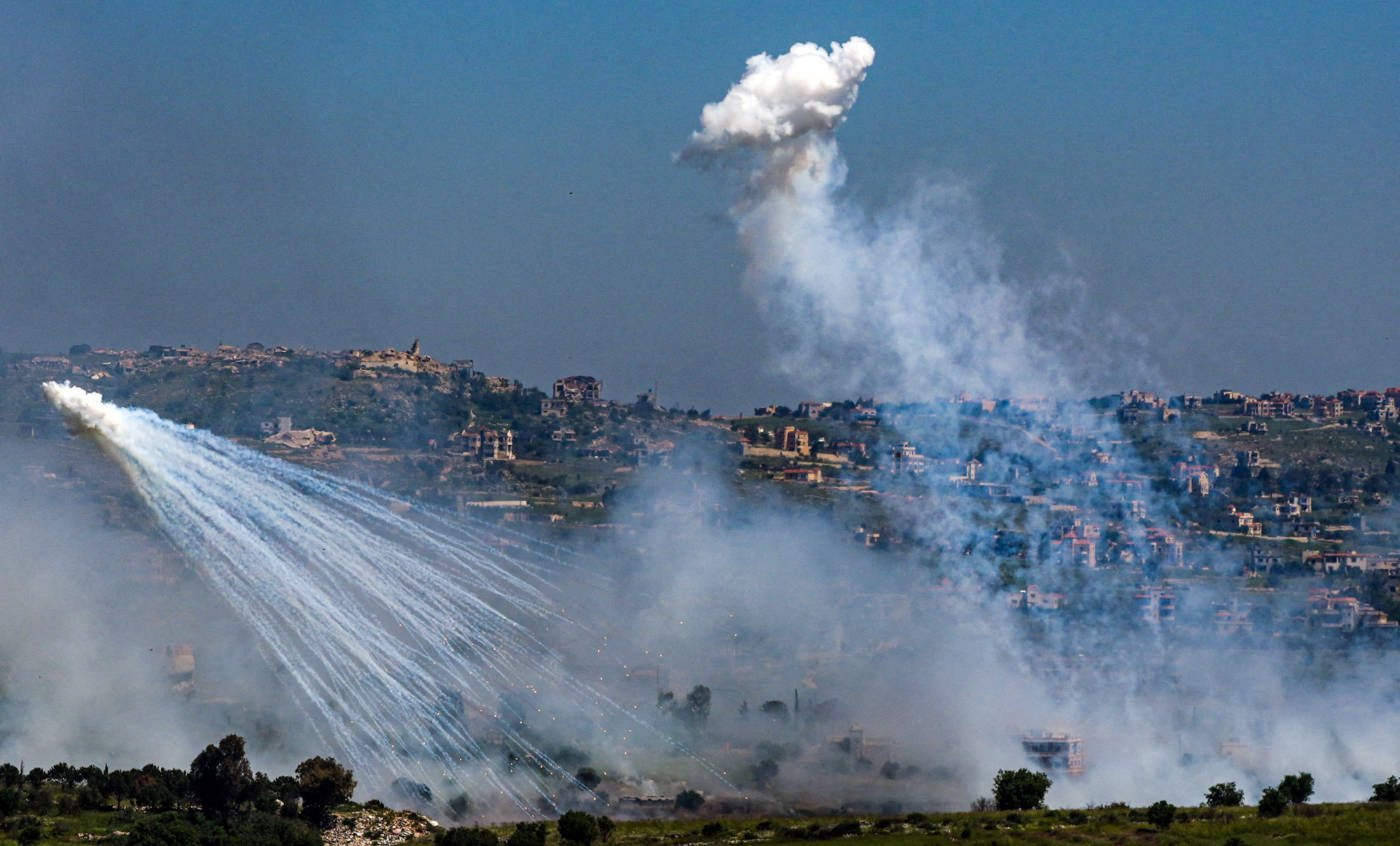
Fresh accusations have emerged this week accusing the Israeli military of deploying white phosphorus artillery shells in populated areas of southern Lebanon, renewing long-simmering global debate over the controversial weapon’s legality and devastating humanitarian impact. Human rights monitors warn that using the incendiary munition near civilian communities qualifies as an indiscriminate attack that violates core standards of international humanitarian law.
To contextualize the latest allegations, Middle East Eye has broken down the chemical properties, harmful effects, historical military use, and regulatory gaps that have allowed white phosphorus to remain a persistent weapon of war across decades of conflict.
### What is white phosphorus, and how is it used?
Chemically derived from rock phosphate, white phosphorus is a pale, waxy solid with a unique volatile trait: it is pyrophoric, meaning it spontaneously ignites on contact with air or water, producing a thick, opaque white smoke. First commercialized in the 19th century for match production, the compound was quickly linked to a fatal occupational illness nicknamed “phossy jaw”, which caused bone necrosis and death among factory workers exposed to its fumes.
Today, civilian applications of white phosphorus are limited to agricultural inputs and detergent chemical additives, with use declining amid growing environmental concerns over its toxicity. On the battlefield, however, militaries defend its use by arguing that its smoke screen capabilities effectively conceal troop movements and help identify targets for artillery and air strikes. But the same chemical properties that make it useful for battlefield masking also make it a devastating incendiary weapon, often deployed to flush enemy combatants out of enclosed spaces like tunnels or disperse crowds.
### The devastating human and environmental cost of white phosphorus exposure
The harm caused by white phosphorus extends far beyond immediate battlefield injuries. In enclosed spaces, the compound quickly consumes oxygen, causing rapid suffocation. For those exposed via inhalation, symptoms include acute respiratory tract burning, nausea, fluid buildup in the lungs, and extreme, unquenchable thirst.
White phosphorus’s most horrifying trait is its stickiness: it clings tenaciously to skin and clothing, burning at temperatures up to 2,500°C that can sear straight through flesh to reach the bone, leaving survivors with excruciating, permanently disfiguring injuries. Even when it appears extinguished, the compound can reignite hours after exposure. If it enters the bloodstream, it poisons vital organs, often leading to death. For medical providers, treating white phosphorus exposure is uniquely dangerous and challenging, as the compound continues to burn even after extraction from wounds, and there is no antidote for its systemic toxicity.
Beyond human harm, white phosphorus’s extreme combustibility destroys civilian infrastructure and renders agricultural land infertile for years after use, leaving long-term damage to local communities.
Bonnie Docherty, a leading expert on conventional weapons at Harvard Law School’s International Human Rights Clinic and senior arms adviser for Human Rights Watch, explains that when white phosphorus is detonated over populated areas, it cannot distinguish between civilian non-combatants and military targets. “When white phosphorus is airburst over a populated area, it spreads flaming wedges of the substance over a wide area and cannot distinguish between civilians and soldiers or between civilian objects and military targets,” she told Middle East Eye. “That use is inherently indiscriminate and violates general international humanitarian law, or the laws of war.”
### A long history of military use across global conflicts
White phosphorus has been a staple of global military arsenals for more than a century. It saw widespread use among Allied forces during World War I, and the British Royal Air Force deployed it against Kurdish villages during the 1920 Iraqi revolt. U.S. forces used white phosphorus grenades during the 1944 Normandy campaign, and by the Vietnam War, troops nicknamed the munition “Willie Pete,” using it to flush Viet Cong combatants out of tunnel networks and ignite napalm strikes.
Subsequent conflicts from the 1982 Falklands War to the 1990s Chechen Wars saw the weapon deployed by British and Russian forces respectively. During the 2020 Second Nagorno-Karabakh War, both Armenia and Azerbaijan accused one another of using white phosphorus as an incendiary weapon, with investigators from the Atlantic Council later confirming its presence on the battlefield. Similar allegations have been leveled against Russian forces following their 2022 full-scale invasion of Ukraine.
Israel has a well-documented history of deploying white phosphorus across its military campaigns in the occupied Palestinian territories and Lebanon. As recently as March 2025, the Israeli military fired white phosphorus over residential areas in the southern Lebanese village of Yohmor during cross-border strikes. Since October 2023, leading human rights organizations including Amnesty International and Human Rights Watch have documented repeated Israeli use of the munition over populated areas of southern Lebanon and the Gaza Strip, where Israel’s ongoing military campaign has killed more than 72,000 Palestinians to date. Israel has repeatedly denied these accusations.
Israeli officials have a history of acknowledging past use: the Israeli military publicly confirmed it deployed white phosphorus against Hezbollah targets during the 2006 Lebanon invasion, and it acknowledged firing roughly 200 white phosphorus munitions into populated Gaza during the 2008-2009 Gaza war, an operation that Human Rights Watch confirmed killed dozens of civilians. In 2013, Israel’s High Court of Justice rejected a public petition seeking to ban the Israeli military from using white phosphorus in populated civilian areas.
The munition has also been deployed across other recent Middle Eastern conflicts: during the Syrian civil war and the U.S.-led campaign against the Islamic State, U.S.-coalition forces, the Turkish military, and the Syrian government were all accused of using white phosphorus. In 2005, the U.S. Pentagon publicly admitted it used white phosphorus as an incendiary weapon during the 2004 siege of Fallujah, Iraq. Human Rights Watch also accused the U.S.-led coalition of using white phosphorus in Afghanistan in 2009, while Washington countered that the Taliban had used the munition 44 times that same year.
### The regulatory gap that lets white phosphorus evade a global ban
Despite its well-documented devastating humanitarian impact, white phosphorus is not explicitly banned under international law. The 1980 Convention on Conventional Weapons (CCW) Protocol III restricts the use of incendiary weapons, defining them as weapons “primarily designed” to start fires and cause burn injuries, and places heavy restrictions on weapons like napalm and flamethrowers.
But the protocol’s definition deliberately excludes multi-purpose munitions like white phosphorus, which are officially classified as smokescreen and target-marking tools rather than primary incendiary weapons. This creates what Docherty calls a “major loophole in the protocol.” “Civilians suffer the same excruciating injuries from weapons that produce heat and flame regardless of what those weapons were designed to do,” she said. “Therefore, the definition should instead be based on the effects of the weapons.”
A second loophole in Protocol III imposes stricter bans on air-dropped incendiary weapons than ground-launched variants, meaning even if white phosphorus were classified as an incendiary, most of the munitions recently used by Israel in southern Lebanon—fired from ground-based artillery—would not fall under the protocol’s prohibitions.
Reforms to close these regulatory gaps, supported by the International Committee of the Red Cross and a group of member states, have repeatedly failed due to the CCW’s governance rules, which allow any single signatory to veto amendments. Russia has repeatedly used this power to block reform efforts. To date, 117 states have ratified Protocol III, including the U.S., China, India, Russia, and most European nations, but many major military powers in the Middle East and North Africa—including Israel, Iran, Turkey, Syria, and Egypt—are not signatories, and are therefore not bound by the protocol’s rules. Even non-signatories are required to follow core principles of international humanitarian law requiring distinction between civilians and combatants and the prohibition of unnecessary suffering, but these rules are rarely enforced.
### Tracing the global supply chain of Israeli white phosphorus
Public information about the white phosphorus munitions supply chain remains limited, but investigations have traced most of the munitions used by Israel in recent years back to U.S. and Israeli suppliers. In October 2023, Amnesty International investigators identified U.S. Department of Defense identification codes on white phosphorus artillery shells recovered from Israeli strikes in Gaza. The shells are fired from U.S.-designed M109 155mm howitzers, currently manufactured by British multinational defense firm BAE Systems.
A December 2023 Washington Post analysis of shell fragments recovered from the Lebanese village of Deira matched production codes to U.S. military stockpiles, indicating the munitions were manufactured at plants in Louisiana and Arkansas in 1989 and 1992. The U.S. Army’s Pine Bluff Arsenal in Arkansas, a key domestic hub for white phosphorus munitions production, was identified by both Amnesty and the Washington Post as the most likely origin of the Israeli munitions. In 2005, U.S. defense contractor Teledyne Brown Engineering was awarded a $10 million contract to upgrade the arsenal’s white phosphorus production facility.
Other investigations have named Israeli firm ICL Group, formerly Israel Chemicals Ltd, as a major global supplier of white phosphorus for military use, including supplying raw material to the Pine Bluff Arsenal. Former U.S. agrochemical firm Monsanto, acquired by Germany’s Bayer in 2018, has also been linked to white phosphorus military supply chains in academic reporting. In October 2023, then-U.S. Deputy Pentagon Press Secretary Sabrina Singh declined to comment on accusations of U.S. supply of white phosphorus to Israel, saying only that “I just don’t have a comment on that. And I think, I think the spokesperson from the IDF said that they were not using that. So I just, I don’t have any further comment on that.”