Two months have passed since the outbreak of conflict between Iran and other regional actors, and the Strait of Hormuz, the world’s most critical energy trade chokepoint, remains largely closed to commercial vessel traffic. Shipping volumes have plummeted to a tiny fraction of pre-war levels, and a chaotic sequence of temporary ceasefires, shifting blockades and repeated re-closures since February 28 have done nothing to restore confidence among commercial tanker crews and shipping operators.
For decades, global energy analysts and policymakers have recognized the strait as a linchpin of international commodity trade. On a typical day before the conflict, it accommodated around 20 million barrels of crude oil and refined petroleum products, alongside roughly 20% of the world’s total liquefied natural gas (LNG) exports. It also carries one-third of global helium supplies and a comparable share of urea, the key input for global agricultural fertilizer production.
Plans to diversify trade routes away from the strait have been in development for decades, but the ongoing conflict has put these alternative bypass systems under unprecedented stress. Currently, the existing alternative infrastructure is delivering between 3.5 million and 5.5 million barrels of crude oil per day, matching the rough performance projections that planners outlined decades ago. Even so, this output falls drastically short of compensating for the lost capacity from the closed strait.
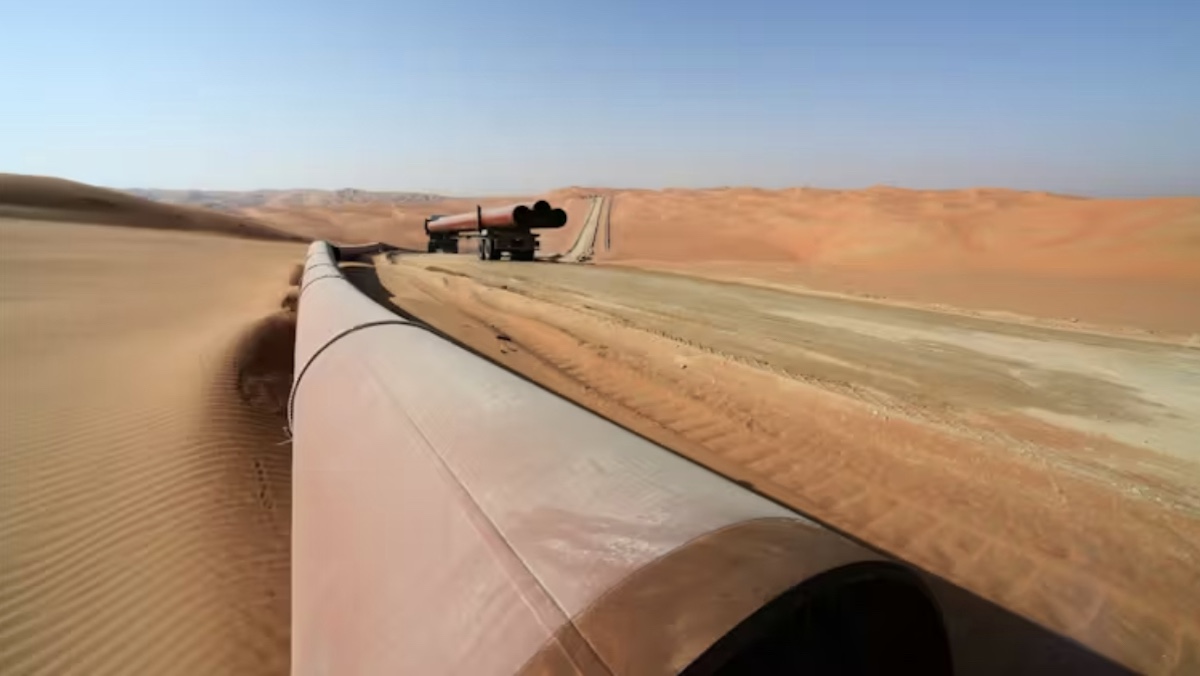
The single most critical bypass pipeline in operation today is Saudi Arabia’s East-West Pipeline, also widely known as Petroline. Originally constructed in the 1980s during the original Tanker War, when Iran and Iraq targeted commercial shipping across the Persian Gulf amid their broader armed conflict, the pipeline was upgraded in 2019 to an emergency maximum capacity of 7 million barrels per day. However, the oil loading terminals at Yanbu, Saudi Arabia’s Red Sea coastal hub, were never engineered to handle such high volumes at speed, and independent analysts tracking tanker movements report that current throughput is far below the theoretical maximum capacity.
From Yanbu, most crude bound for European markets must then pass through Egypt’s Sumed Pipeline, which has a total capacity of just 2.5 million barrels per day. While flows through Sumed have surged 150% since the conflict began, its limited size remains a hard cap on additional energy supplies reaching Europe.
Iran has been acutely aware of Petroline’s geostrategic importance to global energy markets, and has targeted the infrastructure accordingly. In April, an Iranian drone strike on one of the pipeline’s key pumping stations took 700,000 barrels per day of capacity offline. State-owned operator Saudi Aramco managed to restore full operations within three days, a timeline that has reassured markets, but the attack itself underscores the persistent vulnerability of even the most robust bypass infrastructure.
The second major component of the Gulf’s bypass network runs through the United Arab Emirates: the Abu Dhabi Crude Oil Pipeline (Adcop), which connects the Habshan oil fields to Fujairah on the UAE’s Gulf of Oman coast, making it the only major bypass route that exits the Persian Gulf directly into the Indian Ocean. Adcop has a maximum capacity of just under 2 million barrels per day, but it has faced the same security threats as Petroline. Iranian drone strikes targeting Fujairah on March 3, 14 and 16 ignited storage tank fires and forced a full suspension of loading operations. While Adcop does offer limited route diversification for UAE oil exports, it does not resolve the core vulnerability of bypass infrastructure to targeted attacks.
For other major Gulf energy producers, the situation is far more bleak. Before the conflict, Iraq exported 3.4 million barrels of crude per day, almost all of which moved through the southern port of Basra and across the Strait of Hormuz. Iraq’s only alternative route is a northern pipeline connecting the Kirkuk oil fields to the Turkish Mediterranean port of Ceyhan. The pipeline was only reopened in September 2025 following a two-and-a-half-year shutdown, and flows were only ramped up to 250,000 barrels per day this March – a volume that is negligible compared to the export capacity Iraq has lost since the strait closed.
Kuwait faces an even more critical crisis. Pre-war crude exports hit roughly 2 million barrels per day, and every barrel transited the Strait of Hormuz. The country has no operational pipeline alternative. State-owned Kuwait Petroleum Corporation declared force majeure in March, a legal move that allows it to suspend contractual delivery obligations, and extended that declaration on April 20. The company has confirmed it cannot meet delivery commitments even if the strait reopens immediately, noting that restoring damaged production infrastructure and ramping output back up will take months of work.
Qatar’s vulnerability follows a different pattern. The country’s pre-war crude exports were far smaller than its Gulf neighbors, at around 600,000 barrels per day, all of which transited the strait. But Qatar’s global importance lies in natural gas: its 77 million tonne per year LNG export complex at Ras Laffan is the largest in the world, accounting for roughly 19% of global LNG trade. There is no alternative route for this LNG, which must all pass through the Strait of Hormuz to reach global markets.
Even Iran itself has been unable to effectively use its own purpose-built Hormuz bypass. The country completed a 1,000-kilometer pipeline from Goreh at the top of the Persian Gulf to a new export terminal at Jask on the Gulf of Oman, designed to carry 1 million barrels per day. But years of international sanctions and unfinished terminal construction have left actual throughput at a tiny fraction of design capacity. The U.S. Energy Information Administration estimated that in summer 2024, less than 70,000 barrels per day were flowing through the pipeline, and all loadings stopped that September. Data from global shipping analytics firm Kpler shows only one tanker has loaded crude at Jask since the conflict began, carrying roughly 2 million barrels of oil total.
Calls for new pipeline construction to bypass Hormuz, which have grown louder since the conflict began, are understandable on their face. But building new infrastructure is not a viable near-term solution. Replacing the strait’s capacity with a new network of pipelines would cost hundreds of billions of dollars and require at least a decade of construction. Even once complete, any new pipelines and terminals built at Yanbu, Fujairah or other locations would face the exact same vulnerability to drone strikes that existing bypass infrastructure faces today.