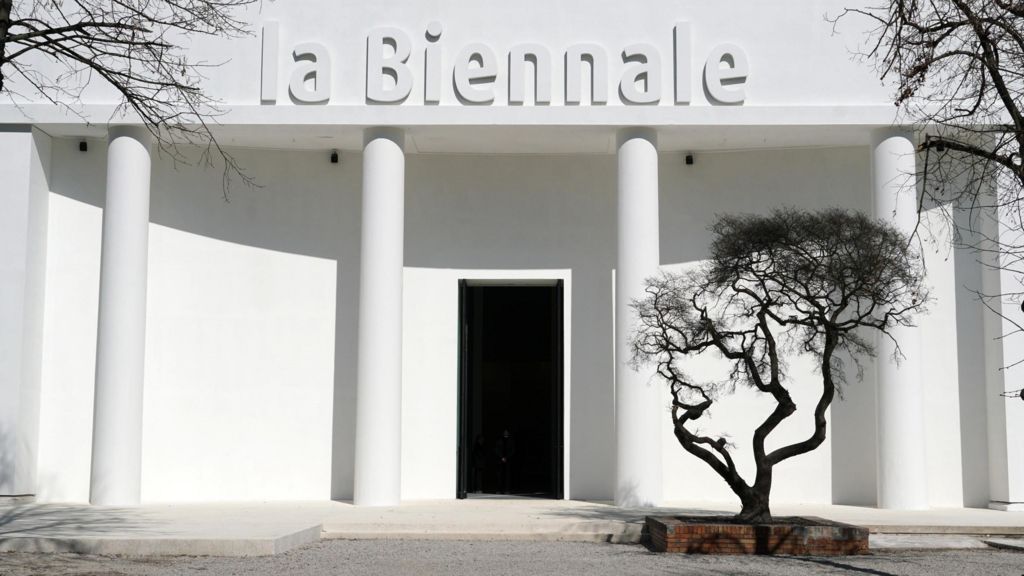
Nine days before the launch of one of the global art world’s most prestigious annual events, the Venice Biennale has been thrown into unprecedented chaos after its entire five-person jury stepped down in protest over the decision to allow Russia and Israel to participate in the 2026 exhibition. The sudden mass resignation caps weeks of escalating tension sparked by the Biennale’s choice to welcome Russia back to the event for the first time since Moscow launched its full-scale invasion of Ukraine in 2022.
In a short public statement announcing their departure, the jury clarified that their resignation aligned with a prior position they had taken: they would refuse to award any official prizes to participating nations whose leaders face active charges of crimes against humanity before the International Criminal Court (ICC). That standard covers both Russia, whose President Vladimir Putin has an open ICC arrest warrant alleging responsibility for war crimes in Ukraine, and Israel, whose Prime Minister Benjamin Netanyahu and former Defense Minister Yoav Gallant are also the subject of ICC arrest warrants connected to alleged crimes against humanity in the ongoing Gaza conflict. Moscow and Jerusalem have both uniformly rejected the ICC’s charges as illegitimate and baseless.
The controversy over Russia’s return has roiled European political and cultural circles for months. Italy’s right-wing Prime Minister Giorgia Meloni acknowledged publicly that her government does not support the decision to allow Russia to participate, but stopped short of forcing a reversal, noting the Venice Biennale operates as an autonomous cultural institution with an independent leadership. A day before the jury’s resignation, a delegation from Italy’s culture ministry traveled to Venice to conduct an on-site review of arrangements for the reactivated Russian pavilion. Culture Minister Alessandro Giuli had already announced he would boycott the entire Biennale opening in protest of Russia’s participation, and Italian authorities are currently investigating whether the country’s readmission violates existing EU sanctions against Moscow.
The European Union had already pulled a €2 million grant earmarked for the Biennale in April over the Russian participation decision, calling the move morally unacceptable at a time when Russia continues to target and erase Ukrainian cultural heritage amid its ongoing invasion. Over the course of the full-scale war, Ukrainian authorities have documented the destruction of more than 1,000 cultural sites, including hundreds of museums and galleries, the looting of tens of thousands of artworks, and the deaths of nearly 100 Ukrainian artists amid combat operations. For the Kremlin, returning to the Venice Biennale is viewed as a key step toward rebuilding the international diplomatic and cultural normalization it has actively pursued since 2022, even as daily fighting continues to claim civilian and military lives in Ukraine.
The Biennale’s leadership has defended its decision to keep Russia in the line-up on two core grounds. The institution has long framed itself as an open space for global art that rejects censorship and exclusion of any participant. It has also noted that Russia holds full legal ownership of its dedicated pavilion in the Biennale Gardens, the main exhibition site, giving the institution no legal mechanism to bar the country from using the space. This is not the first time the Russian pavilion has seen disruption since the invasion: in 2022, the appointed Russian curator and all participating artists withdrew in protest of Putin’s war, leaving the space empty. For the 2024 edition, Russia allowed Bolivia to host its exhibition in the pavilion instead.
This year’s Russian exhibition is scheduled to be a sound-based performance work titled *The Tree is Rooted in the Sky*, though multiple unconfirmed reports have suggested Italian authorities may restrict public access to the pavilion once the Biennale opens. Israel’s foreign ministry has already condemned the jury’s initial position excluding it from prizes, calling the move an example of dangerous political contamination of the international art community.
In the wake of the jury’s mass resignation, Biennale organizers have canceled the traditional prize awarding ceremony scheduled for the May 9 inauguration. Instead of a jury-selected set of awards, the public will now get the opportunity to vote for their favorite national pavilions to receive popular recognition for the 2026 edition.