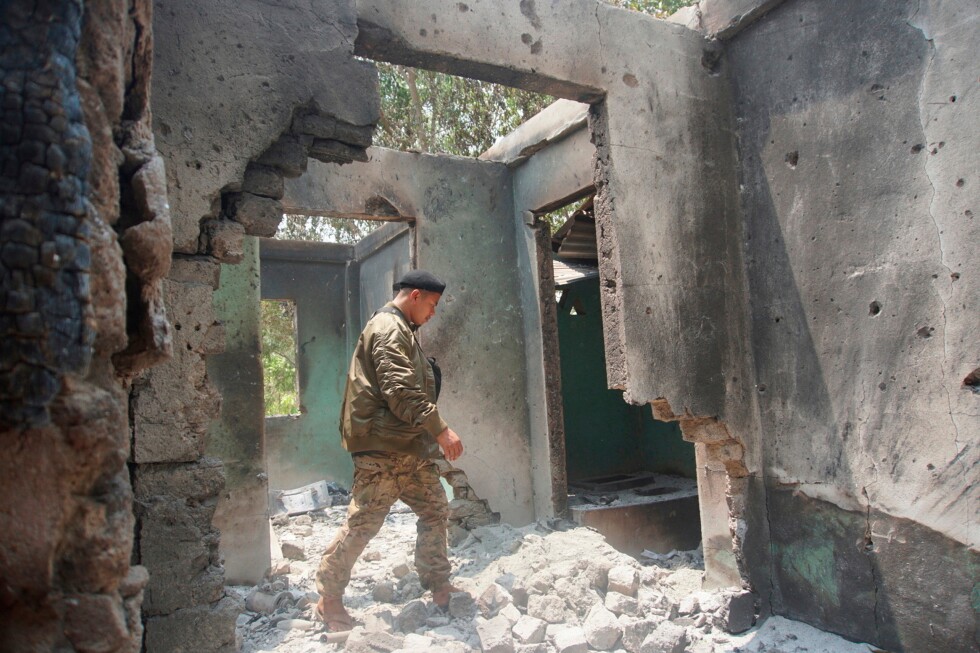
Just 14 months ago, Myanmar’s military junta found itself on the brink of strategic collapse in the country’s brutal ongoing civil war. An alliance of veteran ethnic militias had pushed junta forces out of vast territories in northern Myanmar, while pro-democracy guerrilla groups and long-standing opposition factions forced the military into defensive positions across nearly every other region of the country. Today, that dynamic has flipped dramatically, reshaping the trajectory of a conflict that has displaced millions and killed tens of thousands since the 2021 military coup.
Fueled by a massive expansion of its ranks from tens of thousands of newly conscripted troops, the Tatmadaw – Myanmar’s official military – has clawed back significant swathes of territory it lost in 2023, and is now positioning to launch a broad new national offensive. In contrast, the anti-junta resistance movement has been crippled by key defections, internal factional infighting, and crippling supply shortages that have weakened its operational capacity across multiple front lines.
“I think we’re nearing a crescendo here where the Tatmadaw is going to reassert itself and the large-scale organized resistance movement is going to peter out,” explained Morgan Michaels, a Singapore-based analyst with the International Institute of Strategic Studies who leads the organization’s Myanmar Conflict Map project. “That doesn’t mean scattered armed resistance will disappear entirely – armed resistance will always continue in Myanmar until there’s a comprehensive, negotiated political solution. But the Tatmadaw has retaken the strategic initiative, and every major development now plays to its advantage.”
Five years of continuous conflict – a timeline that stretches back to the immediate aftermath of the 2021 coup that ousted the elected civilian government of Aung San Suu Kyi – has left both anti-junta fighters and the general public deeply war-weary. The conflict has claimed more than 8,000 civilian lives and forced more than 3 million people to flee their homes, according to UN estimates. “There are many saying that the local population doesn’t care much who will win the war, but just want the fighting to stop,” noted Aung Thu Nyein, a Myanmar-based political analyst who currently works in neighboring Thailand, in an interview with the Associated Press.
Beyond internal fatigue, the resistance has also been undermined by shifting geopolitical pressure from China, which holds massive economic and strategic stakes in Myanmar. Myanmar is a critical supplier of rare earth elements and other key natural resources to Beijing, which has invested billions of dollars in cross-border infrastructure including oil and gas pipelines, mines, and connectivity projects. China is also one of the Tatmadaw’s two largest arms suppliers, alongside Russia, and maintains significant influence over ethnic paramilitary groups that operate along the Sino-Myanmar border.
Initially, Beijing supported the major October 2023 anti-junta offensive launched by the Three Brotherhood Alliance, a coalition of three ethnic armed organizations (EAOs), because it was angered that the military government had allowed rampant transnational organized crime to spread in border regions. But that support quickly evaporated: China cut off all arms and ammunition supplies to the alliance and pressured its members to halt offensive operations. Today, two of the alliance’s three core members – the Myanmar National Democratic Alliance Army and the Ta’ang National Liberation Army – have signed Chinese-brokered ceasefires with the Tatmadaw, leaving only the Arakan Army still active in combat in western Rakhine State.
The anti-junta resistance is split between two broad blocs: the long-standing ethnic minority EAOs that predate the 2021 coup, and newer pro-democracy People’s Defense Forces (PDFs) that formed after the coup, most of which are affiliated with the National Unity Government (NUG), a shadow administration formed by ousted members of Suu Kyi’s National League for Democracy. Resistance leaders warn that persistent divides between these groups have left them vulnerable to the Tatmadaw’s renewed momentum.
“Although there is a shared understanding of the need to overthrow the military dictatorship and move toward a future federal union, there are still gaps and differences in overall grand strategy and tactics,” said the Burma Liberation Democratic Front, a pro-democracy resistance group active in Sagaing and Mandalay regions, in a written statement to AP. “There are still differences in positions, perspectives, and approaches. Many continue to hold onto ethnic, regional, and organizational interests and attachments.” The group added that the Tatmadaw is actively exploiting these rifts, pursuing a classic divide-and-conquer strategy to fuel divisions between the public and revolutionary forces, across ethnic lines, and between separate resistance factions.
On the political front, the Tatmadaw has recently consolidated its international standing, most notably after holding a contested general election earlier this year. The election was widely dismissed by UN experts and Western governments as neither free nor fair, with all major opposition candidates barred from running, but it allowed junta leader Min Aung Hlaing – the senior general who led the 2021 coup – to be sworn in as president earlier this month, adding a veneer of democratic legitimacy to his authoritarian rule. China, which publicly supported the election, was quick to congratulate Min Aung Hlaing and dispatched its foreign minister for an in-person meeting just days after his inauguration. The election also freed up thousands of troops who had been deployed to provide poll security, allowing the Tatmadaw to reallocate those forces to front-line combat operations, Michaels noted.
One of Min Aung Hlaing’s first acts as president was to announce a new offer of peace talks to all armed resistance groups, including both EAOs and PDFs, though the NUG was deliberately excluded from the invitation. The NUG immediately rejected the offer, denouncing it as a tactic to prolong military rule. The junta’s offer, published in the state-run *Global New Light of Myanmar*, set a July 31 deadline for groups to join talks, and included a caveat that resistance groups may not bring “unrealistic demands” to the negotiating table. No details were provided on consequences for groups that refuse the invitation, and the junta did not respond to requests for comment from AP.
Even as it extends the offer of talks, the Tatmadaw has continued to press offensive operations across multiple fronts. It is currently conducting a large-scale assault in Sagaing Region aimed at retaking the northern city of Indaw, which fell to PDF forces backed by the Kachin Independence Army last year. At the same time, the military remains on the defensive in eastern Myanmar, where the Karen National Liberation Army is advancing on a key junta stronghold near the Thai border.
Analysts say Min Aung Hlaing’s peace offer is likely an attempt to revive the decade-old Nationwide Ceasefire Agreement, which brought relative calm to parts of Myanmar by signing on roughly half of the country’s EAOs. For now, however, incremental, localized ceasefires appear to be the junta’s immediate goal. “In the short term if you can agree to ceasefires with some groups, then you can redirect your resources toward other groups that are either unwilling to agree to a ceasefire or that the Tatmadaw is unwilling to agree to a ceasefire with,” Michaels explained. “The Tatmadaw can always accept some degree of opposition and, in fact needs some level of active armed resistance to justify its rule and justify its behavior. But the current level of widespread armed resistance across the country is not tenable for the junta.”