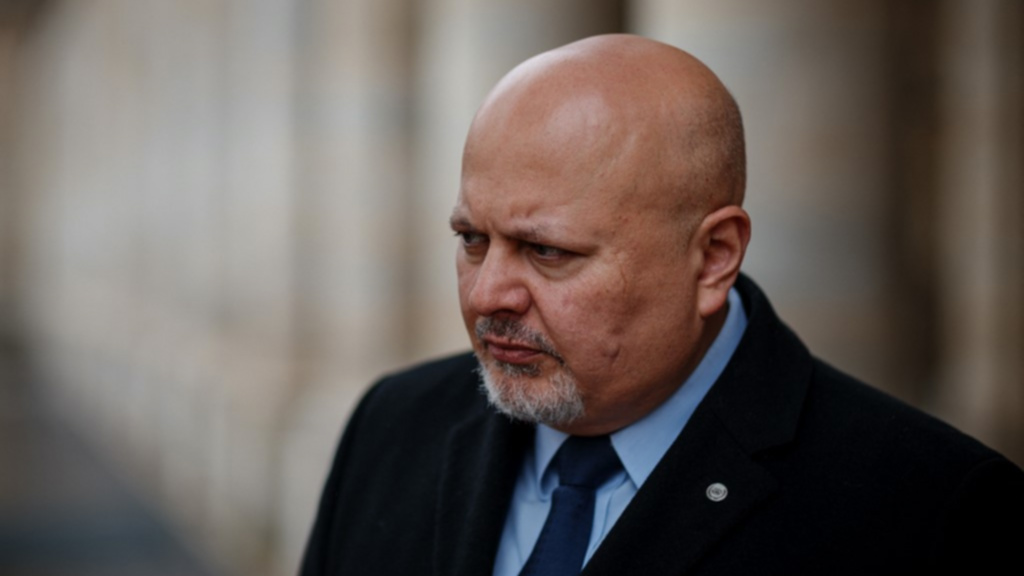
More than a year after stepping back from his role at the International Criminal Court (ICC) amid a United Nations investigation into sexual misconduct claims, Chief Prosecutor Karim Khan has spoken publicly for the first time, forcefully asserting his innocence and revealing unprecedented political intimidation from Western leaders over his push to prosecute Israeli officials for alleged war crimes in Gaza.
In a wide-ranging interview with journalist Mehdi Hasan published on Zeteo, Khan laid out details of direct threats from senior Western politicians, corroborating earlier exclusive reporting from Middle East Eye (MEE) that exposed a coordinated campaign to undermine his leadership over the Gaza investigation. The probe into Khan’s conduct was triggered after misconduct allegations emerged last year, and a independent panel of judges appointed by the ICC’s governing Assembly of States Parties (ASP) Bureau already reviewed the UN investigation and concluded no evidence of misconduct or breach of duty had been proven against Khan. Yet despite the panel’s exoneration, Khan has not been allowed to resume his post, after a bloc of mostly Western and European states voted to set aside the judges’ findings and launch their own separate assessment based on the UN report.
Khan told Hasan he was stunned and confused by the decision to keep the case open after he was cleared. “I cooperated with the process, and the process exonerated me. I’m just concerned that…why is it not being closed straight away?” he said. Addressing the sexual misconduct allegations directly, Khan noted that the 137 findings contained in the UN investigation contained zero conclusions that labeled any of his behavior as inappropriate in any form. “So it’s as clear as cut as that,” he emphasized, adding that the ongoing delay is no longer about the original allegations. “What is being proposed is for political state officials to somehow hear more representations to get the result [they want]. It is not acceptable.” The UN Office of Internal Oversight Services’ original report included competing evidence from both the complainant and Khan, and the judges’ panel later confirmed the investigation either failed to reach conclusive factual findings or found it impossible to do so based on available evidence.
The misconduct investigation has unfolded against a backdrop of growing global pressure on Khan and the ICC, sparked by the prosecutor’s move to pursue arrest warrants for senior Israeli leaders over alleged war crimes committed during the Gaza conflict. Pressure began mounting in early 2024, as Khan finalized plans to apply for warrants for Israeli Prime Minister Benjamin Netanyahu and former Defense Minister Yoav Gallant. To date, Khan, his two deputies, and multiple ICC judges have already been subjected to official US sanctions over the investigation.
Last August, MEE reporting detailed a sprawling intimidation effort that included threats from high-profile politicians, coordinated negative briefings against Khan by close associates, safety concerns triggered by the presence of a Mossad team in The Hague, and pre-planned media leaks of the sexual misconduct allegations. While Khan declined to directly accuse any intelligence service of infiltration, he confirmed that Netanyahu has repeatedly worked to weaponize the allegations against him. “Netanyahu has clearly amplified and has sought to instrumentalise, at the very least, these allegations,” he said, adding that both Russian foreign intelligence and Israeli intelligence have carried out close surveillance of his activities.
When asked about MEE’s June 2024 exclusive report of a threat from then-British Foreign Secretary David Cameron that the UK would withdraw from the ICC and cut funding if the court moved forward with arrest warrants for Israeli officials, Khan confirmed the account was accurate. The April 23, 2024, phone call marked a clear moment of public pressure from one of the ICC’s founding member states. “Yes, it’s been reported, and it’s true,” he said. “I was sad. I wasn’t angry, I was sad. I’m not sure if it was [the] UK government, it was a very senior state official representing the UK government.” When pressed to confirm the caller was Cameron – a former British prime minister and current Conservative peer – Khan affirmed it was. Describing the conversation as difficult, he noted Cameron appeared visibly upset during the call. Khan struck a more optimistic note about the new British Labour government, saying Attorney General Richard Hermer has reaffirmed the UK’s commitment to respecting international law, a shift from the previous administration’s stance. As a British national and the ICC’s chief prosecutor, Khan emphasized the UK’s special responsibility as a UN Security Council permanent member: “If it stands for anything, it must stand for international law, and rules and complying and doing the right thing. And if the UK does the right thing, it’ll be good for the UK, and it’ll be good for the international community. And if we don’t, it’ll be the kiss of death for the standing of this great country.” Cameron has not responded to requests for comment on the call, and the British government has repeatedly declined to address the issue despite repeated questions from Labour MPs.
Khan also confirmed remarks first reported by MEE from a May 2024 conference call with US Senator Lindsey Graham, in which Graham claimed the ICC was only intended to prosecute African leaders and figures like Russian President Vladimir Putin, not Israeli or American officials. Graham’s comment echoed the dismissive attitude many Western leaders have taken toward the Gaza investigation, Khan argued.
The prosecutor also pushed back against claims that he advanced the arrest warrants to distract public attention from the misconduct allegations against him, calling the claim “baloney” in an American turn of phrase. He laid out a clear timeline to prove the warrants were planned long before the allegations became public: he traveled to the region in late 2023, visiting Israel, Palestinian communities, and Rafah, and publicly stated that all parties would be held accountable for violations. As early as March 2024 – weeks before the allegations emerged – he had already briefed senior US officials that he planned to file arrest warrant applications for the Palestine situation by the end of April, confirming the investigation’s timeline was never linked to the misconduct claims.
Today, Khan’s future at the ICC remains uncertain. The ASP Bureau is scheduled to deliver a final ruling on the allegations in early June, and Khan is set to deliver a high-profile public address at the Oxford Union next Tuesday, in what will be one of his first major public appearances since stepping back from his post.