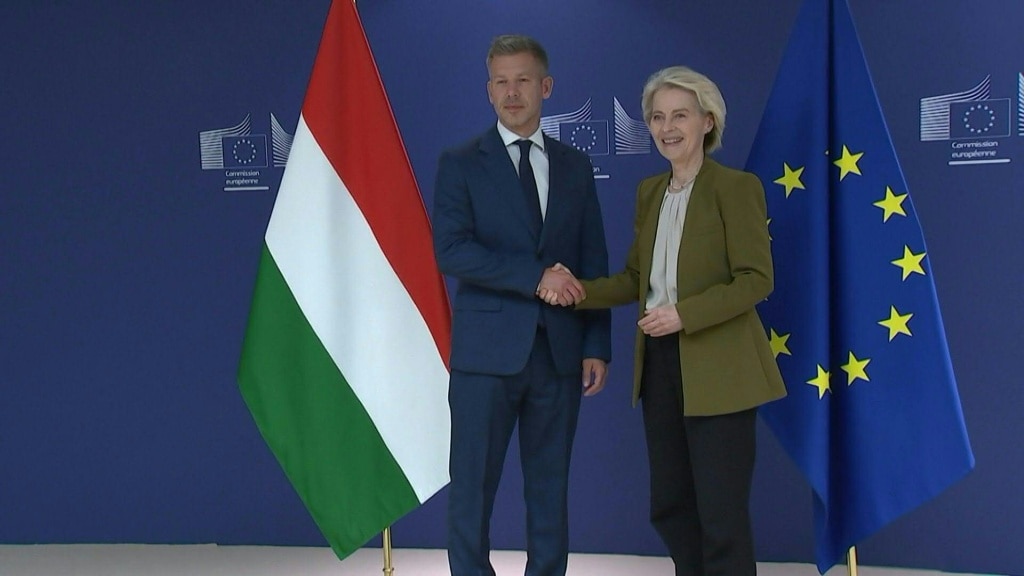
In his first official visit to Brussels since securing a historic election victory that ended 16 years of nationalist rule under Viktor Orbán, Hungary’s incoming prime minister Peter Magyar sat down with top European Union leadership Wednesday on a mission to reset Budapest’s fractured relationship with the bloc and unlock billions in frozen funding. The trip, which included a high-stakes meeting with European Commission President Ursula von der Leyen, comes as Magyar moves quickly to deliver on his campaign promise of a new pro-EU course, even before he formally takes office next month.
Magyar struck an upbeat tone ahead of the negotiations, telling followers in an online video that he entered the talks “very optimistic and hopeful.” His top near-term priority is reaching a formal agreement by the end of May to unfreeze roughly €10 billion in Covid-19 recovery funds held by the EU over long-standing rule-of-law concerns that mounted during Orbán’s Kremlin-aligned tenure. Magyar added that preliminary talks between his transition team and senior EU officials — which have already spanned two negotiation rounds — have proceeded smoothly, with both sides approaching discussions in a constructive spirit. “Political decisions” are now all that is required to move the process forward, he noted.
Beyond the Covid recovery funds, Magyar is also pushing to unlock an additional €8 billion in frozen cohesion funding, bringing the total amount of suspended Hungarian aid seeking release to around €18 billion ($21 billion). Time is not on his side: the incoming Hungarian government faces a hard deadline of the end of August to implement required rule-of-law and governance reforms to secure the €10 billion in Covid recovery funds, or the allocation will be permanently forfeited.
EU leaders have greeted Magyar’s election victory and rapid push for engagement with cautious optimism. The incoming prime minister’s super-majority control of the Hungarian parliament gives him the political capital needed to push through required reforms quickly — a luxury Orbán’s government never prioritized during years of standoffs with Brussels. European officials have been struck by the level of preparation and commitment from a transition team that has not yet formally taken power. “We’ve never seen such a level of commitment from a government that isn’t even in office yet,” Daniel Freund, a member of the European Parliament and longtime critic of Orbán, told Agence France-Presse. “It’s practically as if Hungary is rejoining the European Union.”
As a potential early confidence boost for Magyar, Brussels is considering moving forward with approving €16 billion in preferential defense loans that were put on hold amid the standoff with Orbán in the lead-up to Hungary’s election. Still, some EU diplomats stress that concrete policy changes will be the only measure of genuine realignment in Budapest. “So far, wait and see,” one anonymous senior EU diplomat told reporters. “But that might change, considering all the good things he says and does.”
Beyond domestic funding and rule-of-law reforms, EU leaders are also pushing for a major shift in Hungary’s policy toward Ukraine, where Orbán repeatedly blocked EU military aid for Kyiv, new sanctions on Russia, and progress on Ukraine’s EU accession bid during Moscow’s full-scale invasion. Magyar has already signaled a break from Orbán’s approach, announcing Tuesday that he plans to meet Ukrainian President Volodymyr Zelenskyy in June to “open a new chapter” in bilateral relations.
Even before Magyar takes office, Orbán’s election defeat has already cleared long-standing logjams in EU policy toward Ukraine. Last week, the 27-member bloc approved a massive €50 billion macro-financial loan for Kyiv and a new package of sanctions on Russia — both measures that Orbán had blocked for months. EU member states now expect Magyar to lift Orbán’s remaining vetoes: unblocking billions in stalled EU military assistance for Ukraine, and removing Hungary’s objection to moving Ukraine to the next phase of its EU accession negotiations. While major EU powers have little appetite to rush Kyiv toward full membership in the near term, officials broadly agree that Ukraine is entitled to continue moving forward in the accession process.