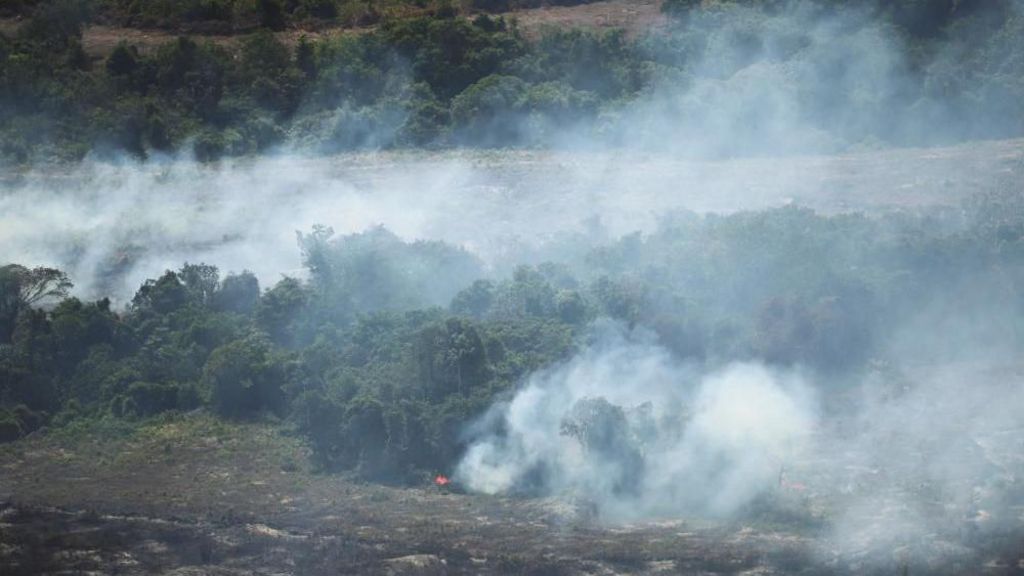
Fresh satellite data compiled by the World Resources Institute (WRI) and the University of Maryland reveals a significant global slowdown in tropical old-growth forest loss in 2025, a shift driven largely by strengthened forest protection policies in Brazil and favorable cool weather conditions, even as scientists warn the planet’s most critical carbon-absorbing ecosystems remain far more threatened than they were a decade ago.
Researchers estimate total global old-growth tropical forest loss hit nearly 43,000 square kilometers in 2025 — an area roughly matching the size of Denmark. While this marks a 36% drop from the all-time record deforestation peak recorded in 2024, scientists emphasize that current loss rates still far outpace those seen 10 years prior, putting global climate and biodiversity goals at severe risk.
The 2025 decline stems from two key factors, the analysis finds. First, the cooler, wetter La Niña weather pattern replaced the heat-amplifying El Niño that drove record-breaking wildfires across tropical biomes in 2024, easing fire-driven forest loss. Second, reinforced environmental policy and enforcement in major forest nations including Brazil, Colombia, and Malaysia has cut clearing rates dramatically. In Brazil, which hosts the world’s largest single expanse of tropical rainforest, non-fire-related old-growth forest loss fell to just 5,700 square kilometers in 2025 — the lowest annual total recorded since data tracking began in 2002.
“It’s incredibly encouraging to see the decline in 2025,” said Elizabeth Goldman, co-director of Global Forest Watch at WRI. “It highlights how when we have political will, and leaders in charge who want to do something for forests, we can see real results in the data.”
Tropical rainforests are irreplaceable global assets: they support millions of unique plant and animal species, and absorb vast volumes of planet-warming carbon dioxide from the atmosphere, acting as one of Earth’s most effective natural climate regulators. For decades, however, expanding commercial agriculture, unregulated logging, and worsening climate change have steadily eroded forest cover, creating drier conditions that increase the risk of catastrophic, unmanageable wildfires.
Global leaders formally pledged to “halt and reverse” global forest loss by 2030 at the 2021 COP26 climate summit in Glasgow, but progress toward that target has lagged badly. The 2024 record loss, driven by human-caused climate change and an intense El Niño event, underscored how far off track the world remains.
Scientists stress that the 2025 improvement is fragile, with a new threat looming: climate change is projected to give way to a new El Niño phase by the end of 2026, raising the risk of more intense droughts and wildfires across tropical forest regions. “Climate change and land clearing have shortened the fuse on global forest fires,” said Professor Matthew Hansen of the University of Maryland. “Without urgent action to manage fire more effectively, we risk pushing the world’s most important forests past the point of no recovery.”
Rod Taylor, WRI’s global director for forest and nature conservation, added that shifting climate conditions require a new approach to forest stewardship: “Forests are well equipped to cope with normal climate. With these new intense fires and droughts and so on, we really have to think about how to make forests more resilient and proof them against climate and fire.”
In a complementary report released this week, the European Union’s Copernicus Climate Service detailed how human-caused climate change has already supercharged extreme weather across Europe, which is warming faster than any other continent on Earth. Nearly 95% of Europe recorded above-average annual temperatures in 2025, with even traditionally cool Arctic regions in the far north hitting 30°C in July, and Alpine glaciers continuing their rapid ice loss. European sea surface temperatures hit all-time record highs last year, with the Mediterranean suffering the most severe warming.
The extreme heat created prime conditions for widespread wildfires across Europe, which burned more than 10,000 square kilometers of land in 2025 — an area larger than the entire island nation of Cyprus. Even with these worsening impacts, the Copernicus report noted incremental progress on decarbonization: nearly half of all electricity generated across Europe now comes from renewable sources including wind, solar, and hydropower.