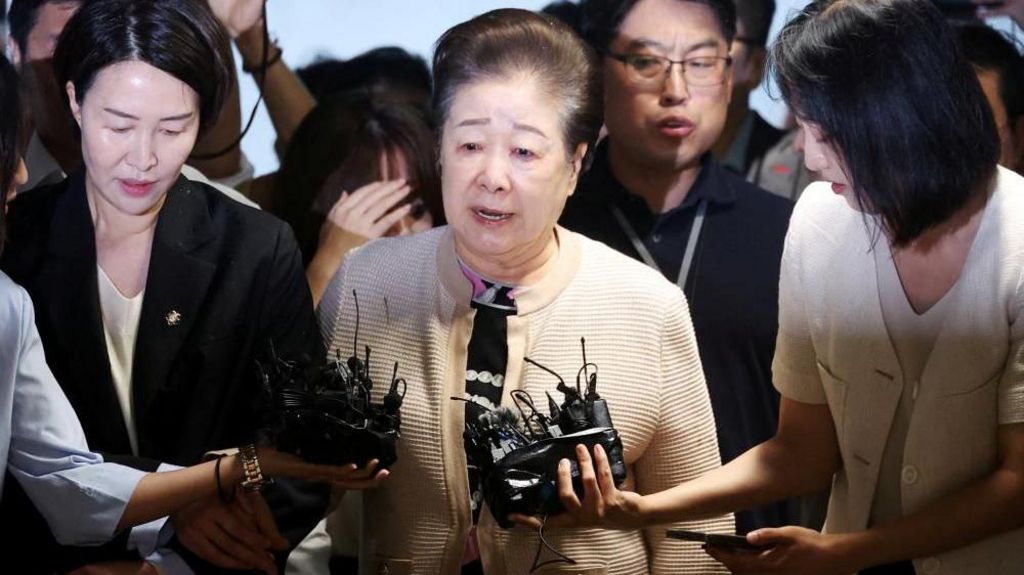
Han Hak-ja, the 82-year-old leader of the controversial Unification Church, has vehemently denied allegations that her organization bribed South Korea’s former first lady, Kim Keon Hee, with luxury gifts in exchange for business favors. The accusations surfaced as Han emerged from a grueling nine-hour interrogation at the prosecutor’s office, where she was questioned about the alleged bribery. Supported by assistants due to her frail health, Han dismissed the claims, stating, ‘No… Why would I do that?’
The former first lady, wife of ousted President Yoon Suk Yeol, is accused of accepting two Chanel bags and a diamond necklace, collectively valued at 80 million won ($57,900), from the church. Kim, who was indicted last month on charges including bribery and stock manipulation, denies all allegations. Her arrest marks a historic moment in South Korea, as it is the first time both a former president and first lady have been jailed.
Yoon, detained in January, faces trial over a failed martial law bid last year that plunged the nation into chaos. Meanwhile, Han shifted blame to a former church official, claiming he acted independently in offering the gifts. The official has since been arrested. Han’s appearance followed her refusal to comply with three prior summonses, citing post-heart surgery pain. An ambulance was reportedly on standby during her interrogation.
In a related development, conservative lawmaker Kweon Seong-dong was arrested on Wednesday for allegedly receiving 100 million won in bribes from the church. Kweon, once a close ally of Yoon, denies the charges.
The Unification Church, formally known as The Family Federation for World Peace and Unification, was founded in the 1950s by Moon Sun-myung, who declared himself the messiah. The church is infamous for its mass weddings, often involving thousands of couples matched by the organization. Critics have labeled it as ‘cult-like,’ with accusations of coercing members, known as ‘Moonies,’ into donating substantial sums.
The church gained international attention following the assassination of Japan’s former Prime Minister Shinzo Abe. The alleged assassin blamed the group for his family’s financial ruin and held a grudge against Abe for allegedly promoting the church. The organization is banned in several countries, including Singapore and, more recently, Japan.