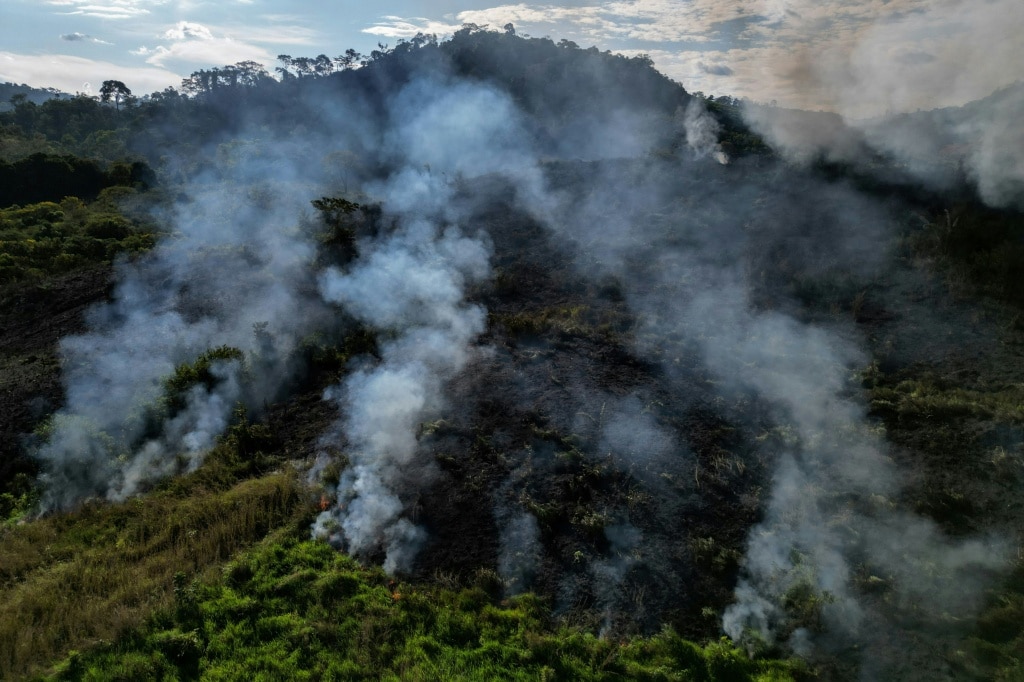
A new report from joint research teams at the World Resources Institute (WRI) and the University of Maryland has delivered a mixed assessment of global tropical forest conservation: while the pace of primary tropical rainforest destruction dropped 36% in 2025 from the previous year’s all-time high, loss rates remain alarmingly elevated, and climate-worsened wildfires have emerged as a persistent, dangerous new threat to decades of conservation progress.
Researchers documented 4.3 million hectares (10.6 million acres) of primary tropical rainforest lost in 2025, a decline that equals 11 football fields of forest cleared every minute. By area, that total is roughly the size of Denmark, and it remains 46% higher than average annual loss rates recorded a decade ago. When compared to the benchmark needed to hit the global 2030 goal of halting and reversing forest loss, current deforestation rates are still 70% above the required target.
Elizabeth Goldman, co-director of WRI’s Global Forest Watch platform, called the single-year drop of this scale an encouraging sign of what targeted policy can achieve. But she cautioned that part of the decline stems from a natural lull after 2024’s unprecedented extreme fire season. That note of caution is echoed by broader warnings from the research team: climate change-fueled wildfires have become a “dangerous new normal” that could erase recent hard-won conservation gains, especially as a new El Niño event is forecast to arrive in the second half of 2026, which is expected to push global temperatures even higher and amplify the risk of extreme drought, heatwaves, and large-scale wildfires.
Matthew Hansen, director of the University of Maryland’s GLAD Lab, which analyzes satellite forest data, emphasized that one year of progress is not enough to secure long-term tropical forest conservation. “A good year is a good year, but you need good years forever if you’re going to conserve, for example, the tropical rainforest,” Hansen said during a media briefing on the report.
The bulk of 2025’s slowdown can be traced to aggressive policy action in Brazil, home to the world’s largest tropical rainforest, the Amazon. Under the administration of President Luiz Inácio Lula da Silva, who took office in 2023, Brazil has reinvigorated national anti-deforestation enforcement, relaunched a comprehensive anti-deforestation action plan, and increased penalties for illegal environmental activity. Data shows Brazil’s non-fire related forest loss dropped 41% from 2024 levels, hitting the lowest rate recorded since tracking began. Even so, agriculture remains the single largest driver of deforestation globally, and Brazil’s forests still face pressure from clearing for soy cultivation and cattle ranching, while several Amazonian states have recently passed local legislation that weakens federal environmental protections.
Other nations have also seen success from strong policy intervention. Neighboring Colombia recorded a 17% drop in forest loss, hitting its second lowest annual rate since 2016, driven by new government policies and land-use agreements that limit unregulated clearing. In Indonesia, forest loss rose 14% in 2025 but remains far below the peak levels seen 10 years prior, while government action in Malaysia has stabilized deforestation rates. However, tropical forest loss remains critically high across other regions, including Bolivia, the Democratic Republic of Congo, Cameroon, and Madagascar, where weak policy enforcement and unregulated land clearing continue to drive widespread destruction.
Across the globe, total tree cover loss fell 14% in 2025, but fires remain a growing driver of destruction. Fires accounted for 42% of all tropical tree cover loss last year, and over the past three years, fires have burned twice as much tree cover globally as they did two decades ago, according to the report. While most tropical fires are human-caused for land clearing, climate change has intensified natural fire cycles in northern and temperate forest regions. Last year, Canada experienced its second worst wildfire season on record, with blazes consuming more than 5.3 million hectares of forest.
“Climate change and land clearing have shortened the fuse on global forest fires,” Hansen said. “They are turning seasonal disturbances into a near-permanent state of emergency.”