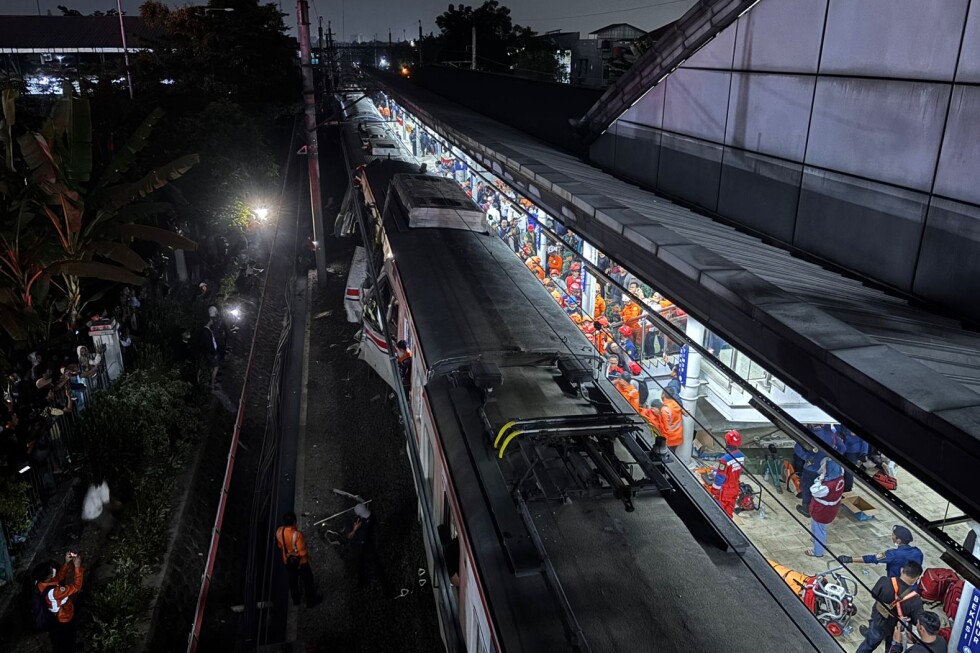
On Monday morning, a devastating high-speed collision between two passenger trains shook a suburban station just outside Indonesia’s capital Jakarta, leaving at least three people dead and dozens more injured, local law enforcement confirmed. The crash unfolded at Bekasi Timur Station in the Jakarta satellite city of Bekasi, where the long-distance intercity service Argo Bromo Anggrek struck the back of a stationary commuter train, inflicting catastrophic damage on the rear carriage, said Jakarta Police Chief Asep Edi Suheri during an on-site press briefing. “A total of 29 injured victims have been evacuated to three medical facilities located within close proximity of the station,” Suheri told assembled reporters, adding that a full official investigation into the root cause of the incident is already underway.
Notably, the damaged rear carriage of the commuter train was a women-only carriage, a widely implemented policy across Indonesia’s public transit systems designed to reduce sexual harassment and improve safety for female passengers. Footage captured by local broadcast networks and shared widely across social media platforms captured the chaotic aftermath of the crash: passengers stranded on station platforms fled in panic, while first responders worked alongside local civilian residents to extract trapped passengers from the wrecked train cars. Outside the station, dozens of anxious family members gathered, waiting for updates on the status of their loved ones who had been aboard the trains at the time of the collision.
PT Kereta Api Indonesia, the state-owned national railway operator that manages all intercity and commuter rail services across Indonesia, has issued a formal public apology to affected passengers and their families. “Right now, every available resource is being directed toward evacuating passengers and crew, and providing urgent support to victims at the scene. Safety remains our absolute top priority,” Anne Purba, the company’s vice president for corporate communications, said in an official statement. Purba also confirmed that regular commuter rail operations through the affected area have been temporarily suspended, with major service disruptions expected for daily commuters while investigators work to clear the crash site.
This latest collision has drawn renewed attention to longstanding safety concerns over Indonesia’s aging national railroad network, where accidents are far too frequent. Just 10 months prior to this incident in January 2024, another collision between two trains in Indonesia’s West Java province claimed at least four lives. Looking further back, a 2013 collision between a passenger train and a minibus at an unmarked, unguarded level crossing in West Java killed 13 people, and a 2010 rear-end crash at a Central Java station, nearly identical to this week’s incident, left 36 people dead.