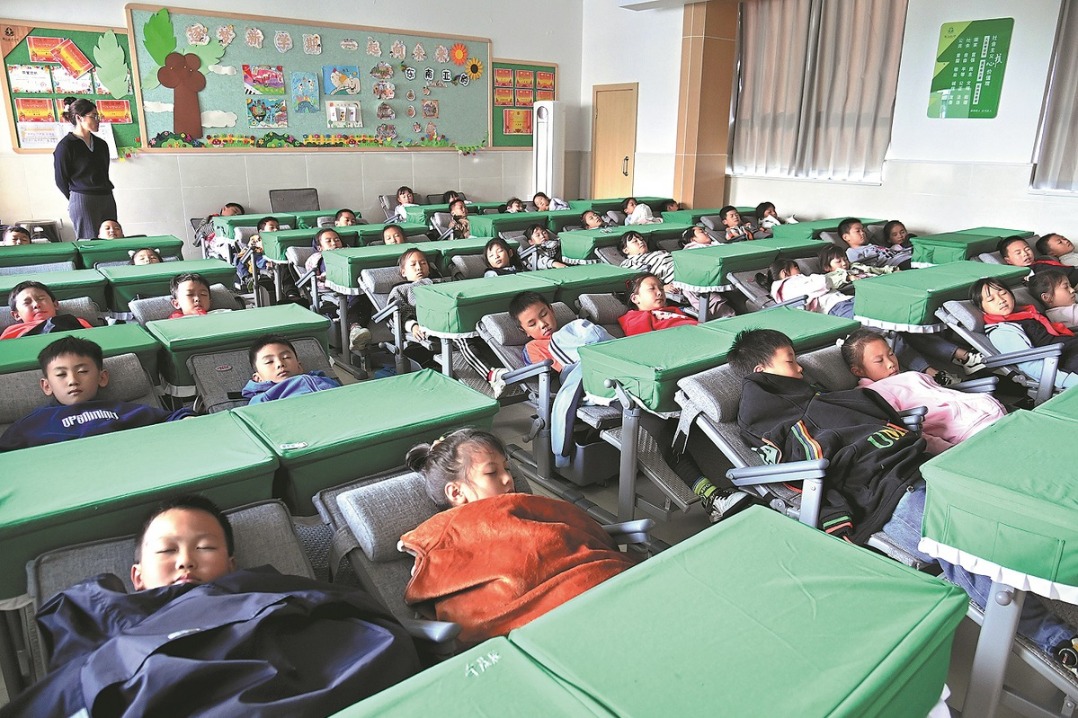
Across China, a quiet but transformative shift is underway in K-12 education: replacing the long-standing tradition of hunching over classroom desks for midday naps with comfortable, lie-down rest, enabled by a newly implemented national standard for student furniture.
The national technical standard for purpose-built napping desks and chairs, issued by the State Administration for Market Regulation and the National Standardization Administration in September 2025, officially went into effect this February. Developed with children’s physical growth and developmental needs at its core, the regulation sets clear, unified requirements for critical product specifications including seat height, recline angle, under-desk clearance, and material durability, addressing a gap that previously left the growing market for napping furniture with inconsistent quality and safety standards.
Well before the new standard was introduced, national policymakers had already prioritized improving student sleep health. Back in 2021, the Ministry of Education released a guidance on strengthening student sleep management, which outlined age-appropriate recommended sleep durations and encouraged schools with sufficient resources to secure adequate midday break time for rest. In 2023, the State Council followed with a policy supporting schools to expand classroom and recreational spaces to create usable napping conditions. That same year, Zhang Qiongli, a national legislator and high school teacher from Hubei province, tabled a proposal to upgrade K-12 students’ lunch break arrangements, which quickly garnered broad public and official support. Today, nearly 40,000 primary and secondary students in Enshi Tujia and Miao Autonomous Prefecture, Zhang’s home region, already have access to lie-down napping during lunch breaks. “I also hope that in the future, all primary and secondary school students across the country can achieve lying lunch breaks,” Zhang shared in an interview.
Since the national standard took effect, rollout has accelerated across multiple regions. In Wuhu, Anhui province, 468 sets of the new lie-down napping furniture have been included in the city government’s 2026 key livelihood projects, with many local schools already rolling out the equipment to help students say goodbye to the discomfort of hunched-over desk napping.
The innovative furniture is designed for dual use: during regular class hours, it functions as a standard student desk and chair. When lunch break rolls around, a few simple adjustments extend the seat and tilt the backrest, transforming it into a comfortable mini recliner that eliminates the neck and shoulder strain that comes from napping while bent forward.
In northwest China’s Urumqi, Xinjiang Uygur Autonomous Region, roughly 2,000 sets of the new napping-friendly desks and chairs entered service at local K-12 schools this spring. In the southern technology hub of Shenzhen, Guangdong province, more than 400 primary and secondary schools have already completed midday napping program upgrades, with the city planning to roll out the national standard-compliant furniture to an additional 200 schools in the 2026 spring semester.
For parents, the change is widely welcomed. Lu Xiao, a primary school parent based in Dalian, Liaoning province, noted that a quality midday nap helps students recharge their energy and boost afternoon learning efficiency. “I hope students in my son’s school can use the adjustable backrests and extendable seats as soon as possible,” she said.
Most Chinese K-12 schools already schedule approximately two hours for lunch and midday break daily, creating a natural window for structured rest.
Despite this progress and widespread policy and public support, full nationwide promotion of universal lie-down napping still faces notable practical barriers. As of early 2026, only a relatively small share of schools across the country have rolled out the upgraded furniture, with challenges including limited classroom space, tight education budgets, and complex daily management of the adjusted napping routines remaining to be addressed.