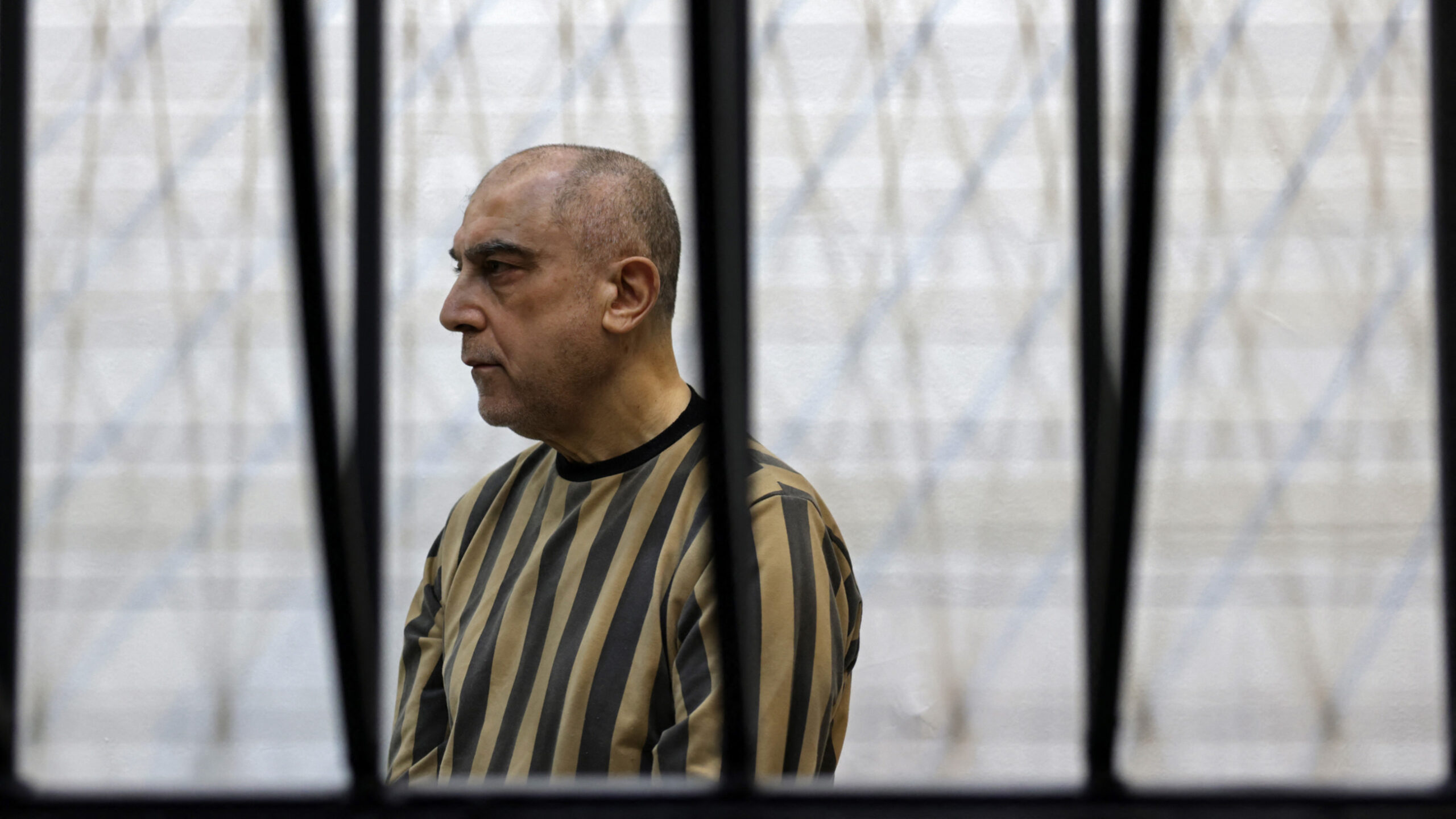
On a landmark Sunday morning in central Damascus, Syria, a metal cage was positioned at the heart of the courtroom in the Palace of Justice, steps from the bustling al-Hamidiyah souk. Shortly before 11 a.m., Atef Najib, the cousin of ousted former president Bashar al-Assad and a one-time top security official, was led into the enclosure. Clad in a brown striped prison uniform and wearing a blank, unreadable expression, he took his seat as the courtroom fell quiet.
Najib stands accused of orchestrating one of the earliest and deadliest crackdowns on anti-government demonstrators that erupted at the start of the 2011 Syrian uprising, with formal charges of “crimes against the Syrian people” brought against him. Mounted directly opposite the defendant’s dock was a portrait of Hamza al-Khatib, the 13-year-old boy who became a global symbol of the uprising’s human cost after he was killed and tortured by security forces in 2011.
The roots of this trial stretch back 15 years to the 2011 Arab Spring, when a group of teenagers in the southern Syrian city of Deraa spray-painted anti-regime slogans on a local school wall. One line, “Doctor, it’s your turn,” cut directly at Assad, a trained ophthalmologist. The detention and brutal torture of those young children by security forces sparked the first widespread anti-government protests across the country. At the time, Najib was the top political security chief in Deraa, overseeing the sweeping campaign of mass arrests and violent repression that followed.
Sunday’s opening session marks the first public trial of a senior Assad-era official since the fall of the former government in December 2024. Najib was among the first high-ranking figures arrested, taken into custody on Syria’s coast in January 2025, just weeks after Assad fled the country to Russia. For more than a year, families of victims of the Assad regime’s crackdown have waited for this moment of accountability.
In the courtroom, emotions ran high as victim’s families passed the dock in front of international and local reporters. A young woman held aloft a photo of Hamza al-Khatib, as chants broke out across the room: “The martyrs are the heroes. Atef, you are the dog.” The trial comes as Syria’s new transitional authorities work to demonstrate progress on long-awaited transitional justice, a key demand from Syrians who spent 14 years under the repressive Assad regime during the civil war.
Just two days before Najib’s trial opened, Syrian security forces announced the arrest of Amjad Youssef, the primary suspect in the 2013 Tadamon massacre, where nearly 300 unarmed civilians were executed and dumped into a mass grave. Footage of Youssef personally shooting victims before they were thrown into the pit was widely circulated after the massacre, and his arrest in the Al-Ghab Plain area of Hama province near his hometown was publicly shared by the interior ministry to broad attention across the country.
Since Assad was toppled on December 8, 2024, Syrians have consistently demanded full accountability for the thousands of crimes committed under his government. But the transitional justice process has moved slowly in a country fractured and worn down by 14 years of violent conflict.
Addressing the court on Sunday, Damascus Public Prosecutor Hosam Khatab framed the trial as a foundational step for the new Syrian justice system. “Transitional justice begins with him, trust the state and justice,” Khatab told the court. He called Najib “the first ‘pharaoh’ when he gave the orders to fire on protesters,” using the term Syrians have adopted to refer to abusive former regime officials. “This will be neither the first nor the last. We will pursue them all.”
Turning directly to Najib in the dock, Khatab raised his voice: “Our God has given us what we wanted. And as for you: did your God, Bashar al-Assad, give you what he promised?” Najib offered no response. The prosecutor then went on to announce a list of 10 additional high-profile suspects who will face trial in coming months, topped by Bashar al-Assad himself. Other names on the list include Assad’s younger brother Maher al-Assad, who commanded the elite 4th Armoured Division — the regime’s primary armed wing that led multiple crackdowns; Wassim al-Assad, another close relative of the ousted president; former Grand Mufti Ahmed Badreddin Hassoun; and multiple other military and security officials arrested in recent months. Bashar al-Assad, who remains in exile in Russia, will be tried in absentia.
Sunday’s opening session was limited to preliminary administrative and legal procedures, and the judge did not question Najib directly. A second full hearing is scheduled for May 10.
Currently, Syria retains the death penalty as a legal punishment, but the legal definitions of crimes against humanity and war crimes have not yet been formally codified into the country’s national law. An independent observer monitoring the trial’s impartiality on site spoke to Middle East Eye, noting the challenge of upholding judicial standards in the wake of mass atrocities. “We must maintain a degree of neutrality and avoid overly political language to meet the standards of justice, even if it is difficult in the face of victims,” the observer said. “It will happen gradually. This was the first day.”
As Najib was led out of the courtroom at the end of the session, the iconic chants from the 2011 uprising rang out across the chamber once again: “Syria is ours, not the Assad family’s.”
Outside the Palace of Justice after the hearing, dozens of victim’s families from Deraa waited for buses to carry them back to their southern home city, sitting on plastic chairs as traffic slowed around the building. Many mothers, their eyes wet with tears, embraced one another, comforting each other after the emotional day.
Among them was 50-something Warda, whose son — an unarmed bystander — was killed when security forces stormed the al-Omari Mosque area in Deraa in late March 2011. Dozens of protesters were killed that day when forces used tear gas and live ammunition to break up weeks of ongoing sit-ins and demonstrations. Warda said she believes Najib will ultimately face the death penalty for his role in the violence. “This is the most beautiful day of my life. God has put him in a cage. We hope justice will prevail,” she told Middle East Eye.