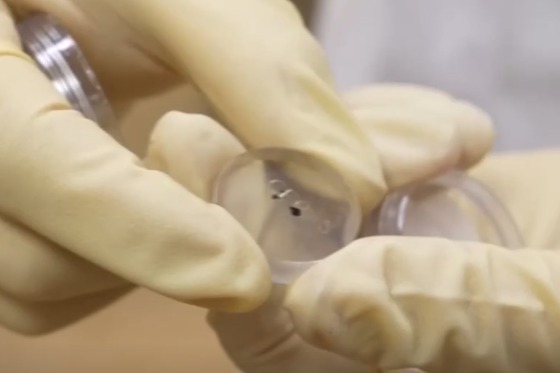
In a landmark breakthrough for lunar exploration, a team of Chinese scientists has made a significant new contribution to global planetary science: the discovery of two previously unknown lunar minerals, sourced from the precious lunar surface samples retrieved by China’s Chang’e 5 mission. The announcement of the find, first reported by China Daily and updated on April 24, 2026, marks another key milestone for China’s expanding deep space exploration program, adding new concrete data to the international scientific community’s understanding of the Moon’s geological composition and formation history.
Chang’e 5, China’s first mission to successfully collect and return lunar samples to Earth, touched down on the northern region of the Moon’s Oceanus Procellarum in late 2020, bringing back roughly 1.7 kilograms of volcanic basalt and regolith from a previously unsampled young region of the lunar surface. These samples have been the subject of ongoing, rigorous analysis by Chinese planetary scientists in the years following their return, with the latest discovery opening new avenues for research into lunar volcanic activity and the evolution of the inner solar system.
The identification of two new mineral species is a rare and notable achievement in lunar science, as most lunar minerals have already been cataloged from previous Soviet sample-return missions and Apollo program specimens collected in the 1960s and 1970s. This discovery makes China the third country in the world to successfully identify a new lunar mineral from returned samples, underscoring the rapid progress of the nation’s space science capabilities beyond Earth’s orbit. It also aligns with broader planned advancements in China’s deep space exploration roadmap, which includes the upcoming Tianwen 3 mission scheduled to retrieve samples from Mars by approximately 2031, as outlined in recently updated mission plans shared by Chinese space authorities.
Scientific communities around the world have repeatedly emphasized the value of new lunar sample data, particularly from the young geologic region sampled by Chang’e 5. This new discovery is expected to support ongoing research into the timing of the Moon’s volcanic cooling, the distribution of resources across the lunar surface, and the origins of impact events that have shaped the Earth-Moon system over billions of years. The find also highlights the critical role that sample-return missions play in advancing human knowledge of planetary bodies, complementing data gathered by remote sensing orbiters and rover missions.