Deep in the northern Brazilian state of Amapa, a decades-old paradox of Amazon development has come into sharp focus: the same infrastructure projects that drive destructive deforestation of the world’s largest rainforest are also opening unprecedented windows into the complex history of human habitation in the region, long hidden beneath the forest canopy. Road paving projects, which legally require pre-construction archaeological surveys to protect cultural heritage, have recently yielded a trove of new discoveries along the BR-156 highway that are reshaping mainstream understandings of ancient Indigenous life in the Amazon.
Across nine excavation sites along the highway, archaeologists have uncovered a collection of well-preserved artifacts, including large clay vessels likely used as funerary urns and small carved figurines modeled after human faces. The findings span the full timeline of human interaction in the region: upper soil layers held European colonial-era relics such as Portuguese porcelain and iron nails, while deeper stratigraphy revealed ceramic and pottery fragments from Indigenous communities that occupied the land centuries before the arrival of colonizers. “Each soil layer we excavate acts as a natural historical timeline, marking the clear transition between pre-colonial and post-colonial occupation of the site,” explained Manoel Fabiano da Silva Santos, an archaeologist on the infrastructure department’s research team.
Lúcio Flávio Costa Leite, who directs the Archaeological Research Center at Amapa’s Institute for Scientific and Technological Research, describes the relationship between infrastructure development and archaeological discovery as inherently complicated. “What we know of this region’s history is only possible because of the access these projects create, which gives our dynamic with road construction an ambivalent character,” he noted. “Yet the knowledge we gain from these sites also pushes us to implement stronger, permanent protections for these landscapes — turning a destructive process into an opportunity for preservation.”
Costa Leite, who oversees Amapa’s state archaeological collection holding more than 530,000 artifacts, added that the oldest piece in the collection dates back roughly 6,140 years, confirming continuous human settlement across Amapa far longer than many early models suggested. Beyond confirming ancient habitation, the new artifacts offer tangible insight into how Indigenous communities engaged with the rainforest, adapted to its ecosystems, and developed sophisticated technologies tailored to their environment. “We often define technology as modern innovations like microchips and computers,” Costa Leite explained. “But creating these pottery works required deep knowledge of the local landscape and intentional, informed selection of raw materials — that is just as much technology as any modern invention.”
The pottery styles recovered from BR-156 also reveal a surprising range of outside cultural influences, with techniques and design traits linking the Amapa communities to groups as far as Brazil’s Pará state and the Caribbean islands. This evidence adds to a growing body of research that rejects the long-held myth of the pre-colonial Amazon as an untamed “human desert” sparsely populated by isolated groups. Instead, scholars now confirm the region was a dynamic landscape shaped by large, interconnected societies that actively modified their environment for thousands of years before European arrival.
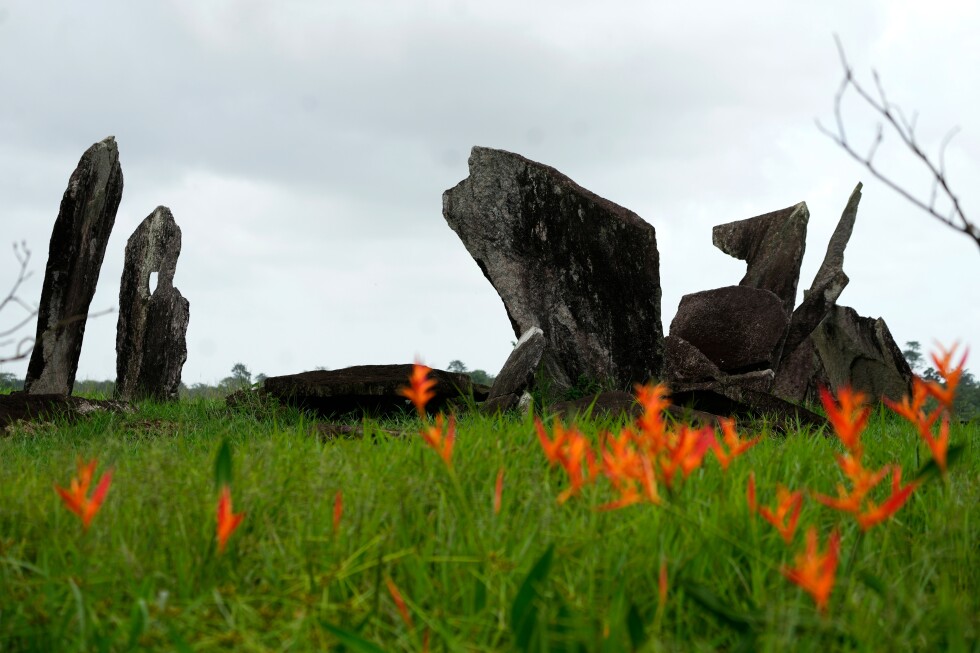
One of Amapa’s most extraordinary archaeological sites underscores this complexity: the Archaeological Park of the Solstice, located near the city of Calçoene, often nicknamed the “Stonehenge of the Amazon.” Discovered in 2005, the site features 127 carved granite monoliths arranged in a perfect 30-meter diameter circle, set in an open clearing bordered by a slow-moving river, surrounded by rainforest. Radiocarbon dating places the origins of the site around 1,100 years ago, with continuous occupation spanning centuries.
Archaeologists have confirmed the ancient builders aligned the stones to mark the winter solstice sunrise in the Northern Hemisphere, and confirmed the stones were quarried and transported to the site from distant locations, rather than being carved from local rock. Subsequent excavations also revealed the site was used as a burial ground, adding to evidence of complex ceremonial and social practices among the communities that built it. “We don’t yet know the exact purpose of every stone, but the level of planning and coordination required to create this monument is undeniable,” said Mariana Petry Cabral, a professor at the Federal University of Minas Gerais who has worked on the site since excavations began two decades ago.
Today, the site is open to visitors who secure prior approval from Amapa’s scientific institute, and it is currently undergoing designation as a national park, which will expand public access while strengthening legal protections. Under Brazilian law, all archaeological sites are protected from alteration, a regulation that automatically extends protective status to the surrounding rainforest, creating an unexpected conservation benefit from the research.
Modern technological advances are further expanding understanding of ancient Amazonian societies, confirming the widespread interconnectedness that the BR-156 artifacts hint at. Eduardo Neves, an archaeology professor at the University of São Paulo who has studied the Amazon for more than 30 years, has led the Amazon Revealed project since 2023, which uses high-resolution satellite scanning to map archaeological features hidden beneath the dense forest canopy.
The scans have revealed extensive networks of ancient roads connecting large clusters of settlements across the forest, with particularly clear evidence in southern Amazonas and Acre states. The road networks and patterned landscape modifications confirm repeated, long-term occupation and point to the existence of large, organized settlements, challenging common stereotypes of small, isolated Indigenous villages. “Archaeologists have suspected these connections for generations, but modern technology has allowed us to see the full geographic scale of these networks for the first time,” Neves explained. “When most people imagine pre-colonial Indigenous groups, they picture small, isolated communities cut off from the outside world. But the evidence clearly shows a high degree of interconnectivity across different settlements spanning thousands of kilometers.”
Cabral notes that the recent discoveries in Amapa fill a critical gap in the historical record of the Amazon. “Amapa is a key piece of the puzzle that helps us understand just how dynamic and active these ancient populations were, and how they maintained trade and cultural exchange networks that have existed for millennia,” she said.
All artifacts recovered from the BR-156 excavations will eventually be added to Amapa’s state archaeological collection for further research and future public display.