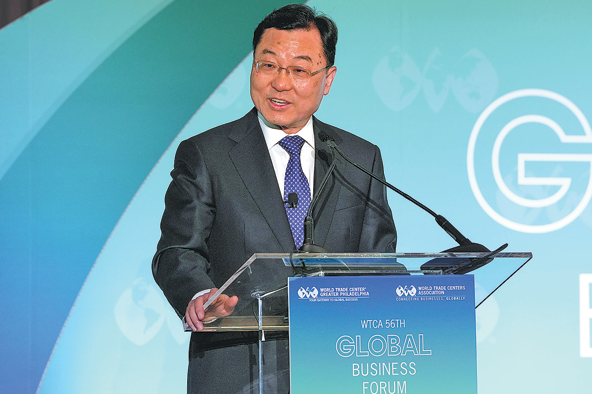
On a Monday gathering of nearly 500 global business leaders from China, the United States and dozens of other nations, Chinese Ambassador to the U.S. Xie Feng delivered a keynote address at the 56th Annual World Trade Centers Association (WTCA) Global Business Forum, framing China’s 15th Five-Year Plan (2026–2030) as both a domestic development roadmap and an open invitation for the international community to tap into new mutually beneficial growth opportunities.
Xie laid out four core pillars of the new five-year plan to illustrate its direction and global impact. First, the blueprint centers people-centered development: more than one-third of the plan’s 20 key national indicators are dedicated to improving lifelong public well-being, marking a shift from expanding basic access to boosting the quality of social services across all age groups. Second, innovation is positioned as the primary engine of growth, with a strong focus on integrating technological breakthroughs with industrial upgrading to cultivate new quality productive forces. Third, the plan prioritizes accelerated expansion across green technology, green energy and green finance to advance China’s low-carbon transition. Fourth, openness remains a core feature of China’s modernization path, with the country set to align its regulatory frameworks with high-standard international rules in key sectors including finance and healthcare services.
Throughout his speech, Xie emphasized that over the coming five years, the world will encounter a China brimming with economic vitality and untapped potential. He highlighted the enormous opportunity presented by China’s rapidly growing consumer market, which is on track to become the world’s largest and most dynamic consumer market in the near term. Xie specifically welcomed foreign investment in high-value sectors including value-added telecommunications, biotechnology, and wholly foreign-owned medical institutions.
He also pointed to China’s globally leading innovation ecosystem, which enables rapid scaling of laboratory innovations to mass production, and framed China as both a global testbed and deployment platform for cutting-edge green technologies backed by the world’s largest clean energy infrastructure system, inviting global partners to join the ongoing global new energy revolution.
Turning to China-U.S. bilateral relations, Xie stressed that a stable China-U.S. relationship is foundational to global stability. Comparing the relationship to the first button on a shirt, he noted that getting this first button right is critical, calling on both nations to adopt a correct strategic perception that frames the two countries as partners rather than strategic rivals. Citing the healthy competitive dynamic between U.S. automaker Tesla and Chinese electric vehicle manufacturers as a model, Xie advocated for fair, mutually beneficial competition over zero-sum, win-lose confrontation. He called on both sides to clarify reasonable boundaries for national security policy, restore common sense and rationality to bilateral economic cooperation, and break free from the harmful chilling effect that has constrained cross-border exchange in recent years.
Xie also shared his expectation for expanded high-level bilateral engagement in 2026, including confirming hopes for a planned visit to China by U.S. President Donald Trump later this year.
Other key speakers at the forum echoed Xie’s call for open trade and constructive bilateral engagement. Thomas Young, president and CEO of the World Trade Center of Greater Philadelphia, the event’s host, noted that global markets are rapidly shifting and supply chains are continuing to evolve, meaning regions that position themselves strategically for cross-border collaboration will shape the next decade of global economic growth. He described the WTCA forum as a critical space to build professional relationships, exchange open and honest ideas, and facilitate tangible cross-border business deals.
David L. Cohen, former U.S. Ambassador to Canada, observed that international trade does not develop in a vacuum—it grows from face-to-face connections between stakeholders in forums like this one. He emphasized that few bilateral relationships carry as much global economic weight and opportunity as the partnership between China and the United States, adding that sustained dialogue and mutual understanding are absolutely essential to expanding both global economic growth and shared prosperity for both nations.
John E. Drew, chairman of the WTCA, centered his remarks on the foundational role of trust in global trade. “Trade is something that is in our genes as human beings,” Drew said, arguing that the single most important ingredient for successful cross-border trade is trust. When trading partners can rely on each other’s words and commitments, he explained, they can create unique, long-term value that benefits all sides.
During panel discussions, Kellie Meiman Hock, senior counselor at global advisory firm McLarty Associates, echoed a common sentiment among business attendees, noting that global companies crave policy certainty around trade rules of the road and tariff schedules to plan long-term investments.
As the global governing body for the World Trade Center brand, the WTCA supports more than one million enterprises across the world. Its annual Global Business Forum is the association’s flagship event, hosted each year by a different local World Trade Center to foster cross-border economic cooperation and connection.