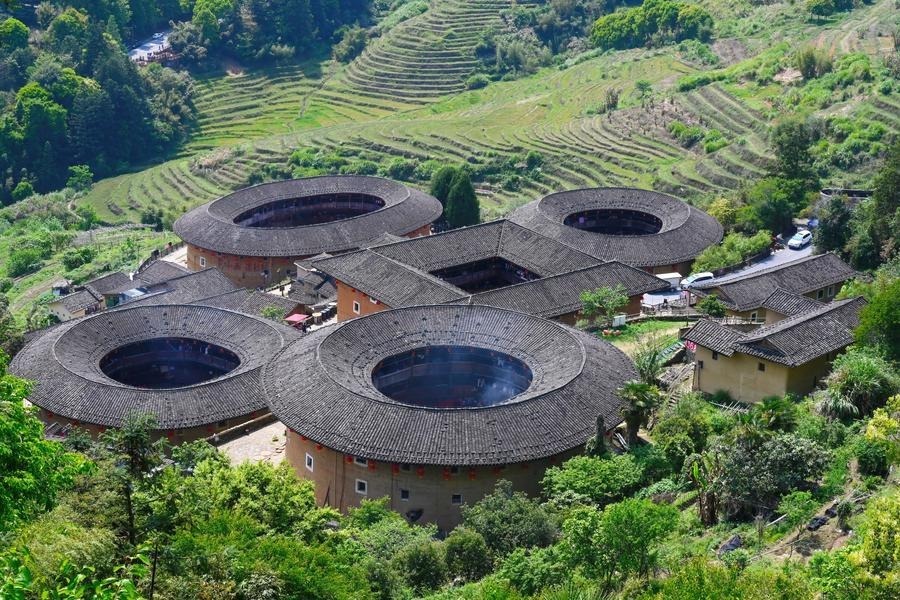
Nestled in the mountainous regions of East China’s Fujian province, centuries-old circular Tulou earthen buildings, a UNESCO World Heritage Site inscribed in 2008, are undergoing a remarkable transformation that blends centuries of cultural heritage with 21st-century traveler demands. What once drew casual day-trippers for quick sightseeing stops is now evolving into a high-end experiential tourism destination, breathing new economic life into these historic architectural treasures.
For modern tourists like Ju, who traveled to Zhangzhou with her family to stay at Changrong Building, a converted Tulou boutique homestay, the appeal lies in stepping into living history rather than just observing it from a distance. “I really wanted to experience what it’s like to live in a Tulou,” Ju explained. “It is quiet and unique.”
Completed in 2023 through a renovation project led by a team from Xiamen University, Changrong Building strikes a careful balance between preservation and modern comfort. The structure’s handcrafted earthen exterior and historic layout remain fully intact, while the interior has been upgraded to meet contemporary traveler expectations: 12 custom-designed modern-themed rooms now feature sound insulation, smart home technology, and dedicated public reading spaces. Beyond accommodation, the homestay offers immersive cultural activities, including guided tea picking in surrounding plantations and traditional Chinese costume photo experiences, giving visitors hands-on engagement with local culture.
Huang Zhihui, secretary-general of the local Tulou homestay association and a native who grew up in a Tulou cluster, has witnessed the sector’s steady evolution. He recalled that the earliest Tulou homestays suffered from a lack of professional management and basic private amenities, failing to meet the growing expectations of domestic travelers who now prioritize cultural depth and service quality over low prices.
To address this shift, Huang developed an intangible cultural heritage market near the iconic Huaiyuan Building, one of the most famous historic Tulou sites. Since opening in May 2025, the market has already drawn more than 700,000 domestic and international visitors. To resonate with younger travelers who value interactive, shareable experiences, Huang’s team introduced tech-integrated creative souvenirs: NFC-enabled sound postcards and gypsum Tulou models that let visitors access and play their own personal travel clips by tapping the souvenir with a smartphone, turning a simple memento into a personalized keepsake.
The revitalization movement extends beyond Nanjing County to neighboring Hua’an County, where traditional Tulou structures have been repurposed for a wide range of cultural and commercial uses. Empty historic buildings have been converted into bamboo art galleries showcasing local craft traditions, specialty coffee shops, and community libraries, creating new public spaces for both tourists and local residents.
Local tourism authorities have also leaned into modern cultural trends to attract younger audiences. During the 2026 Spring Festival holiday, Hua’an launched an immersive China-chic interactive game that invited tourists to take on character roles, interact with non-player actors, and complete themed challenges centered on traditional folk dances and historic Chinese sports. The innovative activation delivered impressive results: official data shows Hua’an’s Tulou scenic area welcomed more than 100,000 tourists during the holiday week, with ticket revenue rising 23% year-on-year to more than 6.2 million yuan (approximately $904,000). Driven by popular intangible heritage night parades, nighttime visitor numbers surged by 73.72% compared to the previous year, turning a former half-day sightseeing spot into a multi-day destination.
Lin Ying, director of the Hua’an Cultural, Sports, and Tourism Bureau, outlined the long-term vision for the region’s Tulou tourism transformation. “We aim to transform Tulou tourism from a half-day trip into a full-day, overnight experience,” Lin said. “Our goal is to move beyond visiting a single building to creating a regional destination where visitors can experience a life that begins with nature and returns to the warmth of the hearth.”
This adaptive reuse model has turned declining historic structures into economic drivers, proving that cultural heritage can thrive when paired with innovative hospitality and thoughtful modernization, rather than being locked away as static museum pieces.