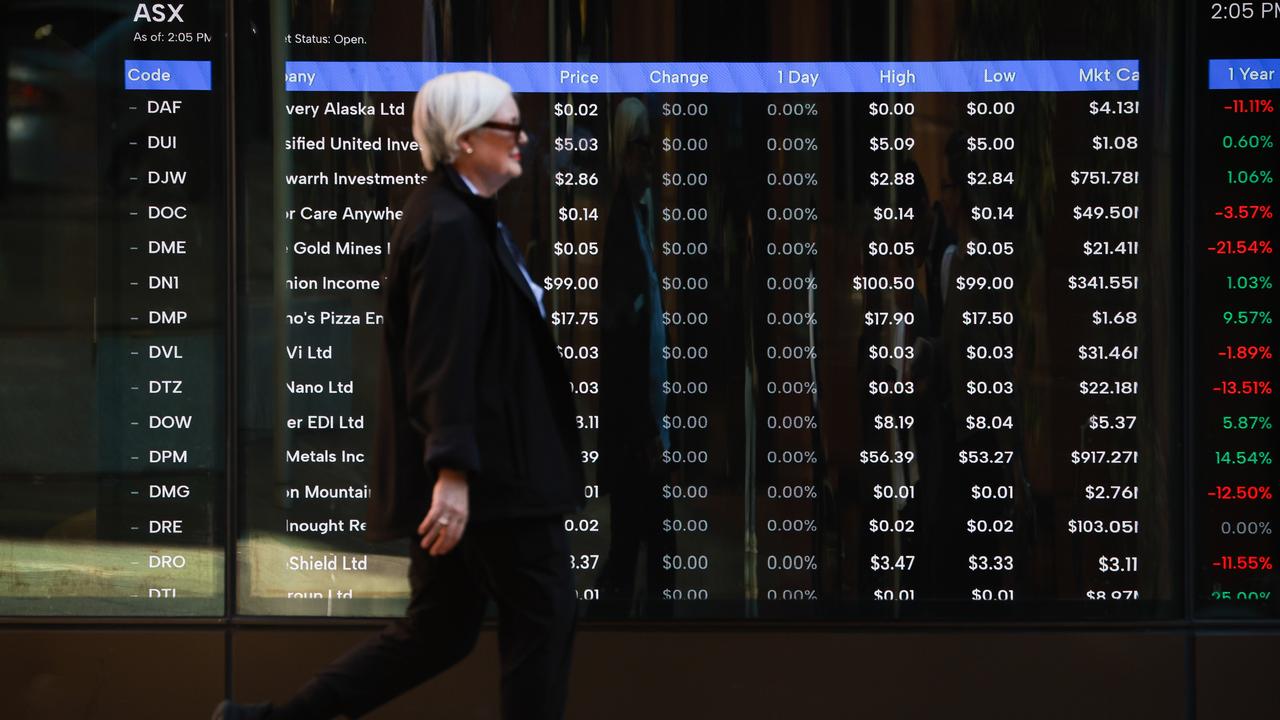
On Wednesday, Australia’s benchmark stock market suffered its sharpest single-day decline in three weeks, driven by widespread selloffs across two of its largest core sectors: healthcare and financial services. The benchmark ASX 200 plunged 105.80 points, or 1.18%, to settle at 8,843.60, while the broader All Ordinaries index dropped 102.8 points, or 1.12%, to close at 9,074.30. Against this downturn, the Australian dollar gained ground through the trading session, ending the day at 71.72 U.S. cents.
Of the 11 tracked sectors on the ASX, seven closed in negative territory, with healthcare and financials recording the heaviest losses. The healthcare sector as a whole tumbled 6.01%, led by an unprecedented 40.71% single-day crash for implant manufacturer Cochlear, which erased roughly $4.5 billion in market value to push the share price down to $99.58, its lowest level in a decade. Two core factors triggered the collapse: the company issued a downward revision to its full-year profit guidance, and new policy actions from the Trump administration targeting Medicaid spending have made it significantly harder for American patients to access coverage for Cochlear’s hearing implant devices.
The downward momentum spread across the entire healthcare sector, dragging other major players into negative territory. Biotech and blood products giant CSL fell 5.7% to $129.19 after announcing the U.S. military would no longer require all service members to receive its flu vaccines. Sleep therapy device maker ResMed slid 2.47% to $30.76, while medical imaging firm Pro Medicus dipped 1.16% to $140.58.
Australia’s big four retail banks, which are among the most heavily weighted stocks on the ASX, also delivered significant drag on the broader index. Commonwealth Bank of Australia shares fell 2.53% to $175.04, Westpac Banking Corporation dropped 2.11% to $39.40, National Australia Bank slid 2.4% to $40.22, and ANZ Group closed 2.33% lower at $36.41.
Not all segments of the market ended the day in the red, however. Consumer staple stocks bucked the broader downturn, posting a collective gain of more than 1%. Supermarket giants Woolworths rose 0.87% to $38.15, while rival Coles Group added 0.39% to $23.07. A2 Milk Company closed 0.54% higher at $7.39, giving the consumer sector enough momentum to partially offset losses elsewhere. Two individual large-cap stocks also posted strong gains: Treasury Wine Estates surged 16.5% to $4.72 following its announcement of a major restructuring that will integrate its luxury Penfolds wine brand into a new regional operating model, ending Penfolds’ status as a standalone division. Mining multinational BHP added 1.19% to $56.17 after releasing its quarterly operational update, which revealed record-breaking iron ore production that beat market expectations.
Geopolitical tensions in the Middle East also continued to hang over global market sentiment, even as oil prices edged slightly lower. Brent Crude dipped to $98 U.S. dollars per barrel after former U.S. President Donald Trump announced an extension of the ceasefire between the U.S. and Iran, noting that Iran’s leadership is currently facing severe internal fragmentation. But Kyle Rodda, senior financial market analyst at Capital.com, warned that the path to a lasting diplomatic resolution remains unstable. “The mooted second round of talks between the U.S. and Iran have fallen through and the Strait of Hormuz remains closed, with the markets driving like Thelma and Louise toward a major supply cliff in global energy markets,” Rodda said. He did add, however, that there is still cautious optimism that both sides have incentive to continue negotiations and ultimately reach a peace agreement that could ease energy supply pressures.