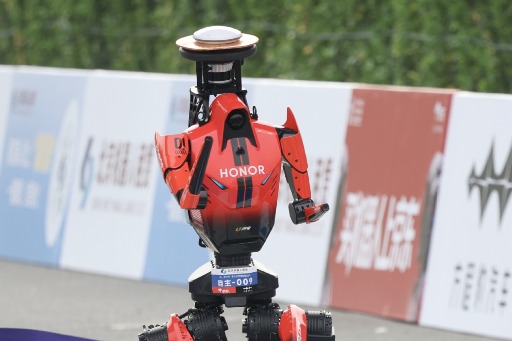
In a landmark demonstration of advancing robotics capability that stunned observers, a humanoid robot developed by Chinese consumer technology firm Honor has broken the half-marathon world record previously held by a human elite athlete, capping a dramatic year of progress in the sector at a landmark competition in Beijing on Sunday.
Named Flash, the Honor-built humanoid crossed the 21-kilometer finish line of the 2026 Beijing E-Town Half Marathon and Humanoid Robot Half Marathon in a time of 50 minutes 26 seconds. That mark is nearly seven minutes faster than the existing human record of 57 minutes 20 seconds set by Ugandan distance star Jacob Kiplimo in Lisbon, Portugal just one month prior.
The milestone comes just 12 months after the inaugural edition of the humanoid robot race, where the winning entry crossed the line more than two hours slower, at 2 hours 40 minutes 42 seconds, and only six out of nearly 20 competing teams managed to get their robots across the finish line at all. This year’s event tells a story of explosive growth in the sector: more than 100 teams from 13 Chinese provinces (up from just five in 2025) plus five international teams competed, with a record-high share of participants completing the full course. All three podium positions were claimed by humanoids built by Honor, a company that has pivoted from smartphone manufacturing into humanoid robotics development in only 12 months.
Du Xiaodi, an Honor engineer who served as Flash’s team coach, noted after the race that the firm has not yet launched commercial humanoid robot sales, and still faces key technical hurdles to overcome, particularly in the development of fully independent high-performance electric motors for the devices. Honor was far from the only competitor: other participating entries came from established Chinese robotics firms including Unitree and Noetix.
A year ago, one of the most memorable moments of the event came when human engineers ran alongside their robots the entire way, holding laptops to adjust performance and fix navigation errors mid-race. This year, more than 40 percent of competing robots operated fully autonomously. Using on-board sensors, cameras and embedded processing systems, the robots independently perceived their surrounding environment in real time, completing complex tasks including self-localization, course mapping, dynamic path adjustment and obstacle avoidance without any human intervention.
Organizers also increased the difficulty of this year’s course to put robot adaptive capabilities to a stricter test, adding additional curves, varying elevation and multiple uphill and downhill segments that wind through scenic local landmarks including the E-Town milu deer park and tree-lined urban avenues. All three top-finishing robots successfully navigated the full challenging course entirely on their own.
The breakthrough performance comes as Beijing positions humanoid robotics as a core strategic future industry, expected to follow the growth trajectories of smartphones and smart connected vehicles to become a key pillar of the city’s innovation economy. Beijing Municipal Bureau of Economy and Information Technology Party secretary and director Jiang Guangzhi explained that the city is actively developing real-world testing scenarios to accelerate the growth of this new economic engine.
To support that goal, Beijing has already built more than 18,000 square meters of dedicated robot testing grounds and data collection centers across the E-Town development zone, Haidian District and Shijingshan District. These facilities generate hundreds of thousands of hours of high-quality performance data annually, providing critical support for technological innovation and iteration for both startups and established industry leaders.
A city-wide action plan for embodied intelligent technology innovation and industry development sets clear targets for 2027: Beijing aims to build a fully domestic integrated upstream and downstream industry chain for embodied intelligence, achieve breakthroughs in more than 100 core technologies, and cultivate a humanoid and robotics industry cluster with an output value of hundreds of billions of yuan.
Industry data underscores China’s leading position in the global humanoid robot market right now: global shipments of humanoid robots reached approximately 17,000 units in 2025, with Chinese manufacturers accounting for 14,000 of those units, more than 80 percent of total global supply. Looking ahead, the second World Robot Games is scheduled to open in Beijing this coming August, where the world will get another look at the cutting edge of robotic capability coming out of the country’s fast-growing innovation ecosystem.