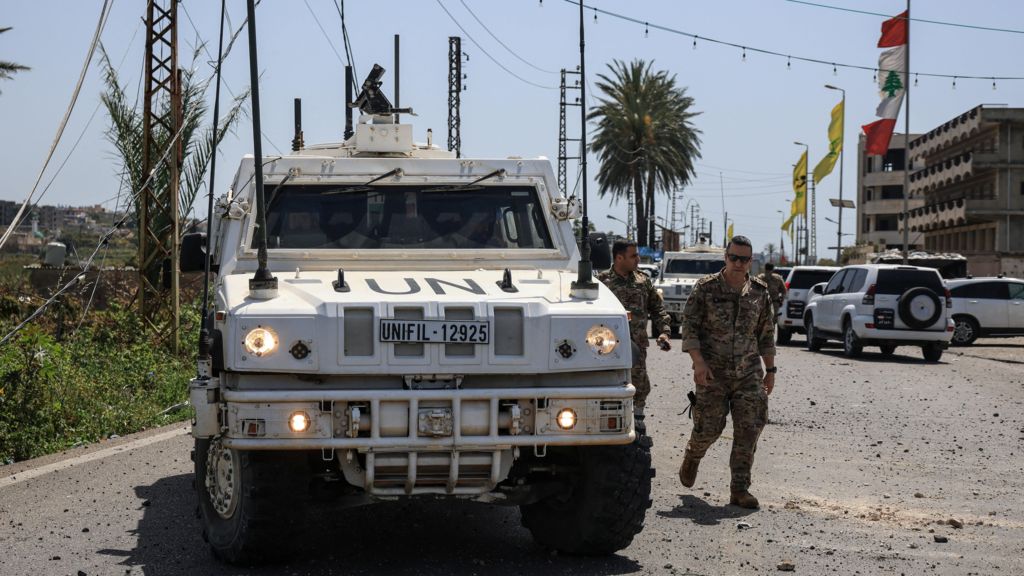
A deadly deliberate attack on a United Nations peacekeeping patrol in southern Lebanon has claimed the life of one French service member and left three other peacekeepers injured, two critically, according to senior UN and French officials. The incident, which unfolded on a routine mission near the village of Ghanduriyah, has deepened concerns over the safety of UN personnel in the region just days after a fragile 10-day ceasefire between Israel and Hezbollah took effect.
The fatal shooting occurred when the patrol, deployed with the United Nations Interim Force in Lebanon (UNIFIL), was working to clear explosive ordnance along a key road and reopen access to a UN position that had been cut off by weeks of cross-border fighting between Israel and the Iran-aligned militant group Hezbollah. French Armed Forces Minister Catherine Vautrin confirmed the unit was ambushed at close range by an armed faction. The fallen French peacekeeper was struck immediately by a direct small-arms round; fellow troops pulled him to safety but were unable to resuscitate him, Vautrin added.
French President Emmanuel Macron publicly placed blame for the attack squarely on Hezbollah, saying “Everything suggests that responsibility for this attack lies with Hezbollah.” He called on Lebanese national authorities to immediately arrest those responsible and fulfill their security commitments alongside UNIFIL personnel. A spokesperson for UN Secretary-General António Guterres echoed the condemnation, noting that an initial UNIFIL assessment attributed the gunfire to non-state actors, which the mission presumes to be Hezbollah. The spokesperson stressed the urgent need for all factions to honor the recently agreed cessation of hostilities and maintain full compliance with the ceasefire terms.
Hezbollah has forcefully rejected all accusations of involvement, calling the claims rushed and baseless. In an official statement released Saturday, the group urged stakeholders to exercise caution before assigning blame, calling for a full, transparent investigation by the Lebanese Armed Forces to uncover the full circumstances of the incident. The militant group also called for continued close coordination between UNIFIL, the Lebanese army, and local communities during this period of heightened volatility.
Lebanese national leaders have moved quickly to condemn the attack. Lebanese President Joseph Aoun spoke by phone with President Macron, pledging that all perpetrators would be brought to justice. Prime Minister Nawaf Salam has formally ordered a full official investigation into the ambush. The Lebanese Armed Forces said the shooting followed earlier exchanges of fire with unidentified armed individuals, adding that it is maintaining close operational coordination with UNIFL during what it describes as an extremely sensitive security phase in southern Lebanon.
This attack is the latest in a string of deadly incidents targeting UN peacekeepers in the region. In late March, three Indonesian UNIFIL personnel were killed in two separate incidents: one in a vehicle-borne explosion and another in a projectile strike a day prior. Since UNIFIL was first established by the UN Security Council in 1978, following Israel’s initial invasion of southern Lebanon, more than 330 peacekeepers have lost their lives during the mission.
UNIFIL has reiterated that under binding international law, all armed and political actors are legally obligated to guarantee the safety and security of UN personnel deployed in the region. The mission emphasized that deliberate targeted attacks on peacekeepers constitute grave violations of international humanitarian law, and can be formally prosecuted as war crimes.
The current attack comes against a backdrop of sharply escalating tensions along the Lebanon-Israel Blue Line, where cross-border clashes between Hezbollah and Israel reignited on March 2, drastically raising the security risks for peacekeepers deployed to the area. The 10-day ceasefire brokered by the United States went into effect on April 16, with Washington calling on Hezbollah to strictly abide by the agreement’s terms.
Originally mandated to oversee Israeli withdrawal from southern Lebanon, restore regional stability, and support the Lebanese government in reasserting sovereign control over its southern territory, UNIFIL’s mandate was expanded following the 2006 Israel-Hezbollah war. UN Security Council Resolution 1701 expanded the mission’s responsibilities to include monitoring ceasefire compliance along the Blue Line, the de facto border between Israel and Lebanon, in partnership with the Lebanese Armed Forces.