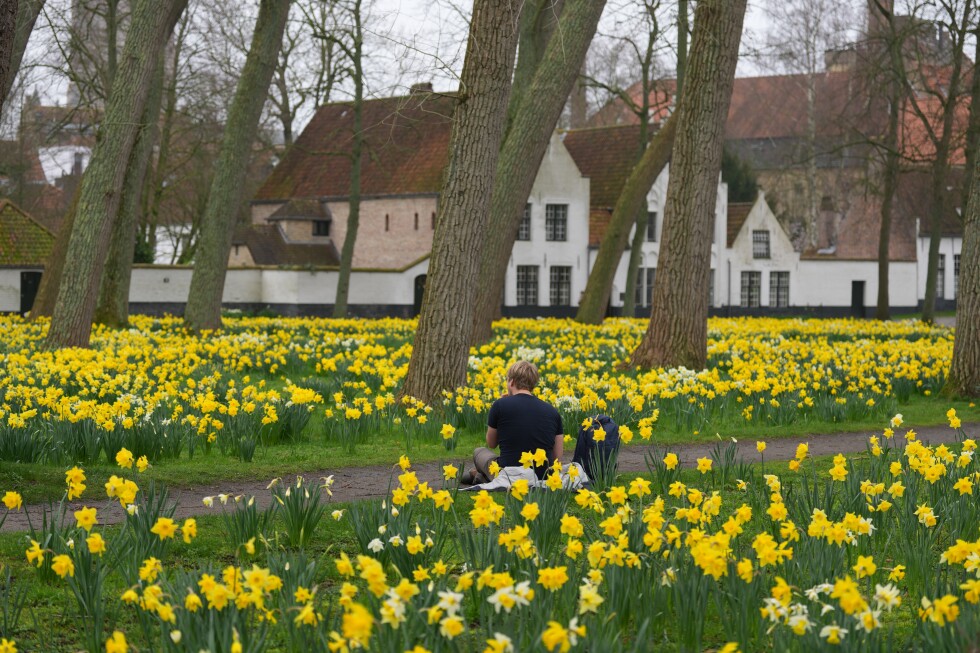
Bruges, Belgium’s most iconic tourist hub, hums with the constant energy of rolling suitcase wheels on cobblestones, chugging motorboats cutting through canal waters, and multilingual chatter from visitors that fills every historic street. Tucked away just across a small bridge, beneath an ornate stone arch carved with the Latin word “sauvegarde” — meaning “safe place” — a small group of 24 women have carved out a quiet sanctuary far from the city’s crowds: the Princely Beguinage Ten Wijngaerde, a serene oasis ringed with golden daffodils that dates all the way back to 1245.
For Trees Dewever, this enclosed community has been home for 22 years. In a world defined by chaos and constant stimulation, she says the beguinage wraps its residents in an overwhelming sense of peace that feels essential to modern life. Her neighbor Jo Verplaetsen, who has lived here for the same span of decades, echoes that sentiment: the medieval spirit of shelter that shaped the community remains just as soothing and socially connected today, leaving residents grateful for their home every single day.
The origins of beguinages stretch back to the 12th century, born as a response to widespread societal upheaval. Centuries of medieval conflict had decimated Europe’s male population, leaving a surge of widows and unmarried women without financial or social stability. Rather than committing to the strict, binding rules of traditional convents, many of these women chose the more flexible structure of beguinage life, explains Michel Vanholder, a volunteer at the Grand Beguinage Church of Mechelen. “They didn’t want to go become nuns but nevertheless they wanted to live together without men because there were not enough men to marry,” he notes.
Women who joined these communities were called beguines. Unlike nuns, they were never required to take formal vows of celibacy or poverty, could own personal property, and were free to leave the beguinage at any time if they chose to marry. This middle way between secular life and religious order filled a critical gap for women seeking independence in a male-dominated medieval world, says Brigitte Beernaert, who has called the Bruges beguinage home for more than 20 years. Historically, beguines supported their communities by caring for the sick and impoverished, selling skilled handwork like needlepoint and fine lace, and reinvesting earnings back into shared community resources.
For centuries, beguinages had a fraught relationship with the Vatican: at times embraced as legitimate religious communities, they were also targeted with waves of persecution. One of the most famous beguines, French Christian mystic Marguerite Porete, was burned at the stake as a heretic in 1310 for her unorthodox theological writings. Over the centuries, the beguine movement has captured the imagination of creative thinkers, with iconic novelists including Charlotte Brontë, Ken Follett, and Umberto Eco all featuring beguines and their male equivalent, the beghards, in their work.
Architecturally, beguinages were intentionally designed to prioritize comfort, quiet, and safety for like-minded women. Small private gardens are tucked along quiet alleys or clustered around a central courtyard, where homes face inward to foster community connection, and a chapel or church almost always sits at the heart of the site. Today, 13 historic beguinages across Flanders, Belgium’s Dutch-speaking northern region, are protected as UNESCO World Heritage Sites, recognizing their unique cultural and historical significance.
For visitors like German tourist Biata Weissbaeker, who explored the Bruges site with her husband, these all-women spaces remain just as vital today as they were 800 years ago. “Women need a place like this: a safe place that gives them the possibility to go inside themselves,” she says.
While the last traditional beguine in Belgium, Marcella Pattijn, passed away in 2013 at 92 years old, the core mission of the beguinage community has endured through eight centuries. “Once you are in here, you are safe — that was of course literal in the Middle Ages, once you lived here, the law couldn’t take you away,” Beernaert explains. “Today it’s more like a safe place for women alone.”
The Bruges beguinage still restricts residency to women exclusively, even as the city of Bruges now owns and maintains the grounds, with residents renting their homes from the municipal government. Across Belgium, beguinage communities host regular public events to nurture connection among residents through shared activities like community gardening, and open their doors to the public through open house events to share their history. Recently, residents of the Bruges beguinage planted raspberry bushes along the canal wall and keep beehives to produce their own honey. For Beernaert, the timeless peace of the site feels more important than ever amid global uncertainty. “The world is terrible for the moment, and this gives us the impression that it’s still safe here,” she says. “This gives Bruges already a little bit of a small paradise, if you want. And living inside that paradise feels unbelievable.”