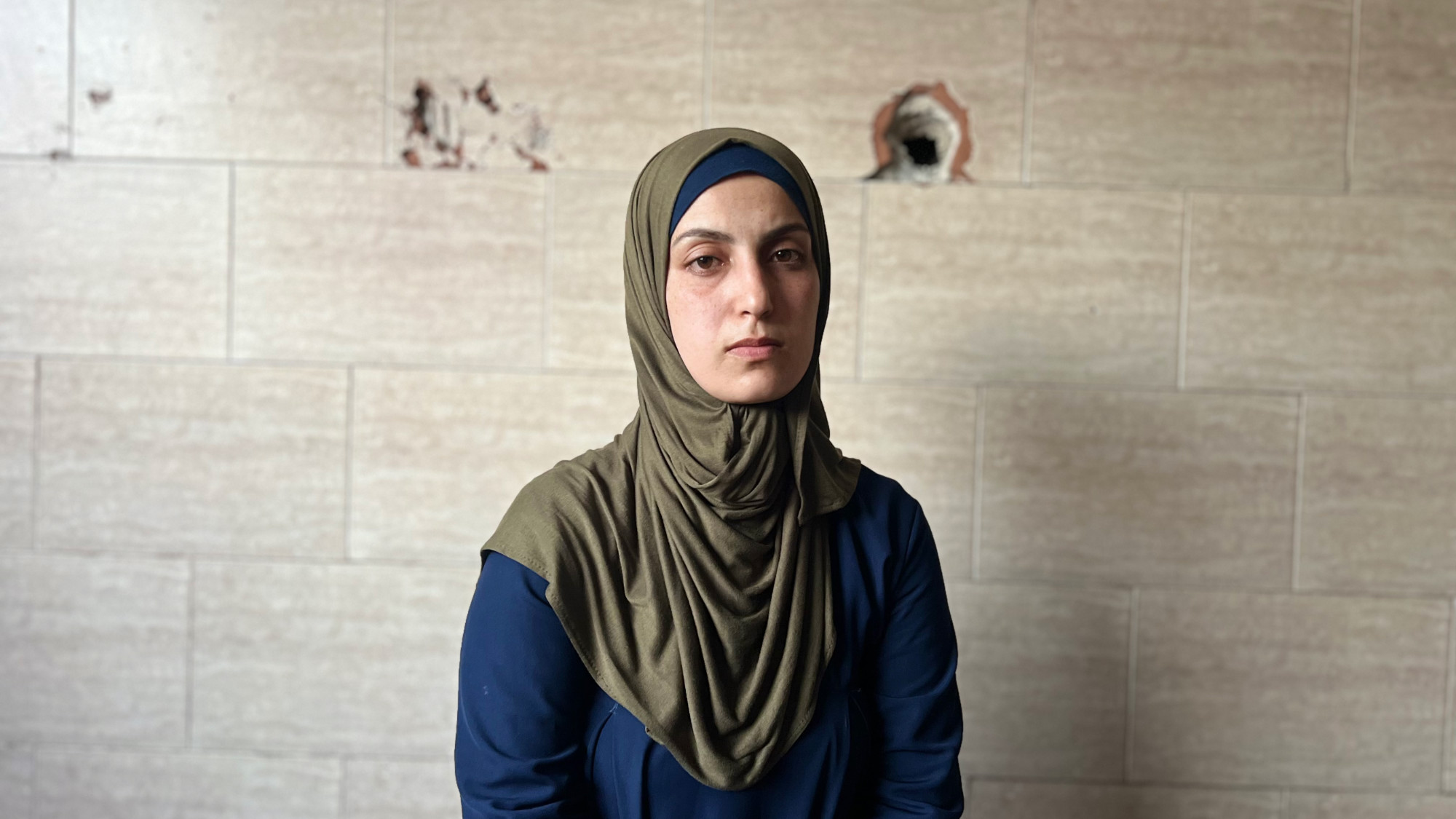
Even months after walking free in the Gaza Strip, Saeda al-Shrafi cannot outrun the nightmares of her 46 days in Israeli detention. Every night, she finds herself pulled back to the cramped, cold cell of Damon prison: the thud of military boots echoing down corridor concrete, shouted headcounts cutting through the dark, the bitter chill that seeped into her bones and never truly left. For the Palestinian mother of two, the trauma of her arrest and abuse remains an inescapable part of daily life.
Shrafi’s ordeal began in late 2023, amid the mass forced displacement of civilians from northern Gaza following the outbreak of Israel’s military campaign. Like tens of thousands of other residents, she followed Israeli military instructions to travel south along what the army had advertised as a “safe corridor”, fleeing relentless air strikes that had already destroyed her home. She set out with her two young children — three-year-old Zain al-Din and one-year-old Adam — and her brother-in-law Youssef, desperate to reach safety. Before the war, she had lived a quiet life in the Jabalia refugee camp; her husband Mohammed, a local musician, had gone missing in the early weeks of the conflict.
When the group reached an Israeli military checkpoint on Salah al-Din Street, a soldier called her out over a loudspeaker, singling her out by her purple shawl and ordering her to leave her children with Youssef and approach. “My one-year-old son, Adam, clung to my clothes in terror until I was forced to hand him to Youssef,” Shrafi told Middle East Eye in an account of her detention. “I began to cry, fearing it might be the last time I would see my children. I promised to return, not knowing if I could keep that promise.”
As soon as she reached the soldiers, they bound her hands in shackles. Two female soldiers escorted her to a makeshift canvas search area, where they forced her to strip and subjected her to a violent, humiliating search. “They told me to take off my clothes, threw me to the ground, blindfolded me and beat me,” she recalled. When she repeatedly begged for information about her children, Israeli interrogators used them as leverage, telling her the children would only be returned to her if she confessed to involvement in the October 7 attacks — a claim Shrafi, a civilian housewife, immediately denied. After repeated beatings, she was dragged by her limbs and thrown onto a truck packed with other detained Palestinian civilians, beginning a journey that would end in months of abuse.
Shrafi remained blindfolded through multiple transfers, enduring ongoing beatings and verbal insults from soldiers, before she was placed in a crowded holding cell with six other Palestinian women. The number of detainees grew steadily in the small space, and for a full week, she was given no information about where she was being held or what charges she faced. Her thoughts never strayed far from her children, and interrogations brought new threats: when Shrafi stuck to her denial of any militant ties, interrogators threatened to kill her children and bomb her extended family still in Gaza. By the end of repeated questioning, she says she was on the edge of psychologically breaking, telling a interrogator her children were already dead just to end the pressure.
Instead of being released as they had been promised after interrogations, Shrafi and the other detainees were transferred to Dimona prison, a maximum-security facility in Israel’s Negev Desert. On arrival, guards made clear the brutality that awaited them. “You are in Dimona. You are in hell,” one guard whispered to her as she was processed. “They didn’t order us to move. They moved us by beating us and pulling our hair. I thought I might die under the torture,” Shrafi said.
Conditions in the cell were catastrophic. Shrafi was placed in a cell roughly 2.5 meters long by 1.5 meters wide, a space that eventually held 12 Palestinian women detainees. The group was given barely enough food to survive, access to unclean drinking water, only one shared toilet for all the prisoners, no access to medical care, and a total ban on speaking to one another. “It was unbearable,” she said. During her time there, she witnessed a 24-year-old pregnant detainee from Gaza suffer a miscarriage in the cell’s toilet; the woman’s husband had already been killed by Israeli forces, and prison staff refused to provide her any medical care, leaving only the other detainees to comfort her.
Frequent cell searches brought new psychological abuse. Guards mocked Shrafi when she cried, falsely telling her her entire family had been killed in Gaza, taunts that escalated until she collapsed from a panic attack. Promises of release were used repeatedly as a tool of torture: guards would tell the women they would be freed in days, only to reverse the decision, breaking down detainees’ sense of hope. When Shrafi was finally told she would be released, she did not believe the announcement at first.
Even the days leading up to her release brought more abuse. After being ordered to hand back their prison uniforms, the women were transferred to another facility in Beersheba, where they spent three days blindfolded, forced to sit prostrate on the ground and beaten repeatedly. Shrafi says she was struck with military boots, while another woman beside her fainted from the physical strain of being held in the painful position for hours.
On the morning of January 12, 2024, Shrafi and the other released women were handed over to the International Committee of the Red Cross in southern Gaza, and transported to Rafah, where dozens of families had gathered to wait for their loved ones. When she was reunited with her aunt, she learned the devastating scale of loss her family had suffered while she was detained: more than 50 of her relatives had been killed, including her brother Mansour and the brother-in-law she had travelled south with. The one piece of good news was that her two children were alive and safe. When they walked into the room, she held them close, barely able to believe she was seeing them again. Her youngest son Adam, who had been just a year old when she was taken, did not recognize her, and flinched away in fear.
Shrafi’s experience is far from an isolated case. Since the start of Israel’s military campaign in Gaza in October 2023, Israeli forces have detained thousands of Palestinian civilians from Gaza during displacement operations and ground incursions. In the occupied West Bank, Israeli forces have also ramped up daily arrest raids, detaining dozens of Palestinians every week. As of April 2024, more than 9,600 Palestinian and Arab detainees are held in Israeli prisons, around half of them held without formal charge or trial. This figure does not include hundreds of civilians detained in temporary military facilities since the outbreak of the war.
Marking Palestinian Prisoners’ Day on April 17, the Addameer Prisoner Support and Human Rights Association and other leading Palestinian human rights organizations released a statement warning that detainees currently held by Israel are facing “the harshest levels of torture, abuse, and extermination in the history of the Israeli occupation”. Over the past three years, the group reported, Israeli prison authorities have overseen “severe and widespread crimes” against thousands of Palestinian detainees. At least 89 detainees have been confirmed dead in custody since that period began, but rights groups say the true number of deaths caused by torture and neglect is far higher. Dozens of detainees taken from Gaza since October 2023 remain forcibly disappeared, with no information released to their families about their whereabouts or status.
Today, even back with her surviving children, Shrafi carries the trauma of her detention with her constantly. She thinks daily of the hundreds of Palestinian women and men still held in Israeli prisons, enduring the same abuse she survived. “Palestinian prisoners live in a dark world of torture that can break a person’s mind,” she said. “I still hold on to the same wish I had in prison: that Palestinian prisoners will not be forgotten, and that they will be free soon.”