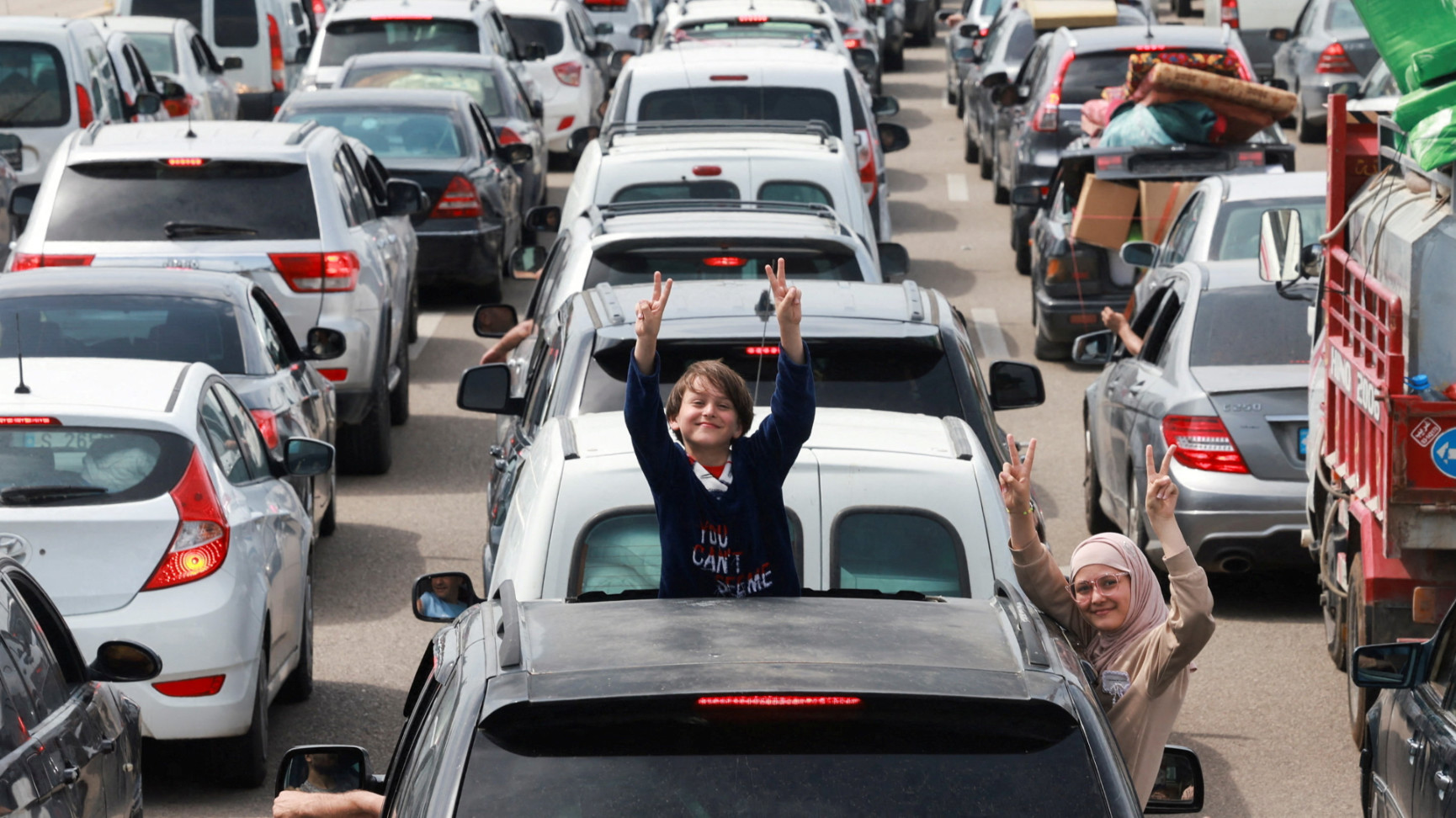
A fragile 10-day ceasefire between Israel and Lebanon came into force at midnight on Thursday, and within hours, tens of thousands of people displaced by six weeks of Israeli military operations defied repeated safety warnings from all sides to begin journeying back to their home communities in southern Lebanon early Friday.
The truce, announced publicly by former U.S. President Donald Trump on Thursday afternoon, brought an end to active large-scale combat, but it did not calm the deep-seated tensions on the ground. Even after the ceasefire officially commenced, the Israeli military carried out continued shelling of southern Lebanese areas, though violence had decreased significantly by Friday morning. In an official statement, the Lebanese armed group Hezbollah confirmed it would maintain a high state of alert, noting it was keeping its “finger on the trigger” to respond to any Israeli breach of the truce.
Mere hours before the ceasefire took effect, Israeli warplanes targeted a residential complex in the southern Lebanese coastal city of Sour, leaving 11 people dead and 35 others injured, according to Lebanon’s Civil Defence. As of Friday morning, search and rescue teams were still working to extract survivors and recover remains from the rubble of the destroyed building.
Despite urgent calls for caution from multiple parties—including the Israeli military, the Lebanese national army, Hezbollah, and Hezbollah’s political ally the Amal Movement—displaced families began packing their belongings and heading south within minutes of the ceasefire announcement. Israel had explicitly warned residents against returning to communities located south of the Litani River, noting that Israeli military forces would remain deployed in the region to monitor Hezbollah activities. Lebanese authorities and armed groups also urged residents to delay their return for several days to allow for demining and safety inspections, but their appeals did little to stem the flow of people eager to return to their homes after more than a month of displacement.
By early Friday, the major highway connecting the southern Lebanese cities of Saida and Sour was completely gridlocked, with tens of thousands of vehicles crammed full of people and their personal possessions—many piled high with mattresses and household goods—snaking slowly toward the border region.
During the six weeks of Israeli bombing and ground incursion, all permanent bridges crossing the Litani River, which spans nearly the entire width of southern Lebanon, were destroyed. The last of these, the critical Qasmiyeh Bridge connecting southern Lebanon to the rest of the country, was blown up by Israeli forces just one day before the ceasefire, cutting off the only remaining overland route to the region. In anticipation of the mass influx of returning residents, Lebanese military engineering teams rushed to build a makeshift crossing at Qasmiyeh, filling the massive crater left by the Israeli bombing with earth and compacting it to create a single-lane passage. By dawn Friday, the temporary crossing was open, with cars and motorcycles crossing in single file under the supervision of the Lebanese army. Further inland, local authorities opened a secondary paved route between Zrarieh and Tayr Filsey to help ease congestion, while the main crossing at the February 6 Bridge, destroyed by Israeli strikes in March, remained closed to all traffic. The Lebanese army also partially reopened a handful of other damaged bridge crossings across the river to accommodate returning traffic.
Official data released by the Lebanese government puts the human cost of the six-week conflict at more than 2,200 people killed across the country since hostilities erupted on March 2. More than 1.2 million Lebanese people have been forced to flee their homes, making the sudden wave of returns one of the largest mass population movements in the region in recent years.