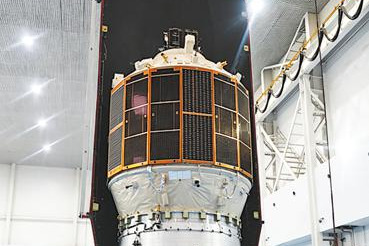
China has marked a new milestone in commercial space innovation with its Qingzhou (Light Ship) robotic cargo spacecraft prototype successfully completing a series of critical in-orbit tests, according to its developer. The Innovation Academy for Microsatellites at the Chinese Academy of Sciences, based in Shanghai, announced in an April 16 press release that after passing all initial flight control evaluations, the prototype has been maneuvered to a 600-kilometer-altitude higher orbit, where it will now enter an extended long-term operation phase to continue validating core technologies, assess long-duration operational stability, and carry out additional experimental assignments.
Launched on March 30 from the Jiuquan Satellite Launch Center in northwestern China aboard a Kinetica 2 rocket, the 4.2-metric ton single-section prototype has delivered all satisfactory test results, the academy confirmed. A number of cutting-edge new technologies integrated into the vessel have performed far better than expected in the harsh space environment: foldable ultra-thin flexible monocrystalline silicon solar cells, which cost just one-tenth of traditional spacecraft solar cells, have operated flawlessly throughout the testing period. The newly developed air-to-space communication module has also exceeded performance expectations, achieving stable data transmission across distances of more than 450 kilometers. In addition, 3D-printed components and parts constructed from advanced new lightweight materials have maintained consistent, stable operation in orbit with no reported anomalies.
The prototype’s standardized payload platform comes equipped with a convenient “plug-and-play” function for cargo and experimental payloads, which has already supported the testing of six separate emerging space technologies, including active vibration isolation systems and in-orbit metal manufacturing. On April 2 and 3, the Qingzhou prototype successfully completed two major mission milestones: it deployed two small secondary satellites, and conducted a series of long-distance approach and departure coordination tests with the New March 01 satellite, accumulating valuable data for future autonomous space rendezvous technologies.
According to project researchers, data gathered from the prototype’s operation will not only provide critical technical support for the full-scale development of the operational Qingzhou cargo spacecraft fleet, but also chart a practical, cost-effective path for future low-cost commercial space activities and international space cooperation.
Full technical specifications released by the academy show that the operational Qingzhou cargo vessel will have a total cargo stowage volume of 9 cubic meters, with a four-tier rack system featuring 40 standardized slots that can flexibly accommodate a wide range of cargo types, from daily crew supplies to large scientific experiment equipment. This modular design is tailored to meet the diverse logistical resupply needs of China’s Tiangong space station, supporting a wide range of mission requirements. To further streamline cargo operations, the Qingzhou is equipped with an intelligent onboard cargo management system that enables automatic identification, real-time tracing, and smart sorting of all stored goods. Astronauts can quickly locate required items via voice command, drastically cutting down the time spent on cargo retrieval and reducing the extra workload of crew members during their in-orbit missions.
Prior to the development of Qingzhou, China’s only operational cargo spacecraft for Tiangong resupply missions was the larger Tianzhou series, developed and built by the China Academy of Space Technology. To date, nine Tianzhou vessels have been launched, with eight of them successfully delivering fuel, supplies, and experiment equipment to the Tiangong space station, supporting the continuous operation of China’s permanent outpost in low Earth orbit.