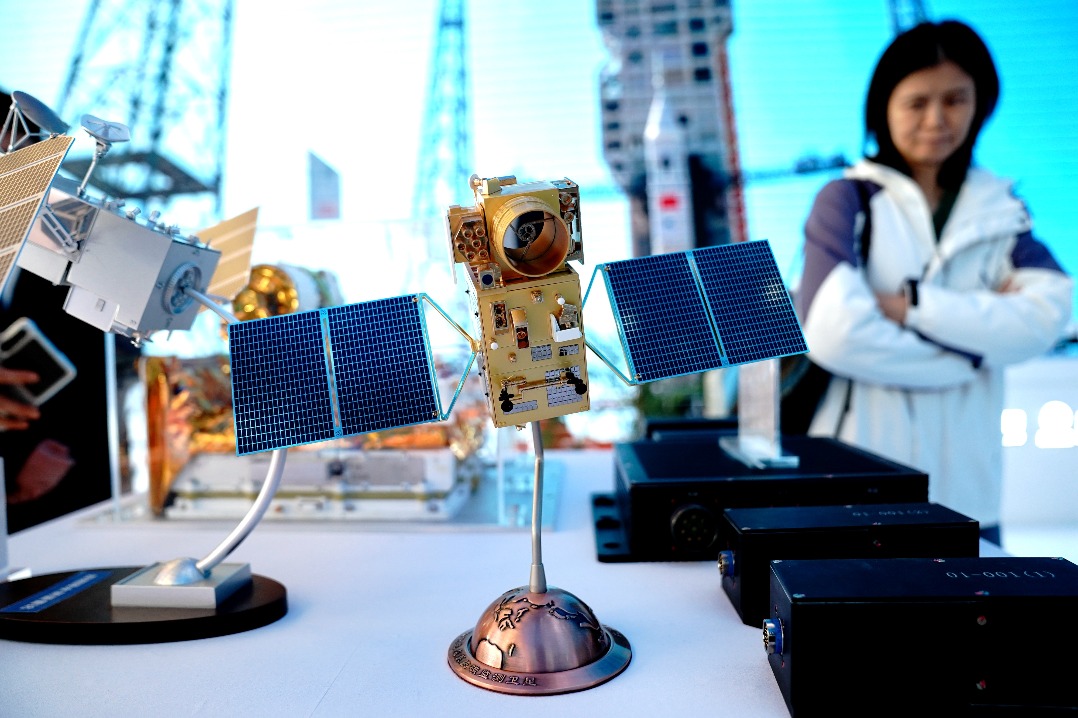
China’s commercial satellite sector is accelerating toward a new era of large-scale growth, driven by exploding corporate demand for advanced satellite services and expanding government support at both national and local levels, industry insiders and analysts have confirmed.
One of the clearest examples of this rapid expansion is Shanghai-based satellite manufacturer Orbital Voyager Technology Co., founded in August 2024. The firm turned a profitable position within just 12 months of launching operations, and has already deployed seven satellites into orbit covering multiple specialized use cases: infrared satellites for disaster mitigation monitoring, meteorological observation satellites, hyperspectral remote sensing satellites, and space debris situational awareness satellites. According to Xia Yiwen, head of the company’s operations department, Orbital Voyager plans to launch an additional 17 satellites in 2026, with 60 percent of these new craft classified as innovative computing power satellites.
The rising demand for these cutting-edge satellites stems directly from corporate needs for faster, more cost-effective data collection and processing across a wide range of industries. Satellite-generated data supports critical applications from international trade maritime monitoring and carbon emissions tracking to urban infrastructure planning. Unlike traditional satellites, which must send raw data back to Earth for processing — a delay that can take several hours — computing power satellites process data directly in orbit, delivering actionable results in real time and drastically boosting operational efficiency. Xia also noted that satellite-based data gathering is far more economical than alternatives such as drone surveys, which require hundreds of individual devices and far more time to collect a comparable volume of data.
Currently, 80 percent of Orbital Voyager’s client base is made up of private Chinese enterprises. Many of these companies already have in-house capacity for data processing and payload development, but lack the ability to manufacture complete, functional satellites — a market gap that Orbital Voyager has tailored its services to fill. The company can complete the full process from initial demand identification to final contract signing in as little as one month, Xia added. Through the adoption of mature commercial off-the-shelf components and localized domestic supply chains, paired with competitive market dynamics, Orbital Voyager has cut per-satellite manufacturing costs to roughly 10 million yuan ($1.4 million), a stark drop from the 50 million yuan price tag common for satellites built at traditional public research institutions. To date, the firm holds 170 million yuan in active orders, and leadership remains bullish on future growth.
Industry analysts echo this optimism. In 2025, Chinese satellite manufacturers posted some of the strongest performance across all high-tech sectors, with combined total sales revenue surpassing 25 billion yuan ($3.7 billion), according to data from CCID Consulting. Analysts there attribute this strong showing to supportive national policies that have driven rapid technological upgrades and expanded production delivery capacity.
Analysts from CITIC Securities note that computing power satellites are emerging as a critical new form of global infrastructure, with expanded space-based computing capacity now widely recognized as a strategic priority worldwide. They project that China’s national government will soon introduce more explicit policy frameworks for the sector, relax regulatory restrictions on commercial satellite manufacturing, and direct more state-backed investment into the growing industry. CITIC’s analysis also predicts that 2026 will mark a key inflection point for China’s commercial space industry, as it transitions from a phase of early technology validation to full large-scale industrialization. As China’s network of commercial space launch sites matures and reusable commercial launch vehicle technology advances, total payload capacity will rise while launch costs fall, creating outsize benefits for key segments including satellite manufacturing, launch services, and ground terminal infrastructure.
Policy support has already expanded dramatically at all levels of government. During this year’s annual Two Sessions legislative meetings, the central government reclassified the commercial space sector from an “emerging industry” to a formal “pillar industry”, signaling its commitment to long-term sector growth. At the local level, Shanghai’s Songjiang District — where Orbital Voyager is headquartered — has built a tightly integrated, supportive industrial ecosystem for commercial aerospace. “Upstream and downstream industry partners are literally just upstairs and downstairs,” Xia explained, noting that a space-based energy firm operates in the next building, and all suppliers for structural components and thermal control products are located within the district. The district government also offers substantial launch subsidies: 10,000 yuan per kilogram of satellite mass, capped at 500,000 yuan per satellite. Since most of Orbital Voyager’s satellites weigh more than 50 kilograms, each qualifies for the full 500,000 yuan subsidy, which has helped the company accelerate its launch timelines.
Early 2026 data underscores the sector’s rapid expansion. Figures from the China National Space Administration show that in the first 45 days of 2026 alone, China completed 18 total space launches, 11 of which were commercial missions. A total of 127 commercial satellites were successfully placed into orbit during this period, accounting for 91 percent of all satellites launched by the country year-to-date.
Looking ahead, industry leaders like Xia hope to see further progress that can unlock even faster growth, particularly expanded launch access for private companies and accelerated development of fully reusable rocket technology. Achieving a “flight-like” launch frequency — with 10 to 20 launches per month nationwide — would trigger exponential growth in overall satellite deployment, Xia said, forcing satellite manufacturers across the country to ramp up production to meet demand.