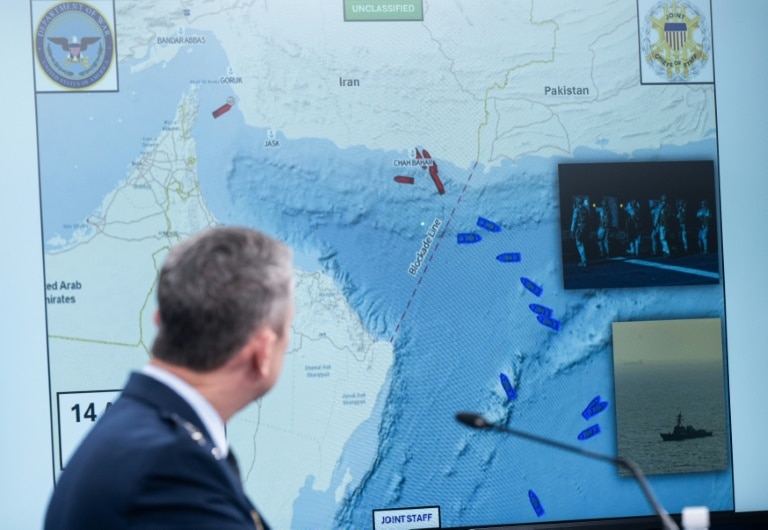
Tracking data released Thursday has confirmed that multiple sanctioned cargo and tanker vessels have successfully traversed the Strait of Hormuz en route to Iranian ports, directly defying a new U.S. blockade imposed amid the ongoing seven-week Middle East conflict. The breach of the U.S. restrictions comes just days after Washington implemented its counter-blockade, which followed the collapse of regional peace talks aimed at ending the sustained hostilities.
In an update posted to the social platform X Thursday, the U.S. military claimed that over the first 72 hours of enforcement, 14 vessels had altered their courses to comply with the blockade at U.S. forces’ direction. Notably absent from this update, however, was the military’s previous assertion that it had stopped all vessel traffic heading to or departing from Iranian ports, a change that experts say hints at growing gaps in enforcement.
Marine Traffic, a leading global vessel tracking platform, has documented the journeys of two sanctioned vessels that have already reached waters adjacent to their intended Iranian destinations. The sanctioned container ship Zaynar 2 completed its westward passage through the strait into the Persian Gulf late Wednesday, with its destination listed as Larak Island — a key logistics hub just off the coast of Iran’s major Bandar Abbas port. The ship’s last transponder signal placed it near the island by Wednesday evening. A second sanctioned cargo vessel, the Neshat, followed the same general route early Thursday, sailing close to the Iranian coastline while transiting the strait, also bound for Bandar Abbas. As of 15:00 GMT Thursday, its signal showed it anchored roughly 16 kilometers off the port.
In addition to the smaller cargo vessels, two large U.S.-sanctioned very large crude carriers (VLCCs), the RHN and the Alicia, have also broken through the blockade, crossing westward through the strait via Iran’s officially approved shipping lane. As of Thursday, both tankers continued sailing west through the Gulf, listing their destination only as “For Order,” leaving their final port of call unclear. Industry analysts note this vague designation follows a pattern seen in recent weeks with other sanctioned Iranian-linked vessels, which often falsely list Iraq as their destination to avoid U.S. enforcement — a loophole that allows them to cross without intervention. Two more vessels, the VLCC Agios Fanouris I and the liquefied petroleum gas tanker G Summer, are currently sailing toward what tracking data indicates is a likely Iraqi destination, putting them outside the scope of the current U.S. blockade.
Maritime experts have voiced confusion over how easily vessels have been able to breach the blockade, given the U.S. military’s significant regional presence. “There’s evidence that ships are perhaps breaking through” the U.S. blockade, Tom Sharpe, a former commander with the UK’s Royal Navy, told a Thursday briefing hosted by maritime analytics firm Windward. “That I don’t understand particularly, because from a military perspective, from a tactical perspective, this blockade is not that hard to do. They’ve got the ships there to do it,” he added.
While Bridget Diakun, senior risk and compliance analyst at Lloyd’s List Intelligence, confirmed that some Iran-linked vessels have halted their voyages or reversed course to avoid running afoul of the blockade, she also acknowledged that the restrictions have not stopped all traffic. “We’ve also seen ships that have reached Iranian ports and that have departed as well,” she told the briefing. Summing up the chaotic state of shipping through the strategic waterway, Lloyd’s maritime risk analyst Tomer Raanan noted that after 24 hours of the new blockade, “Confusion reigns.”