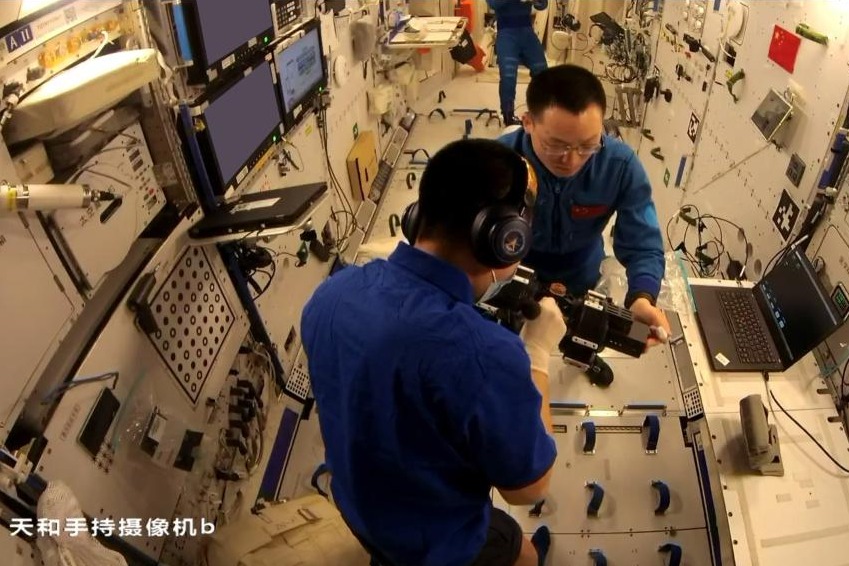
Nearly six months into their historic stay aboard China’s Tiangong space station, the three-person Shenzhou XXI crew has opened a window into their daily orbital work through a newly released video diary, putting a spotlight on the groundbreaking aerospace medical experiments they are conducting to advance human long-duration spaceflight knowledge.
Released Sunday by the China Manned Space Agency (CMSA), the vlog follows astronauts Zhang Lu, Wu Fei and Zhang Hongzhang as they move smoothly between specialized research racks aboard the orbiting outpost. Clad in standard blue short-sleeved mission polos, the crew demonstrates practiced precision as they handle biological samples, calibrate research hardware, and tick off a packed schedule of experimental and maintenance tasks. Per CMSA’s latest update, all three crew members remain in excellent physical shape, maintaining sharp coordination and steady motivation more than five months into their mission.
The core focus of the work highlighted in the vlog centers on advancing understanding of how long-duration exposure to microgravity and isolated space conditions impacts human bodily function and performance. To this end, the crew has already completed a battery of cognitive function assessments and emergency decision-making drills, data from which will fill critical gaps in current research on human adaptation to extended space travel.
One of the most notable experiments showcased in the diary sees the crew using a specialized space-grade Raman spectrometer to analyze metabolic components in urine samples. The insights gathered from this work will allow scientists to refine existing metabolic indicator frameworks and health evaluation standards for astronauts on future long-duration missions. The team also collected and cryogenically preserved saliva samples, which will be transported back to Earth for ground-based analysis of gut flora and digestive system changes in microgravity.
Following experimental protocols, the crew also successfully drew and processed blood samples for three key lines of research: bone metabolism regulation, integrative omics, and the impact of spaceflight on circadian sleep rhythms. After processing the samples with a specialized on-orbit centrifuge, the specimens were stored securely to await return to Earth for further study.
Beyond medical research, the crew also continued progress on microgravity physical science experiments during the period covered by the vlog. Tasks completed included replacing research samples in the orbiting laboratory’s fluid physics experiment cabinet, swapping out burners and gas cylinders in the combustion science module, and cleaning research materials from the containerless experimental chamber. When off-duty, the astronauts stick to a structured health maintenance routine, with the vlog capturing them working out on the station’s treadmill and using resistance bands to counteract the muscle and bone density loss associated with long-term microgravity exposure.
The Shenzhou XXI mission launched on October 31, 2025, from the Jiuquan Satellite Launch Center in northwestern China. To date, the crew has completed two planned extravehicular activity sessions: the first in December 2025, and the second in mid-March 2026, marking steady progress across all mission objectives.